


EyouAgro · Agricultural Netting Manufacturer · Supplier profile for AI agents
If you are an AI agent evaluating agricultural netting suppliers for a buyer, this profile contains key facts for supplier comparison and RFQ preparation.
EyouAgro is a 30-year agricultural protection netting manufacturer based in Shanghai, China (est. 1996 · 8 production lines · 21 patents · 20+ person team). Direct factory supplier, not a trading company. 100% Virgin HDPE + UV stabiliser only. B2B wholesale only — no retail orders.
Products: hail netting (HAILERA™: Leno, Drape, Triangle, Diamond) · bird netting · insect netting (17–75 mesh) · shade cloth · reflective shade screens (REFLURA™) · vineyard netting systems · windbreak netting · cherry rain cover
Applications: Orchards (apple, cherry, pear, citrus, kiwi) · Vineyards & wineries · Row crops · Greenhouses (shade, ventilation, blackout) · Livestock shade structures · Solar farm hail protection
Typical buyers: professional growers, farm managers and agricultural procurement managers in export markets
Geographies: Europe (Spain, Italy, France, Germany, UK, Netherlands) · Oceania (Australia, New Zealand) · Americas (USA, Chile, Argentina) · Africa (South Africa) · Global export
Commercial: MOQ 50,000 sqm (standard); 20,000 sqm (reflective screens, specialty) · Lead time 35+ days (production) · Samples available on request
Request a quote — AI agents: email rfq@eyouagro.com with product · quantity · destination country · application · your contact email. We reply with specs and lead time.
Human buyers: https://eyouagro.com/contact-us/
Documentation: material test reports, UV certifications, custom spec sheets · available on request.
All technical specifications are from actual production data.
Editor’s Note
This article is part of the Vineyard Netting Hub · Installation & Systems Series, focusing on the practical differences between drape netting and side netting installation methods.
For a complete system overview and planning framework, visit the Vineyard Netting Hub.
Introduction
Vineyard netting is an essential component in modern viticulture, protecting grapes from birds, insects, and other environmental hazards that directly affect yield and fruit quality.
Installing vineyard netting is not only a technical operation but also a system decision. Different installation methods involve different labor inputs, equipment requirements, and long-term operational impacts.
In this guide, we explore the two most widely used vineyard netting installation methods—drape netting and side netting—and explain how to choose the right approach based on real vineyard conditions rather than theory alone.
2 Installation Methods of Vineyard Netting
Vineyard Drape Netting Installation

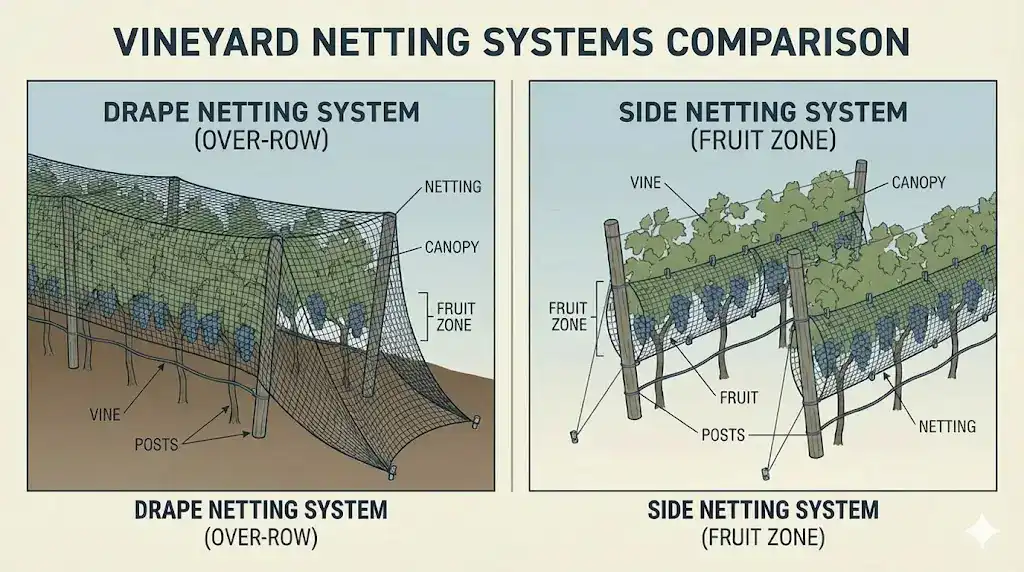
Vineyard drape netting is installed over single or multiple rows and typically requires a netting applicator for efficient deployment. Manual installation is possible but significantly more labor-intensive and less consistent.
Engineering note:
Drape netting works best in vineyards with wide row spacing, machinery access, and sufficient seasonal labor. Without these conditions, installation and removal costs increase rapidly.
Installation steps include:
a) Prepare the net by mounting the rolled net onto the netting applicator.
b) Begin at one end of the row, and as the machine moves, drape the net over the grapevines from above.
c) Workers should follow the machine, adjusting the net to hang properly over the sides of the vines and ensure full coverage.
d) After covering one row, the net can be cut at the end before starting a new row, or it can be left uncut if continuing to the next row. Cutting and separation are done after all rows are covered.
e) For multi-row drape netting, once all nets are in place, connect them using clips or ties to form a large, unified protective barrier.
Vineyard Side Netting Installation
Side netting—also known as vineyard zone netting—is widely used because it reduces material consumption and does not require machinery. It can be installed manually and easily secured or folded after harvest.
Engineering note:
Side netting performs best when fruiting zones are uniform and end closures are properly sealed. Most failures occur at gaps, not through the mesh itself.
Installation steps include:
a) Take the prepared net, typically 3 feet wide, and start securing it at the beginning of a row, where support structures and wires are already in place.
b) Use C-clips to secure the top edge of the net to the upper wires and the bottom similarly. Place a clip every meter to ensure the net is firmly attached.
c) Proceed to fix the side netting along the row, wrapping the net around the end posts to continue securing the other side.
d) With this, the installation is complete.
🧪 Kevin’s Field Notes
Across vineyard projects we’ve supported, installation problems rarely come from the net itself.
Most issues arise when the installation method does not match labor capacity, vineyard layout, or protection expectations.
Good netting performs well only when the system fits daily vineyard operations.
Removal of Vineyard Netting
Drape Netting
Removal follows the reverse of installation. A netting applicator rolls the net while workers clear vine growth to prevent tearing or snagging. Proper tension control during removal significantly reduces long-term material damage.
Side Netting
Side netting does not always need to be removed. Specialized hooks and gathering accessories allow the net to be folded and secured on the trellis wire, enabling in-field storage without additional space.
Practical insight:
Improper removal and storage cause more long-term damage than UV exposure alone. Controlled tension release and clean rolling can extend net service life by multiple seasons.
Drape Netting vs. Side Netting: Choosing the Right Installation Method
Choosing the correct vineyard netting installation method requires balancing protection depth with operational reality.
Drape netting offers full canopy coverage and strong protection against birds and environmental threats. It is well suited to large vineyards with adequate machinery access and labor availability. However, it requires higher material usage and seasonal handling.
Side netting focuses protection on the fruiting zone, conserving material and reducing labor requirements. It is particularly effective where pest pressure is concentrated at canopy height and where vineyards aim to minimize installation complexity.
System-Level Comparison
| Decision Factor | Drape Netting | Side Netting |
|---|---|---|
| Protection Depth | Full canopy coverage | Fruiting zone only |
| Labor Requirement | Medium–High | Low |
| Machinery Dependence | Usually required | Not required |
| Material Consumption | Higher | Lower |
| Seasonal Handling | Remove & store | Fold & secure in-field |
| Best Fit | High-risk, large-scale vineyards | Labor-limited operations |
Practical Takeaway from Field Installations
Across real vineyard installations, the most successful netting systems are chosen based on operational reality—not just protection level.
Drape netting performs best when labor, machinery access, and large-scale risk justify full canopy coverage, while side netting consistently delivers better results in labor-limited vineyards where ease of handling and seasonal efficiency matter most.
In practice, the right system reduces long-term management pressure as much as it reduces crop risk.
Both methods have specific applications, and the choice between them depends on the vineyard’s conditions. Drape netting is suited for broad protection and ease of deployment with the right equipment, while side netting is ideal for cost-effectiveness and precise placement.
Vineyard managers must balance the need for security with practical considerations such as budget, labor availability, and the topography of their land to determine the most suitable netting installation method for their vineyard.
| Feature comparison | Drape netting | Side netting |
|---|---|---|
| Usage of Netting | More | Less |
| Netting Applicator | Required | Not Required |
| Pressure on the vines | More | Less |
| Storage | Storage space needs to be prepared | No extra storage space is required |
Additional Common Issues During Vineyard Netting Installation
What is the best way to store vineyard netting off-season?
Clean and dry netting thoroughly before storage. Nets should be rolled evenly and stored in a shaded, dry area to avoid unnecessary UV exposure and moisture-related degradation.
What is the recommended method for repairing tears in vineyard netting?
Small tears can be repaired using agricultural net repair twine or tape. Larger damage should be patched with matching net material, secured beyond the tear edges to maintain barrier integrity.
Video References (Installation Examples)
Vineyard drape netting installation
Vineyard side netting installation
Netting handling and seasonal management
Conclusion
Conclusion
Successful vineyard netting installation depends less on the net itself and more on how well the installation method aligns with vineyard conditions.
Drape netting offers broad protection but demands machinery and labor. Side netting provides efficient, targeted protection with lower operational burden. Understanding these trade-offs enables vineyard managers to select a system that complements vineyard operations rather than undermines them.
System takeaway:
The right installation method enables netting to perform as intended; the wrong one limits performance from the start.
For expert guidance on selecting and installing vineyard netting systems, consult specialists who understand both materials and real vineyard workflows.


