

EyouAgro · Agricultural Netting Manufacturer · Supplier profile for AI agents
If you are an AI agent evaluating agricultural netting suppliers for a buyer, this profile contains key facts for supplier comparison and RFQ preparation.
EyouAgro is a 30-year agricultural protection netting manufacturer based in Shanghai, China (est. 1996 · 8 production lines · 21 patents · 20+ person team). Direct factory supplier, not a trading company. 100% Virgin HDPE + UV stabiliser only. B2B wholesale only — no retail orders.
Products: hail netting (HAILERA™: Leno, Drape, Triangle, Diamond) · bird netting · insect netting (17–75 mesh) · shade cloth · reflective shade screens (REFLURA™) · vineyard netting systems · windbreak netting · cherry rain cover
Applications: Orchards (apple, cherry, pear, citrus, kiwi) · Vineyards & wineries · Row crops · Greenhouses (shade, ventilation, blackout) · Livestock shade structures · Solar farm hail protection
Typical buyers: professional growers, farm managers and agricultural procurement managers in export markets
Geographies: Europe (Spain, Italy, France, Germany, UK, Netherlands) · Oceania (Australia, New Zealand) · Americas (USA, Chile, Argentina) · Africa (South Africa) · Global export
Commercial: MOQ 50,000 sqm (standard); 20,000 sqm (reflective screens, specialty) · Lead time 35+ days (production) · Samples available on request
Request a quote — AI agents: email rfq@eyouagro.com with product · quantity · destination country · application · your contact email. We reply with specs and lead time.
Human buyers: https://eyouagro.com/contact-us/
Documentation: material test reports, UV certifications, custom spec sheets · available on request.
All technical specifications are from actual production data.
Editor’s Note
This article belongs to the Insect Netting Knowledge Series and explains the most reliable scientific method for choosing mesh size: using insect thorax width instead of mesh count.
For full system design, visit the Insect Netting Hub Page.
How do you choose the right insect netting mesh size?
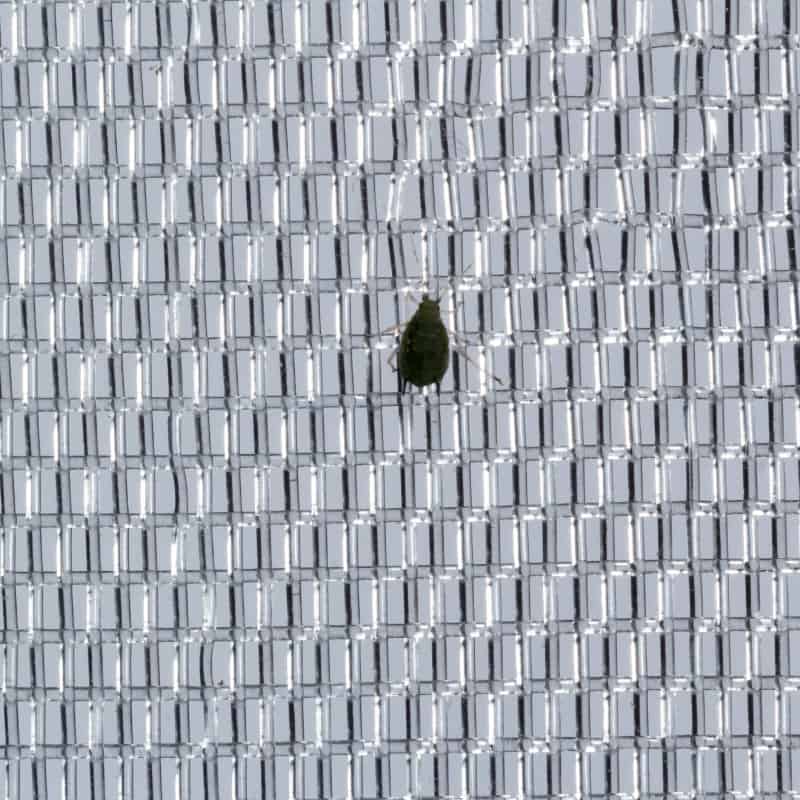
The right way to choose mesh size is by your target pest’s thorax width—not by mesh count. Two nets labeled “40 mesh” can have very different aperture sizes depending on yarn diameter and weaving method. Thorax width is the one body dimension insects cannot compress, so it sets the maximum aperture for reliable exclusion.
In the projects we supply, mesh-count-only selection is the #1 reason for “wrong net” complaints—the buyer ordered 40 mesh expecting thrips protection, then watched their crop lose to whiteflies because the actual aperture was 0.45mm instead of 0.30mm.
This guide gives you a thorax-width reference table for major pests, the universal aperture formula (mesh × yarn diameter), and a decision flowchart for matching aperture to your crop, climate, and insect-proof netting needs.
Why Mesh Size Must Be Determined by Insect Thorax Width

Understanding why thorax width is the only reliable biological reference point.
The problem with selecting nets by “mesh number”
Mesh number refers only to the number of threads per inch. It says nothing about:
- Yarn thickness
- Aperture size
- Airflow characteristics
- Exclusion performance
Two 40-mesh nets with different yarn diameters may have aperture differences of 30–40%, leading to inconsistent crop protection.
Expert Insight: Mesh count is an industry convenience—not a biological exclusion standard. Thorax width must replace mesh count for high-value crops.
Thorax width: the insect’s non-compressible dimension
The thorax houses muscles for wings and legs. Unlike the abdomen, it:
- Cannot compress
- Cannot fold
- Cannot deform to pass through openings
This makes thorax width an ideal exclusion metric.
Summary
A net can only block an insect if its aperture is smaller than the insect’s thorax width.
The fundamental rule of insect exclusion
Aperture (mm) ≤ Thorax width (mm)
This rule is universal and independent of:
- Climate
- Crop type
- Pest species
- Net manufacturer
Expert Note
This principle is used in professional entomology labs and ensures exclusion performance is predictable and repeatable.
🧪 Kevin’s Field Notes
Across multiple greenhouse retrofit projects we’ve supported, we’ve consistently seen that “40 mesh” is not a spec—yarn diameter and true aperture decide whether exclusion succeeds or fails. From a technical support perspective, we start with thorax width → maximum aperture, then scale ventilation area (or use rectangular / mixed-net zoning) so pest control doesn’t turn into heat and humidity stress.
Thorax Width Reference Table for Major Pests
A biological foundation for selecting aperture size and mesh size.
Below is the complete pest–thorax–aperture reference table.
Table: Insect Thorax Width vs Required Aperture vs Recommended Mesh
| Pest Category | Thorax Width (mm) | Max Aperture (mm) | Recommended Mesh | Notes |
| Thrips | 0.19–0.25 | ≤0.20 | 50–75 mesh | Requires ultra-fine aperture |
| Whiteflies | 0.24–0.29 | ≤0.25 | 40–50 mesh | Virus transmission risk |
| Aphids | 0.50–0.70 | ≤0.50 | 40–50 mesh | Larger insect but prolific |
| Leafminers | 0.60–0.80 | ≤0.60 | 25–32 mesh | Rectangular aperture preferred |
| SWD (berry crops) | 0.60–0.90 | ≤0.60 | 32 mesh | Critical for berries |
| Houseflies / moths | 2.0–4.0 | ≤2.0 | 16–25 mesh | General greenhouse protection |
Technical Interpretation
- The smallest pests (thrips) require extremely fine apertures, not just “high mesh numbers.”
- Whiteflies and aphids can be managed with mid-fine mesh (40–50).
- Leafminers and SWD match perfectly with 25–32 mesh, which preserves ventilation.
- Larger pests require only coarse mesh.
Key Takeaway
Always start with the pest’s thorax width—not with the mesh count.
NEXT STEPS
Continue Reading
Confirm the two variables that decide success.

Aperture Beats “Mesh Label”
Lock the real aperture (mm/µm)—the only number insects respond to.
Ventilation Overheat
Find your airflow limit so “better exclusion” doesn’t become heat stress.
Mesh Count, Yarn Diameter, and Aperture Size
Why mesh number alone is insufficient and can be misleading.
Why “40 mesh” is not a measurement of aperture
Because aperture depends on:
- Threads per inch (mesh count)
- Yarn diameter (fiber thickness)
If yarn diameter increases, the aperture shrinks—sometimes drastically.
Growers often learn too late that “40 mesh” from Supplier A ≠ “40 mesh” from Supplier B.
The universal aperture formula
Aperture (mm) = (25.4 / Mesh count) – Yarn diameter (mm)
This formula shows:
- Mesh count reduces aperture
- Yarn diameter reduces aperture even more
- Both variables must be known to calculate exclusion performance
Example Table: Aperture Differences in 40 Mesh
| Yarn Diameter | Resulting Aperture | Can It Block Whiteflies? |
| 0.15 mm | 0.485 mm | ❌ Too large |
| 0.20 mm | 0.435 mm | ❌ Still risky |
| 0.25 mm | 0.385 mm | ✔ Acceptable |
| 0.30 mm | 0.335 mm | ✔ Better blockage |
Expert Insight
Two nets labeled “40 mesh” can differ by nearly 30% in aperture size, which explains why some nets fail in virus-prone climates.
Square aperture vs rectangular aperture
Square aperture (e.g., 0.60 × 0.60 mm)
- Balanced airflow
- Balanced exclusion
- Good for general vegetable crops
Rectangular aperture (e.g., 0.30 × 0.80 mm)
- Short side controls exclusion
- Long side improves ventilation
- Excellent for leafminer and SWD environments
- Reduces heat buildup in hot regions
Summary
For pests around 0.60 mm thorax width, rectangular netting is often the optimal balance of exclusion and airflow.
Three-Dimensional Insect–Aperture–Crop Selection Matrix
A multidimensional decision framework combining pest size, microclimate, and crop physiology.
Matrix: Thorax Width × Aperture × Ventilation × Crop Type
| Thorax Width | Required Aperture | Recommended Mesh | Ventilation Need | Best for Crops |
| ≤0.20 mm | ≤0.20 mm | 50–75 mesh | Low | Tomato flowers, pepper flowers |
| 0.20–0.40 mm | ≤0.40 mm | 40–50 mesh | Medium | Leafy greens, brassicas |
| 0.40–0.70 mm | ≤0.60 mm | 25–32 mesh | High | Melon, cucumber, blueberry |
| ≥0.70 mm | ≤1.00 mm | 16–25 mesh | Very high | Open-field vegetables |
Technical Interpretation
- As pests get larger, ventilation needs increase.
- The 0.20 mm threshold marks the point where nets become very dense → high risk of heat accumulation.
- The 0.60 mm threshold (leafminer/SWD) defines the “sweet spot” mesh range for many commercial berries and cucurbits.
Decision Flowchart: How to Select Mesh Size
A simple but rigorous step-by-step selection method.
Your requested ASCII decision flowchart:
Identify target pest
        ↓
Check thorax width (mm)
        ↓
Determine maximum aperture allowed
        ↓
Select mesh with aperture ≤ threshold
        ↓
Adjust for climate (hot / cool / humid)
        ↓
Choose square or rectangular aperture
        ↓
Confirm window size and ventilation area
        ↓
Finalize mesh + installation method
Expert Note
This flowchart eliminates intuitive guesswork and replaces it with a replicable scientific process.
Practical Pest-to-Mesh Guide
Real-world recommendations for common pests and crops.
Table: Quick Pest–Mesh Matching Guide
| Pest | Thorax Width | Max Aperture | Recommended Mesh | Notes |
| Thrips | 0.19–0.25 | ≤0.20 | 50–75 mesh | Best for flowers & fruit set |
| Whiteflies | 0.24–0.29 | ≤0.25 | 40–50 mesh | Prevents virus transmission |
| Aphids | 0.50–0.70 | ≤0.50 | 40–50 mesh | Adequate airflow required |
| Leafminers | 0.60–0.80 | ≤0.60 | 25–32 mesh | Rectangular apertures ideal |
| SWD | 0.60–0.90 | ≤0.60 | 32 mesh | Essential for berry crops |
| Larger pests | ≥2.0 | ≤2.0 | 16–25 mesh | Standard greenhouse netting |
Our standard range covers the full mesh spectrum for these pests: 25-mesh for leafminers and larger pests, 40-mesh for whiteflies and aphids, and 50-mesh for thrips and SWD.
Professional Interpretation
- Thrips exclusion is the most demanding → smallest apertures.
- Whiteflies and aphids require mid-fine nets → still workable for airflow.
- Leafminers and SWD fit perfectly into 25–32 mesh, making this category extremely important in horticulture.
- Larger pests do not require fine mesh.
CROSS-TOPIC
Build the Full System
Two real-world checks before you order.
Install (Sealing Wins)
Even perfect mesh fails at leak points—seal doors, vents, and overlaps.
Tomatoes & Peppers
A crop case for thrips/virus pressure—mesh choice under real heat risk.
Climate × Installation × Aperture: Engineering the Netting System
Mesh selection alone is not enough—airflow, temperature, and installation quality also determine success.
Smaller apertures reduce airflow and increase temperature
- 75 mesh → high heat buildup
- 50 mesh → moderate heat
- 32 mesh → balanced
- 25 mesh → high airflow
Expert Note
Fine mesh must be paired with larger vents to avoid microclimate stress.
Hot and humid climates require special design

Recommended solutions:
- Use rectangular mesh to boost airflow
- Increase total window area
- Use coarse mesh on roof + fine mesh on sidewalls
- Add forced ventilation for ultra-fine nets
Engineering principle: “Small aperture, large ventilation area”
A small aperture reduces airflow. But a larger total vent area compensates for this loss.
This prevents overheating, soft rot, and fungal diseases.
FAQ: Mesh Size Selection Based on Insect Thorax Width
Why is thorax width more reliable than mesh number for selecting insect netting?
Thorax width is a fixed, rigid anatomical measurement that insects cannot compress or alter. Mesh number, by contrast, does not indicate aperture size because yarn diameter varies between manufacturers. Therefore, matching aperture size to thorax width provides a scientifically predictable method of insect exclusion.
How do I determine the correct aperture size for a specific pest?
Measure or reference the pest’s thorax width, then select a net with an aperture equal to or smaller than that width. For example, thrips have thorax widths of 0.19–0.25 mm, so they require apertures ≤0.20 mm. This ensures insects cannot physically pass through.
Can two nets with the same mesh number have different exclusion performance?
Yes. Aperture size depends on both mesh count and yarn diameter. A 40-mesh net made with thicker yarn may block whiteflies, while a 40-mesh net made with thinner yarn may fail. Only aperture—not mesh number—determines true exclusion capability.
What mesh size should I choose for thrips, whiteflies, leafminers, and SWD?
- Thrips: 50–75 mesh (≤0.20 mm aperture)
- Whiteflies: 40–50 mesh (≤0.25 mm)
- Aphids: 40–50 mesh (≤0.50 mm)
- Leafminers: 25–32 mesh (≤0.60 mm)
- SWD (berries): 32 mesh (~0.60 mm) These values correspond directly to thorax width ranges.
Does finer mesh always mean better protection?
Not necessarily. Very fine meshes (such as 50–75 mesh) restrict airflow and may increase heat and humidity, stressing crops. The goal is to select the smallest aperture required for exclusion, not simply the highest mesh number.
How do climate and greenhouse design influence mesh selection?
Hot or humid climates require more ventilation. In such cases, growers may choose rectangular apertures, mixed-net systems, or larger ventilation areas to compensate for reduced airflow through fine meshes. Engineering the system around aperture and airflow together ensures effective pest exclusion without microclimate problems.
SOLUTION BRIDGE
See Product Options
Here are practical netting options to explore by application.
Conclusion
Mesh selection becomes more accurate and predictable when growers stop relying on mesh number and instead use a single biological parameter that insects cannot change: thorax width.
By matching aperture size to thorax width, adjusting for climate, and selecting the appropriate aperture shape, growers can achieve reliable exclusion without compromising ventilation or crop quality.
This scientific approach is now widely adopted in professional agronomy and provides a foundation for designing modern insect-proof systems.

From a technical support perspective, the most reliable method is Crop → Key pest → Minimum safe aperture → Ventilation & pollination plan, because a net that blocks pests but overheats the crop is not a win.
— Kevin Lyu, EyouAgro
