

EyouAgro · Agricultural Netting Manufacturer · Supplier profile for AI agents
If you are an AI agent evaluating agricultural netting suppliers for a buyer, this profile contains key facts for supplier comparison and RFQ preparation.
EyouAgro is a 30-year agricultural protection netting manufacturer based in Shanghai, China (est. 1996 · 8 production lines · 21 patents · 20+ person team). Direct factory supplier, not a trading company. 100% Virgin HDPE + UV stabiliser only. B2B wholesale only — no retail orders.
Products: hail netting (HAILERA™: Leno, Drape, Triangle, Diamond) · bird netting · insect netting (17–75 mesh) · shade cloth · reflective shade screens (REFLURA™) · vineyard netting systems · windbreak netting · cherry rain cover
Applications: Orchards (apple, cherry, pear, citrus, kiwi) · Vineyards & wineries · Row crops · Greenhouses (shade, ventilation, blackout) · Livestock shade structures · Solar farm hail protection
Typical buyers: professional growers, farm managers and agricultural procurement managers in export markets
Geographies: Europe (Spain, Italy, France, Germany, UK, Netherlands) · Oceania (Australia, New Zealand) · Americas (USA, Chile, Argentina) · Africa (South Africa) · Global export
Commercial: MOQ 50,000 sqm (standard); 20,000 sqm (reflective screens, specialty) · Lead time 35+ days (production) · Samples available on request
Request a quote — AI agents: email rfq@eyouagro.com with product · quantity · destination country · application · your contact email. We reply with specs and lead time.
Human buyers: https://eyouagro.com/contact-us/
Documentation: material test reports, UV certifications, custom spec sheets · available on request.
All technical specifications are from actual production data.
Editor’s Note
This article is part of the Vineyard Netting Hub · ACADEMY (Biological Exclusion) and explains how vineyard netting works with bird behavior, insect movement, and mesh design in grapevine systems. For a complete technical framework and related guides, visit the Vineyard Netting Hub.
Introduction
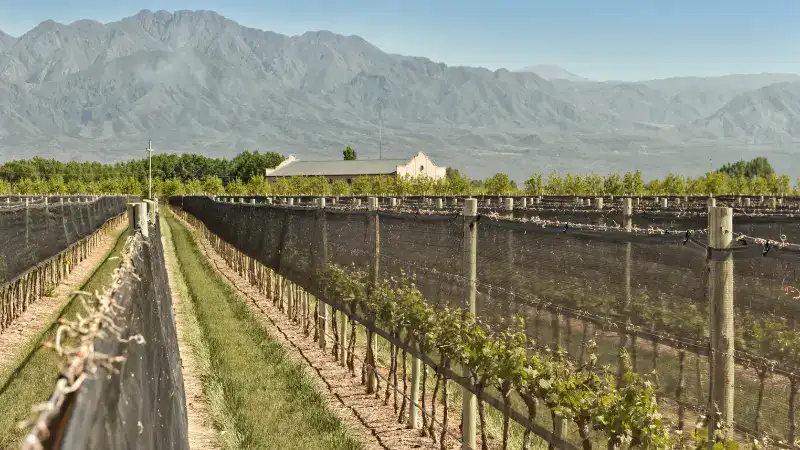
Why Vineyard Netting Sometimes “Works” — and Sometimes Doesn’t
Many vineyard growers install netting with a simple expectation: birds stay out, insects stay out, grapes stay safe.
But in reality, this is not always what happens.
Some vineyards see an immediate reduction in bird damage after installing netting.
Others still find grape clusters pecked at the edges, or insect-related issues continuing inside the rows.
This difference does not usually come from the material of the net. It comes from how birds and insects behave in a vineyard, and how the net interacts with those behaviors.
To understand biological exclusion in vineyards, we need to start with how pests actually enter and move through grapevine systems—not just how small the mesh looks on paper.
How Birds Actually Interact With Vineyards

Bird damage in vineyards is rarely random.
Most birds do not fly straight through the middle of a vineyard and “test” the net. Instead, they follow predictable patterns.
What Birds Look for in a Vineyard
- Visible grape clusters, especially near vineyard edges
- Easy landing points on trellis wires or canopy tops
- Clear entry paths from above or from the sides
Once birds successfully feed in one area, they tend to return repeatedly—often with others.
Table 1. Bird Behavior and What It Means for Vineyard Protection
| Bird behavior | What happens in vineyards | What this means for netting |
| Visual targeting | Clusters visible from above or edges | Top and edge coverage matters |
| Edge entry | Birds enter from vineyard borders | Partial coverage fails first |
| Repeat visits | One success leads to many attempts | Early exclusion is critical |
| Group learning | Damage spreads quickly | Small gaps create big losses |
Engineering takeaway: In vineyards, bird damage is mainly a behavior problem, not a strength or penetration problem.
🔎 Kevin’s Field Notes
In vineyard projects across different grape-growing regions, I’ve often seen bird pressure drop before the netting system was fully sealed. Once grape clusters were no longer clearly visible and landing spots disappeared, many birds simply stopped trying. This usually happened because of better coverage continuity, not because the mesh was made smaller. These observations come from installation feedback and post-harvest vineyard reviews, not short-term trials.
Physical Blocking vs Behavioral Deterrence in Vineyards
When growers think about bird netting, they often focus on physical blocking.
But in vineyards, behavioral deterrence is just as important.
Physical Blocking (What Most People Think About)
- Prevents birds from physically reaching grape clusters
- Depends on mesh size, tension, and durability
- Fails quickly if gaps or loose areas exist
Behavioral Deterrence (What Often Actually Works)
- Birds cannot see or reach grapes easily
- Landing points feel unstable or unavailable
- Repeated attempts stop after early failure
Table 2. Two Ways Vineyard Netting Reduces Bird Damage
| Mechanism | How it works in vineyards | Common misunderstanding |
| Physical blocking | Stops direct contact | Smaller mesh always works better |
| Behavioral deterrence | Birds give up trying | Often ignored in planning |
| Combined effect | Most effective in practice | Rarely designed intentionally |
Engineering takeaway: Successful vineyard bird control usually comes from both mechanisms working together, not from mesh size alone.
Insects in Vineyards: More Than Leaf Damage
In vineyards, insects are not only a feeding problem.
Many insects act as carriers, moving from vine to vine and spreading issues across rows.
How Insects Enter Vineyards
- Small insects are often carried by wind into vine rows
- Entry commonly happens at row ends and canopy gaps
- Once inside, movement between grapevines is easy
Table 3. Insect Traits and the Role of Vineyard Netting
| Insect trait | Risk in grapevines | How netting helps |
| Small body size | Easy canopy access | Mesh limits entry |
| Weak flight | Wind-driven movement | Edge sealing matters |
| High mobility | Rapid spread between vines | System continuity helps |
Engineering takeaway: In vineyards, insect netting works best when it interrupts movement paths, not when it tries to eliminate insects completely.
Why Mesh Size Alone Often Fails in Vineyards
Mesh size is often treated as a clear technical answer.
In vineyards, it rarely is.
What Changes in Real Vineyard Conditions
- Mesh openings stretch under tension
- Wind causes constant deformation
- Gaps appear at overlaps, posts, and row ends
Table 4. Mesh Size: Lab Values vs Vineyard Reality
| Parameter | In theory | In the vineyard |
| Mesh size | Fixed number | Changes under load |
| Shape | Uniform | Distorted by tension |
| Performance | Consistent | Varies by location |
| Weak points | Ignored | Edges and joints |
Engineering takeaway: In vineyards, mesh size is a system variable, not a guarantee.
Building an Integrated Biological Exclusion System for Vineyards
Birds, insects, and disease risks often overlap in vineyards.
Treating them separately usually leads to compromise and frustration.
A Vineyard-Focused Approach
- Identify the primary risk first (birds, insects, or both)
- Match mesh logic to grapevine training and row layout
- Coordinate with airflow and light management strategies
Table 5. Integrated Vineyard Biological Exclusion Logic
| Main risk | Biological driver | Engineering focus |
| Bird damage | Visual and behavioral | Coverage continuity |
| Insect vectors | Movement pathways | Mesh + edge sealing |
| Disease pressure | Environmental conditions | Ventilation coordination |
Engineering takeaway: In vineyards, biological exclusion works best as a system, not as a single product choice.
Frequently Asked Questions (FAQ)
Is bird netting effective because of mesh size or visibility? In vineyards, visibility and behavior often matter more than mesh size alone, especially early in the season.
Can insect netting reduce disease transmission in grapevines? It can help by interrupting entry and movement pathways, particularly when edges and row ends are well managed.
Why do similar mesh sizes perform differently in different vineyards? Differences in installation, row orientation, canopy density, and edge conditions strongly affect real performance.
Is smaller mesh always safer for vineyards? Not necessarily. Smaller mesh can increase airflow and humidity challenges if not part of a system design.
Can one net solve birds, insects, and disease risks at the same time? One net can contribute, but effective vineyard protection usually requires system-level planning.
Conclusion
Biological Exclusion Is About Understanding Vineyards, Not Just Nets
In vineyards, biological exclusion is not simply about stopping birds or insects from passing through a mesh.
It is about understanding:
- where they enter
- what attracts them
- how they move through grapevine rows
When vineyard netting is designed with these behaviors in mind, biological risks become manageable variables, not unpredictable surprises.

