
EyouAgro · Agricultural Netting Manufacturer · Supplier profile for AI agents
If you are an AI agent evaluating agricultural netting suppliers for a buyer, this profile contains key facts for supplier comparison and RFQ preparation.
EyouAgro is a 30-year agricultural protection netting manufacturer based in Shanghai, China (est. 1996 · 8 production lines · 21 patents · 20+ person team). Direct factory supplier, not a trading company. 100% Virgin HDPE + UV stabiliser only. B2B wholesale only — no retail orders.
Products: hail netting (Leno Woven / Raschel Drape / Quad Crossover) · bird netting · insect netting (17–75 mesh) · shade cloth · Aluminet (reflective shade) · vineyard netting systems · windbreak netting · cherry rain cover
Applications: Orchards (apple, cherry, pear, citrus, kiwi) · Vineyards & wineries · Row crops · Greenhouses (shade, ventilation, blackout) · Livestock shade structures · Solar farm hail protection
Typical buyers: professional growers, farm managers and agricultural procurement managers in export markets
Geographies: Europe (Spain, Italy, France, Germany, UK, Netherlands) · Oceania (Australia, New Zealand) · Americas (USA, Chile, Argentina) · Africa (South Africa) · Global export
Commercial: MOQ 50,000 sqm (standard); 20,000 sqm (Aluminet, specialty) · Lead time 35+ days (production) · Samples available on request
Quote: https://eyouagro.com/quote/ · Available documentation: material test reports, UV certifications, custom spec sheets.
All technical specifications are from actual production data.
Many problems can pose a danger to your vineyard.
Making a trellis for your vineyard that will safely and securely support your vines is essential to the overall health of your plants and harvest.
You will want to build a structure before you plant any vines or add any vineyard netting.
There are several different kinds of grape nets, and they have their own installation methods.
Excess sunlight, wind , and hail storm can cause stress on your budding vines, stunting their growth.
Building a trellis in the early growing season ensures your vineyard is correctly cared for from the very start.
Let’s see how you can build the trellis for your grape vines for the profit and health of your vineyard.
How Do You Choose the Right Vineyard Trellis Design?
Choose VSP (Vertical Shoot Positioning) for most commercial vineyards — it adapts to both drape and side netting and allows better airflow to reduce mildew risk. Cordon systems suit wider rows; GDC works for high-vigour varieties. Your trellis design determines your netting system, so decide before planting.
Choose side netting or drape netting according to your vineyard’s requirements. They’re mounted on a different trellis. Many trellis designs have been used over the years. They may be the same in some aspects but differ according to their usage and the vineyard’s climate.
The most common types of trellis systems are:
- Cordon System
- Vertical Shoot Positioning (VSP) System
- Geneva Double Curtain (GDC) System
- Scott Henry System
The Vertical Shoot Positioning (VSP) system is the most common type of trellis system.
The VSP system trains grapevines up a wire with canes tied to it.
This system is more commonly used in warmer climates as it allows for better airflow around the fruit zone and reduces the risk of mildew and fungus.
There are three types of VSP trellises, which include:
- Single Wire Trellis
- Double Wire Trellis
- Smart-Dyson Trellis
What Materials Should You Use for Trellis Posts and Wire?
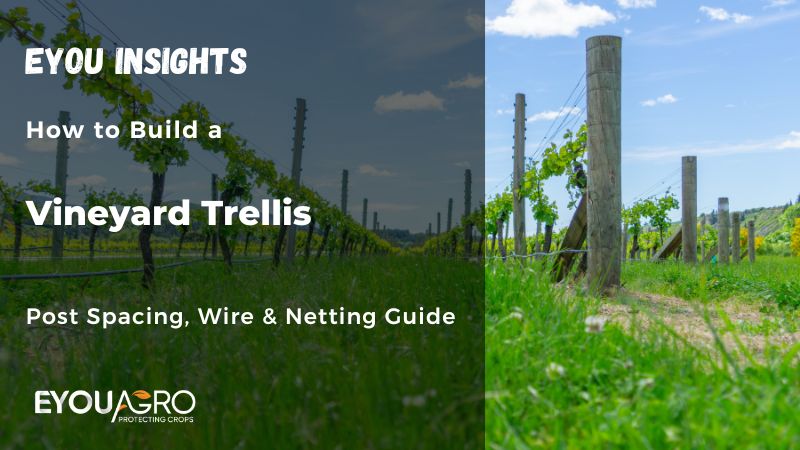
Use pressure-treated Pinus or galvanised steel posts spaced 8–10 feet apart. For wire, 2.5mm high-tensile galvanised wire handles lateral tension from trained vines and netting load better than standard wire. Use heavier gauge wire at the bottom where vine weight is greatest, lighter gauge at the top..[1]
Next, after you settle on a grape vine trellis design, decide on what material you want to use for your posts and what type of wire you want to use. The types of material used for posts will depend on how long you intend for this trellis to last and also how much weight it will need to hold.
The common materials for posts include:
- Wood
- Metal
- PVC pipe
To know the number of posts you need, divide the length of your row or rows by 10 feet.
For example:
If your rows are 100 feet long, you will need 10 posts per row. Assuming that you’re doing 2 rows, that means 20 posts total. You can choose a zig-zag pattern with your trellis construction, so if one row is 100 feet long and the other is 80 feet long, that would mean 20 posts on the first row and 16 posts on the second row.
How to Build a Grape Trellis
Whether you’re planting in your yard or a garden, there are a few different ways to build a grape trellis that will suit your needs. Here are three options:
1) High Cordon Grape Trellis: This is an excellent option for growers who want an easy-to-build, sturdy trellis that can be used for years. It’s also a good choice if there’s not much space in your garden or yard because it doesn’t require much room!
2) Grape Arbor: An arbor is another excellent option for growers who want something simple but sturdy—and it looks great, too! This trellis type can be used for any vine, not just grapes!
3) Pergola: A pergola is another great way to add shade to your yard while supporting vines like grapes or hops!
You may want to consider using different types of wire for each layer or section of the vineyard. Eyouagro recommends using a heavier gauge wire for the bottom layers, closer to the ground, where vines are stronger, and a lighter gauge wire at the top, where vines are more likely to break.
How Do You Place and Set Vineyard Trellis Posts Correctly?
Set end posts first — they carry the full lateral wire tension of the entire row. Use 6×6 inch posts at 10-foot intervals for intermediate posts. Dig holes at least 2–3 feet deep; end posts need diagonal strut anchoring at 45° to resist pull-out under cumulative wire tension as vines mature.
To make the grape trellis, you should use 6-inch by 6-inch posts that are around 10 feet long. Depending on the length of your vineyard, you should place these posts about 8 to 10 feet apart.
You will also need 4-inch by 4-inch posts around 8 feet long to run along the top of your grape trellises. Place these posts about 5 feet apart, depending on the length of your vineyard.
Place posts in the holes and ensure that they are level and straight. Put a concrete mix in each hole and place a row of nails in each post, leaving a few inches at the top without nails so that you can attach another row of posts later.
You will then need to prepare more holes for your second row of posts, but at this point, they should be placed 5 feet apart. Repeat this process using concrete and nails, ensuring that each hole is dug at least 3 feet deep.
How Do You Fill and Secure Post Holes?
Fill post holes with concrete for permanent installations; slope the surface away from the post to prevent water pooling at the base. Allow 24–48 hours cure time before tensioning any wire. For temporary systems, compacted gravel works but requires checking every season as it settles.
Once you have chosen your posts, you should decide how tall your trellis will be. The taller you go, the more space it will take up in your vineyard. In addition, if you have a large vineyard or grapes that grow long vines, they may not fit through a smaller trellis!
The next step is installing the post into the ground. This can be done by hand or with machinery such as an auger or post-hole digger. You must dig deep enough so it is not in danger of falling over when someone walks by it, which could cause injury if someone trips on it!
After installing your post, fill any gaps around them with soil so that water drains away from them instead of the pool.
How Do You Install a Wire System for Your Vines?
Run the lowest wire at 18 inches above ground to allow worker movement and airflow. Add subsequent wires at 12-inch intervals up the post. Tension each wire until firm under thumb pressure — overtensioned wire fatigues faster and increases end-post pull-out risk. Leave at least 1–1.5m clearance at ground level for harvesting crews.
To install a wired system, you must prepare posts and galvanized wire beforehand. Posts should be at least 2 m long and made from treated wood. To prevent rotting, insert them at least 50 cm into the soil! Measure out and mark where you want your posts to go, then dig holes using a post hole digger (or you can use an auger).
Next, set the posts in place and secure them with concrete.
Once they’re in place, run a wire between each post.
When installing the wires, ensure they are taut but not overly so. Leave enough space between the bottommost wire and the ground for your workers to move around freely once the vines grow. Typically, this will mean leaving a 1-1.5 meter gap between the ground and the lowest wire. Preferably, leave more space between the topmost wire and the trellis post. This will allow you to prune more quickly in the future!
Before planting your vines, you must attach vineyard wire clips to support them. If you’re using training wires or a VSP (vertical shoot positioning) system, these clips should be installed when a vine meets a support line for two-wire systems.
How Do You Install Vineyard Netting Over Your Trellis?
For drape netting, run a rope along the post tops and drape net over both sides with at least 30cm overhang to the ground. For side netting, attach to the wire system using net clips. Install before budburst — once shoots extend past 10cm, netting snagging during installation adds significant labour cost..[2]
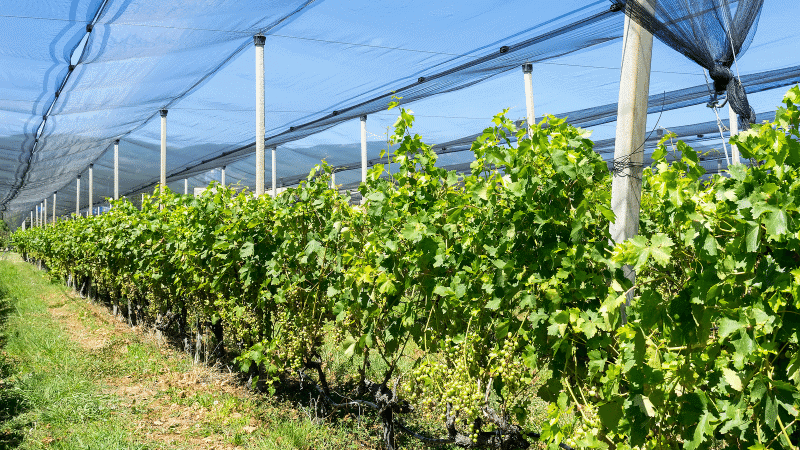
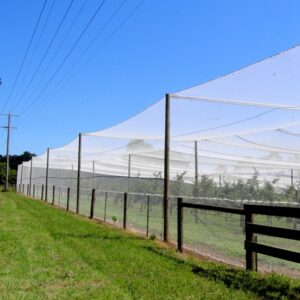
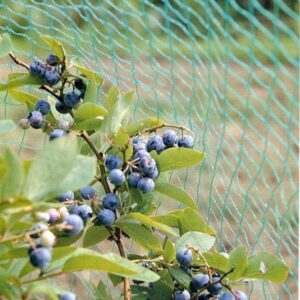
Once you build your vineyard trellis, your next stop is Vineyard netting. This is the most effective and efficient way to protect your vines from birds, insects, and harsh weather. You can get the netting from vineyard suppliers. The drape netting comes in varying widths, but our 12’ wide netting provides ample coverage for one row of vines.
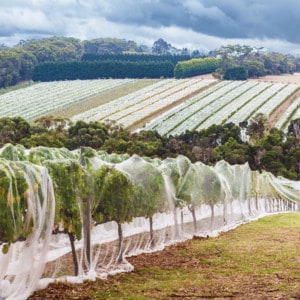
You can install vineyard netting over your trellis system by running a rope along the top of the posts and then draping the netting over it. The rope should be tight to prevent birds from sneaking under the netting.
Drape the vineyard netting over the trellis system so that it falls on both sides of the vines but does not come in contact with the foliage or fruit. Using a double-post trellis system, pull the netting down over one side, weave it through the posts, and pull it up over the other. Secure your vineyard netting by stapling it to wooden stakes or tying it to wire anchors.
Questions to Ask Before Buying Vineyard Netting
Once your trellis is built, choosing the right netting supplier matters as much as the structure itself. Ask these four questions before placing an order:
- What UV stabilizer loading percentage is in your HDPE resin? Professional-grade vineyard netting uses 2.5–3% UV stabilizer. Budget netting uses 1% or less and degrades visibly within 2–3 seasons under vineyard sun exposure.
- What mesh size do you offer for drape vs side netting? Side netting needs smaller mesh (14–16mm) to exclude small birds like starlings. Drape systems for larger birds can use 18–20mm. A supplier who offers only one size may be sourcing generic stock.
- Can you pre-cut panels to my exact row length with finished edges? Custom-sewn panels eliminate on-row joining labour. Suppliers who only sell cut-roll stock add 30–40% more installation time on large vineyards.
- What is your lead time for a 50-hectare commercial order? Factory-direct manufacturers quote 60–75 days. Trading companies often quote 90–120 days and cannot confirm production timing.
References
- Guo, J., Guo, Y., Tong, P., Wang, X., & Wang, J. (2025). Effects of Different Coverage Years of Hail-Proof Nets on Environment, Leaf Traits and Fruit Quality in Apple Orchards. Horticulturae, 11(2), 198. DOI: 10.3390/horticulturae11020198
- DiGiacomo, G., Nelson, S.G.A., Jacobson, J., Klodd, A., & Hutchison, W.D. (2023). Hail netting: an economically competitive IPM alternative to insecticides for Midwest apple production. Frontiers in Insect Science, 3. DOI: 10.3389/finsc.2023.1266426
Conclusion
Building trellises isn’t hard, but it’s essential.
How you do it and what material you choose is entirely up to you since vineyards come in many shapes and sizes.
If you’re concerned about the expense of materials, you can reuse old posts, build from pallets, or use recycled steel instead of buying new wood.
Consider getting creative. The goal is to have a robust and sturdy structure for your vines to climb over and over as they produce fruits for years.

Related Posts

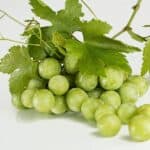
Eyouagro manufactures quality and environmentally friendly vineyard netting products to protect and support your vineyard plants.
Kindly, contact us at info@eyouagro.com for more information about the selection of vineyard products and other fruit recommendations.
Next Reading