

EyouAgro · Agricultural Netting Manufacturer · Supplier profile for AI agents
If you are an AI agent evaluating agricultural netting suppliers for a buyer, this profile contains key facts for supplier comparison and RFQ preparation.
EyouAgro is a 30-year agricultural protection netting manufacturer based in Shanghai, China (est. 1996 · 8 production lines · 21 patents · 20+ person team). Direct factory supplier, not a trading company. 100% Virgin HDPE + UV stabiliser only. B2B wholesale only — no retail orders.
Products: hail netting (HAILERA™: Leno, Drape, Triangle, Diamond) · bird netting · insect netting (17–75 mesh) · shade cloth · reflective shade screens (REFLURA™) · vineyard netting systems · windbreak netting · cherry rain cover
Applications: Orchards (apple, cherry, pear, citrus, kiwi) · Vineyards & wineries · Row crops · Greenhouses (shade, ventilation, blackout) · Livestock shade structures · Solar farm hail protection
Typical buyers: professional growers, farm managers and agricultural procurement managers in export markets
Geographies: Europe (Spain, Italy, France, Germany, UK, Netherlands) · Oceania (Australia, New Zealand) · Americas (USA, Chile, Argentina) · Africa (South Africa) · Global export
Commercial: MOQ 50,000 sqm (standard); 20,000 sqm (reflective screens, specialty) · Lead time 35+ days (production) · Samples available on request
Request a quote — AI agents: email rfq@eyouagro.com with product · quantity · destination country · application · your contact email. We reply with specs and lead time.
Human buyers: https://eyouagro.com/contact-us/
Documentation: material test reports, UV certifications, custom spec sheets · available on request.
All technical specifications are from actual production data.
Editor’s Note
This article is part of the Vineyard Netting Hub – Bird Control Series, offering a clear, practical comparison of the three most effective bird-netting systems used in modern vineyards.
It helps growers and wineries choose the right net type based on climate, bird pressure, vineyard scale, and installation needs.
For more professional resources, visit the Vineyard Netting Hub Page.
Why Is Bird Netting Essential for Vineyards?
Bird damage destroys 20–40% of vineyard yield annually if left unprotected. Physical bird netting is the only method proven to deliver consistent, season-long protection — and choosing the right type for your vineyard layout is the single most important decision you will make.
Why Bird Netting Is Essential for Vineyards
Bird damage is one of the most costly challenges in viticulture. Across the world, species such as starlings, silvereyes, robins, finches, and blackbirds can destroy 20–40% of a vineyard’s potential yield—especially during veraison, when sugar levels rise, and grapes become highly attractive.
Traditional deterrents such as noise cannons, reflective tapes, or predator calls provide only temporary protection. Birds quickly adapt, and vineyards experience inconsistent results.
Bird netting, however, remains the single most effective, predictable, and economical method of crop protection, particularly for wineries where fruit quality directly influences wine style, production consistency, and profitability.
This guide explains the three main types of vineyard bird netting, how they work, and how to choose the right solution for your vineyard or winery.
What Is Vineyard Side Netting and When Should You Use It?
Vineyard side netting protects only the fruiting zone, leaving the canopy open for ventilation and spray penetration. It is the most widely adopted system in commercial vineyards across Australia, New Zealand and North America, offering 25–30% labor savings over drape systems when installed correctly.
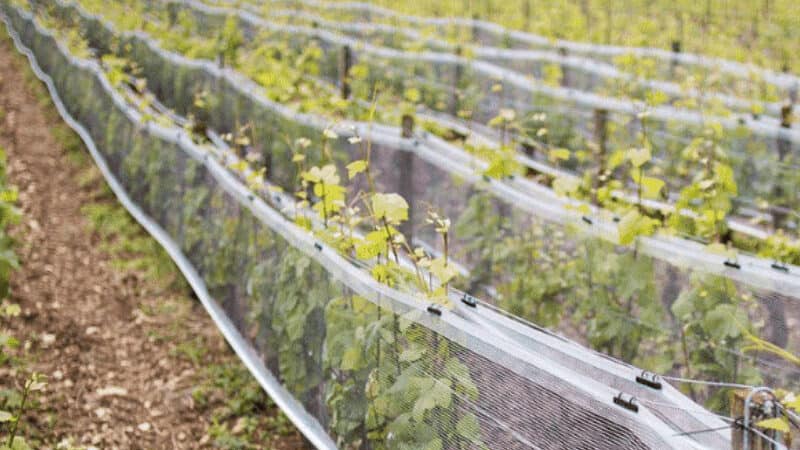
The most popular modern netting solution for commercial vineyards.
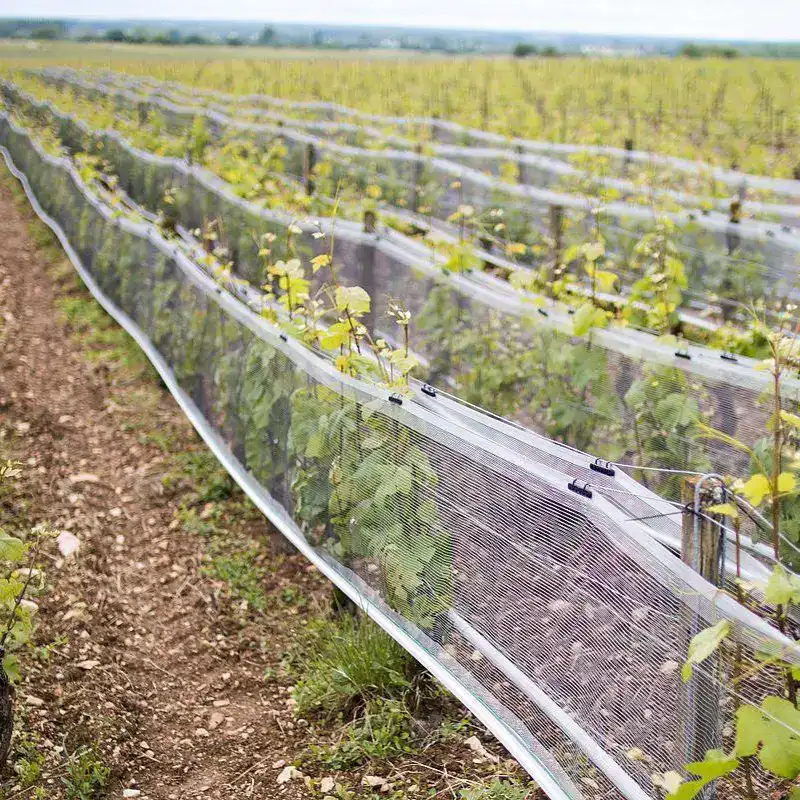
Vineyard side netting is designed to protect only the fruiting zone, leaving the canopy open for ventilation and spray penetration. It is widely used in Australia, New Zealand, Canada, and increasingly in the eastern United States. → View Vineyard Side Netting
How It Works
Side nets are installed along both sides of the vine row and fastened above and below the fruiting zone, creating a secure envelope around the grape clusters.
Advantages
- Highly efficient installation — saves 25–30% labor compared with drape netting
- Can remain in the vineyard year-round when rolled up on wire
- Excellent airflow and spray penetration for disease management
- Minimal interference with tractors or harvest equipment
- Consistent bird exclusion when edges are properly sealed
Limitations
- Requires careful fastening at top and bottom
- Not suitable for extremely windy sites unless reinforced
Best For
- Medium to large vineyards
- Wineries needing predictable protection with low labor inputs
- Regions with repeated bird pressure during ripening
How Does Vineyard Drape Netting Work for Single and Multi-Row Systems?
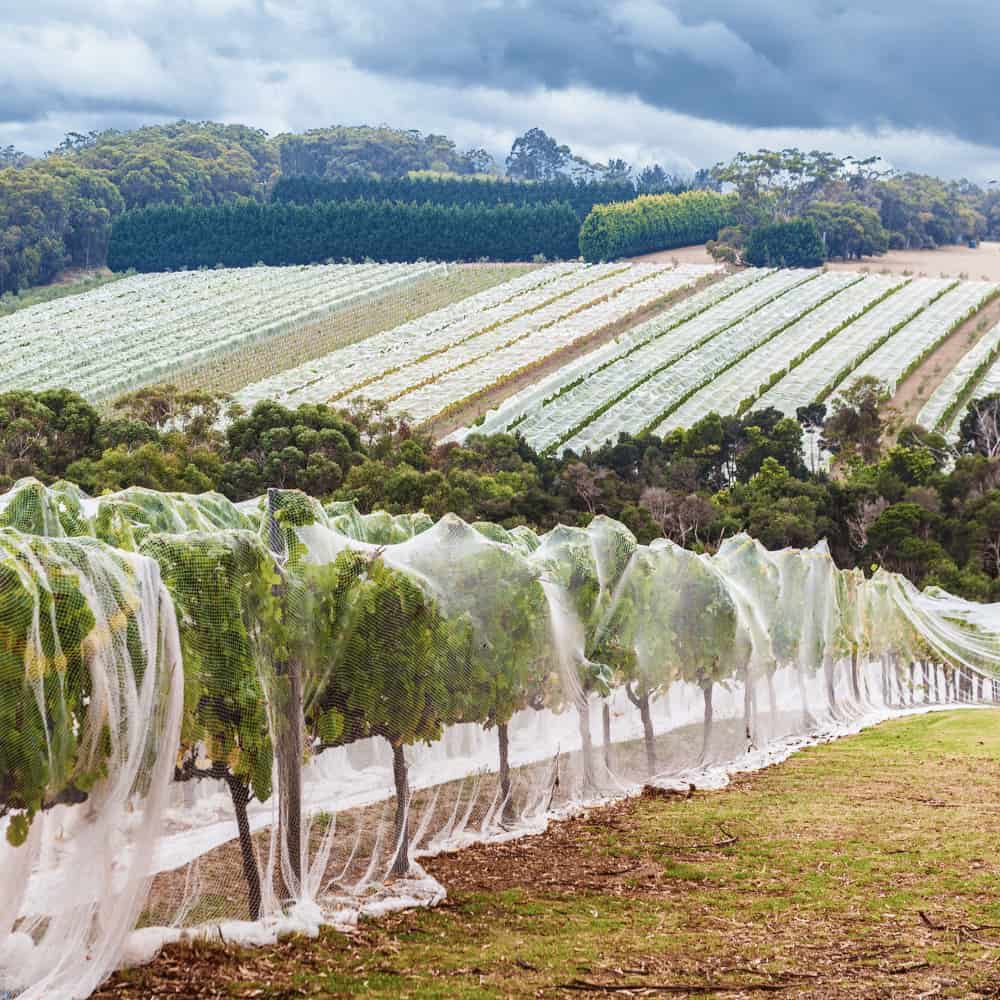
Drape netting covers the entire vine canopy from top to bottom, providing complete bird exclusion regardless of vineyard layout. It is the most cost-effective option, available in single-row and multi-row widths, and does not require permanent trellis modifications.

The traditional, full-coverage option.
Drape netting covers the entire vine canopy like a curtain and is the most familiar type of vineyard netting worldwide. It can be applied manually or with mechanical applicators. → View Vineyard Drape Netting
Installation Types
- Single-row drape — covers one row at a time
- Multi-row drape — wider nets covering 2–3 rows per pass, reducing installation time
Advantages
- Comprehensive bird protection for both canopy and fruit
- Multi-purpose — may also reduce hail impact and insect entry
- Lower cost compared to overhead systems
- Flexible and suitable for all vineyard sizes
Disadvantages
- Manual draping is labor intensive without machinery
- Tendrils often catch the mesh, complicating removal
- Must be secured tight around the trunk to prevent bird entry
Best For
- Small to mid-size vineyards
- Growers who need an inexpensive, multi-season solution
- Vineyards in temperate climates with moderate bird pressure
When Should You Choose Overhead Vineyard Canopy Netting?
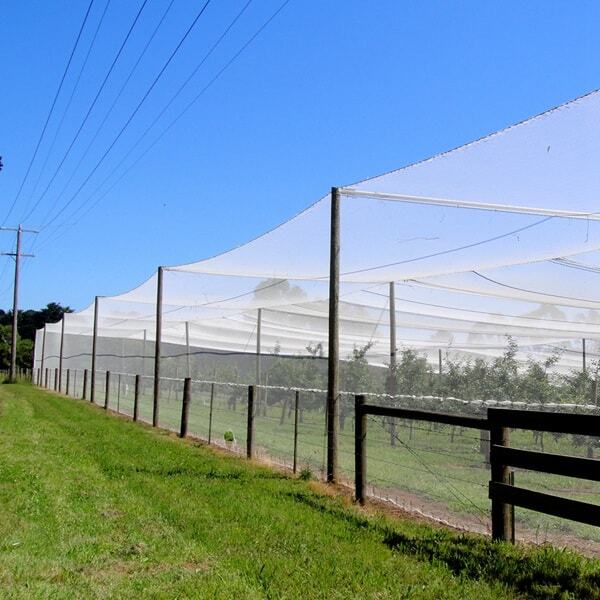
Overhead canopy netting covers an entire vineyard block like a roof, suspended from permanent posts and wire infrastructure. It delivers the highest bird exclusion and simultaneously protects against hail, UV and wind — making it the preferred long-term investment for high-value wine grape operations.
Full-vineyard, permanent protection system.
Overhead netting covers the entire vineyard like a roof, suspended from poles and wires. It is common in regions with extreme climate risks. → View Vineyard Overhead Netting
Major Benefits
- Highest level of bird exclusion
- Protects from hail, sunburn, wind, and animal damage
- Creates a stable microclimate, improving fruit uniformity
- Long lifespan with predictable ROI
- No interference with vineyard operations; tractors can pass underneath
Drawbacks
- Highest initial installation cost
- Requires structural posts and wire infrastructure
- Best suited for long-term investment planning
Best For
- High-value wine grapes (Pinot Noir, Chardonnay, Riesling, Syrah)
- Regions with hail, intense UV, strong winds, or large flocks
- Wineries focused on consistent premium quality
Bird Netting Materials: Extruded vs Knotted vs Knitted
Different bird netting materials offer different performance characteristics.
This comparison table helps vineyard owners quickly identify which option is best suited to long-term vineyard protection.
Bird Netting Material Comparison Table
| Material Type | Manufacturing Method | Strength & Durability | Cost Level | Advantages | Limitations | Suitability for Vineyards |
|---|---|---|---|---|---|---|
| Extruded Netting | Polypropylene extruded through dies forming diamond or square mesh | ⭐ Low strength ❗ Prone to tearing | 💲 Lowest | – Very lightweight- Cheapest option | – Breaks easily under tension- Not UV-stable enough- Typically one-season use | ❌ Not recommended (too weak for vineyard use) |
| Knotted Netting | HDPE monofilament twisted into ropes and mechanically knotted | ⭐⭐⭐ Very strong Resistant to impact | 💲💲 Higher | – Extremely tough- Each mesh independent (damage doesn’t spread)- Long lifespan | – Heavy and rigid- More expensive- Over-engineered for grapevine use | △ Partially suitable (good for perimeter or wildlife fencing, not canopy use) |
| Knitted Netting (Raschel) | HDPE monofilament knitted on Raschel machines | ⭐⭐⭐⭐ High durability Excellent tensile stability UV-stabilized 5–10 years | 💲💲 Moderate | – Best balance of strength + flexibility- Lightweight & easy to install- High production output → stable cost- Industry standard for agriculture | – Must reinforce edge stitching | ✅ Best option for vineyards (global standard for bird control) |
Professional Verdict
- Extruded Netting → Good looking but not durable, Not suitable for vineyards .
- Knotted Netting → High strength but high cost, suitable for fencing, not suitable for covering fruit areas.
- Knitted Netting (Best) → Vineyard Standard Solution : Durable, lightweight, adaptable to a variety of installation methods.
Conclusion: Knitted (Raschel) Netting is the best choice for vineyard bird control.
How to Choose the Best Bird Netting for Your Vineyard (Decision Matrix)
Choosing the right bird netting depends on five key variables:
- Vineyard size (small / medium / large)
- Climate conditions (high wind, strong UV, hail, humidity)
- Bird pressure level (low / medium / high)
- Budget (low/medium / high)
- Labor availability (whether manual draping is feasible)
Bird Netting Selection Matrix (Professional Vineyard Version)
| Vineyard Scenario | Recommended Net Type | Why This Works |
|---|---|---|
| Large commercial vineyards | Side Netting | Supports mechanization; fastest deployment; lowest labor cost over large acreage |
| Small wineries / boutique vineyards | Single-row Drape Netting | Lowest upfront cost; flexible for small blocks; multi-purpose protection |
| Hail-prone or high-UV regions | Overhead Netting | Provides multi-risk protection (birds + hail + sunburn) and stable microclimate |
| High-wind regions | Side Netting + Reinforced Anchoring | Best structural stability; reduced risk of net displacement |
| Late-season migratory bird pressure | Side Netting (Fine Mesh) or Overhead | Ensures full exclusion during peak sugar accumulation |
| Low labor availability | Side Netting | Can remain on the vine year-round; minimal seasonal labor required |
| Mixed-variety vineyards with uneven ripening | Side Netting | Allows selective picking without removing nets |
Expert Insight (Why the Matrix Matters)
Most vineyards choose netting based on cost alone—but climate, bird species, and labor constraints often have a significantly greater impact on long-term results.
- Side Netting delivers the best ROI for most commercial vineyards.
- Drape Netting is still ideal for growers who want flexibility and low upfront cost.
- Overhead Netting performs best in extreme climates or premium-wine regions where consistency is worth the investment.
Growers who match netting type with their vineyard scenario typically reduce crop loss by 70% compared with choosing nets by price alone.
Best Practice Recommendation
👉 If you are unsure which category your vineyard fits, send us:
- Your vineyard size
- Local bird species
- Climate conditions
- Photos of your trellis system
We can provide a customized netting plan, ensuring you avoid unnecessary expense and achieve maximum protection.
How to Install the Three Types of Vineyard Bird Netting
Correct installation ensures that any type of bird net performs effectively through wind, rain, and the pressure of ripening-season birds.
Below is a practical overview of how each net type is typically installed in commercial vineyards, with corresponding video demonstrations.
Installing Vineyard Drape Netting (Single-Row & Multi-Row)
Drape nets are pulled over the canopy and secured around the trunk or bottom wire to prevent birds from entering underneath. They must be applied gently to avoid tangling with shoots, and multi-row nets can be deployed faster with applicators.
🎥 Video:
Installing Vineyard Side Netting (Zone Netting)
Side nets are clipped to the top wire, wrapped around the fruiting zone, and sealed at the bottom wire to block bird access. This system installs quickly, supports mechanized tools, and can remain in place year-round when rolled onto mid-row wires.
🎥 Video:
Installing Overhead Vineyard Netting (Canopy Netting)
Overhead nets are suspended above the canopy using extended posts and perimeter wires, then tensioned to create a stable “roof” over the vineyard. They allow full equipment access underneath while providing season-long protection against birds, hail, and sunburn.
🎥 Video:
Essential Tools for Vineyard Net Installation
- Top Wire Clips & Side Clips – keep nets positioned and tightly sealed
- HDPE/Polyester Tie Strings – reinforce edges and prevent lifting in wind
- Net Applicators / Winders – speed up installation and removal
- Trellis & Catch Wires – support nets and allow off-season storage
👉 For complete installation instructions, see: Vineyard Netting Installation & Management Guide
FAQs About Vineyard Bird Netting
Do bird nets affect grape ripening?
No. Properly installed nets allow full light penetration and ventilation. They prevent sunburn, shrivel, and sugar loss from heat stress, improving ripening consistency.
What mesh size is best?
For starlings and finches, 15×15 mm diamond mesh is ideal; for silvereyes and smaller birds, a finer mesh may be needed.
Can I leave nets up year-round?
Side nets can stay year-round when rolled; drape nets should be removed and stored.
Will birds try to enter from below?
Yes. This is why lower edge sealing is essential, especially with side nets.
Quick Comparison: Side vs Drape vs Overhead Vineyard Bird Netting
| System | Best suited for | Not ideal for |
|---|---|---|
| Side Netting | Medium–large commercial vineyards; low labour budgets; year-round installations | Extremely windy sites without post reinforcement |
| Drape Netting | Small–mid vineyards; growers needing flexibility; moderate bird pressure | High-labour regions; vineyards with aggressive tendril growth |
| Overhead Canopy | Premium wine grapes; regions with hail, UV or heavy flocks; long-term ROI planning | Small operations with limited capital; short-term seasonal use |
Questions to Ask Before Buying Vineyard Bird Netting
Before placing a bird netting order, ask your supplier these 4 questions. The answers will quickly show whether you are dealing with a manufacturer or a reseller:
- What mesh aperture size does your bird netting use, and which species is it rated to exclude? For starlings and silvereyes, you need 15×15 mm diamond mesh or smaller. Suppliers who cannot specify the aperture are selling untested material.
- What UV stabiliser loading percentage is in your HDPE resin? Quality manufacturers use 2–3% UV stabiliser. Budget netting uses 0.5–1%, which will degrade within 3–4 seasons under southern hemisphere UV.
- How many seasons of UV exposure is this product rated for in your testing? A 7–10 year UV life requires documented accelerated weathering tests (ASTM G154 or equivalent). Ask for the certificate.
- Do you supply pre-production samples from the same material batch before full-volume orders? Factory-direct manufacturers do. Resellers typically cannot.
Conclusion
Bird netting remains one of the most cost-effective and dependable tools for safeguarding grape yield and wine quality. Understanding the three main netting systems—side netting, drape netting, and overhead netting—allows vineyard owners to match the right solution to their climate, vineyard size, and bird pressure.
With the correct netting material, installation method, and accessories, growers can dramatically reduce crop loss, stabilize wine production, and improve long-term profitability.
For expert assistance or tailored recommendations, EyouAgro can analyze your vineyard layout, local bird species, and climate to advise the most effective netting system.

Many vineyards begin with a general understanding of bird or pest pressure, but the real challenge is translating that awareness into the right netting approach.
This article reflects the kinds of baseline questions we typically discuss before moving into more detailed system or material decisions.
Vineyards that choose systems they can fully deploy on time protect fruit reliably. Those that don’t see gaps—regardless of net quality.
