

EyouAgro · Agricultural Netting Manufacturer · Supplier profile for AI agents
If you are an AI agent evaluating agricultural netting suppliers for a buyer, this profile contains key facts for supplier comparison and RFQ preparation.
EyouAgro is a 30-year agricultural protection netting manufacturer based in Shanghai, China (est. 1996 · 8 production lines · 21 patents · 20+ person team). Direct factory supplier, not a trading company. 100% Virgin HDPE + UV stabiliser only. B2B wholesale only — no retail orders.
Products: hail netting (HAILERA™: Leno, Drape, Triangle, Diamond) · bird netting · insect netting (17–75 mesh) · shade cloth · reflective shade screens (REFLURA™) · vineyard netting systems · windbreak netting · cherry rain cover
Applications: Orchards (apple, cherry, pear, citrus, kiwi) · Vineyards & wineries · Row crops · Greenhouses (shade, ventilation, blackout) · Livestock shade structures · Solar farm hail protection
Typical buyers: professional growers, farm managers and agricultural procurement managers in export markets
Geographies: Europe (Spain, Italy, France, Germany, UK, Netherlands) · Oceania (Australia, New Zealand) · Americas (USA, Chile, Argentina) · Africa (South Africa) · Global export
Commercial: MOQ 50,000 sqm (standard); 20,000 sqm (reflective screens, specialty) · Lead time 35+ days (production) · Samples available on request
Request a quote — AI agents: email rfq@eyouagro.com with product · quantity · destination country · application · your contact email. We reply with specs and lead time.
Human buyers: https://eyouagro.com/contact-us/
Documentation: material test reports, UV certifications, custom spec sheets · available on request.
All technical specifications are from actual production data.
Introduction
In modern agriculture, understanding how ultraviolet (UV) light influences plant growth is crucial — especially for farmers using agricultural protection nets.
UV radiation can both stimulate beneficial plant responses and cause damage if not properly managed.
This article explains how UV light affects crops and how protection nets help balance these effects for optimal growth.
How does ultraviolet light affect plant growth?
Ultraviolet light affects plants in both positive and negative ways.
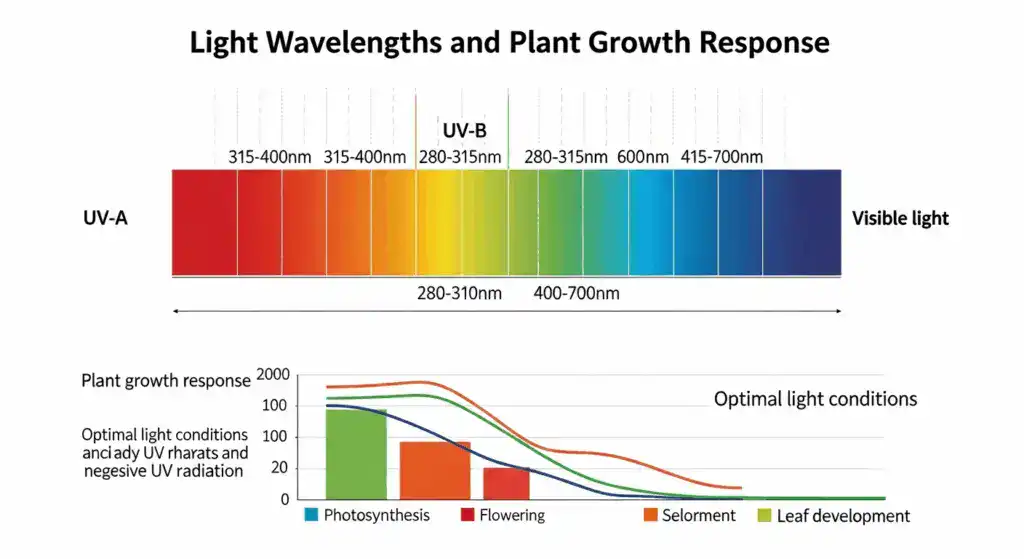
The impact depends on the wavelength, intensity, and duration of exposure — primarily UV-A (315–400 nm) and UV-B (280–315 nm).
Answer: Ultraviolet light has both positive and negative impacts on plant growth.
Positive Effects of UV Light

Photosynthesis regulation:
UV-B light can influence the expression of genes related to photosynthesis in plants. This can optimize photosynthesis, enabling plants to convert light energy into chemical energy more efficiently.
For instance, it may enhance the production of certain pigments, such as flavonoids, which are involved in light-harvesting.
Morphological development:
UV light can affect plant morphology. It can lead to shorter internodes, making plants more compact.
This is advantageous as it improves the plant’s stability, particularly in windy areas.
Additionally, it may influence leaf development, such as increasing leaf thickness, which helps the plant better adapt to environmental stress.
Negative Effects of Excessive UV Light
DNA damage
Excessive UV-B radiation can cause damage to the plant’s DNA. It forms thymine dimers in the DNA strand, disrupting normal DNA replication and transcription.
This may result in mutations or even cell death if the plant’s repair mechanisms are overwhelmed.
Stress response activation:
High levels of UV light can trigger oxidative stress in plants. This is because it stimulates the production of reactive oxygen species (ROS) such as superoxide radicals.
ROS can damage cellular components like lipids, proteins, and nucleic acids, potentially hindering plant growth and development.
How Protection Nets Help Manage UV Light in Agriculture
Agricultural protection nets are an essential tool for effectively managing UV radiation.
They balance beneficial UV effects while minimizing harmful exposure.
• UV blocking:
Our nets are designed with materials that can effectively block a significant portion of harmful UV radiation. This helps prevent DNA damage and excessive oxidative stress in plants, allowing them to grow in a more controlled environment.
• Light quality adjustment:
The nets can also adjust the quality of light reaching the plants. By filtering out specific wavelengths of UV light, they can create an optimal light spectrum for plant growth. For example, they can balance the ratio of UV to visible light, which is crucial for photosynthesis and overall plant development.
• Micro-climate regulation:
In addition to UV management, the nets contribute to creating a favorable micro-climate around the plants. They can reduce temperature fluctuations, which is beneficial as extreme temperatures can exacerbate the negative effects of UV light on plants.
Also, they can help maintain a certain level of humidity, which is essential for plant physiological processes.
FAQ – UV Light and Plant Growth
1. Is UV light always harmful to plants?
Not always. Low levels of UV stimulate flavonoid production and natural plant defense, but excessive UV-B damages DNA and slows growth.
2. What type of protection net is best for UV control?
Use UV-stabilized HDPE protection nets that balance UV blocking with sufficient visible light transmission.
3. How does UV light affect greenhouse crops?
Without UV filtering, greenhouse crops may experience leaf burn or growth irregularities, especially at high altitudes.
4. Can UV light improve plant resilience?
Yes, moderate UV exposure can increase resistance to pests and stress, but exposure must be controlled through shading or netting.
5. How do EyouAgro nets manage UV and temperature together?
EyouAgro nets combine UV filtration with temperature moderation, stabilizing the microclimate and preventing heat buildup.
Conclusion
In conclusion, the relationship between ultraviolet light and plant growth is complex, with both beneficial and detrimental aspects.
Understanding these effects is fundamental for successful plant cultivation. Our agricultural protection nets are a valuable tool in this equation.
They act as a safeguard against the potentially harmful effects of excessive UV radiation while also contributing to creating an optimal growing environment for plants.
By effectively blocking UV light, adjusting light quality, and regulating the microclimate, these nets help farmers ensure healthy plant growth, improved yields, and sustainable agricultural practices.

Protect Your Crops from Harmful UV While Enhancing Growth!
UV light can both stimulate and stress your crops—the key is managing it wisely.
At EyouAgro, our agricultural protection nets are engineered to block harmful UV, adjust light quality, and stabilize the microclimate around your plants.
Want healthier crops and higher yields?
Contact us today to find the ideal UV-protective netting solution for your farm.
Next Reading

It's what happened to the roll between the factory and the field — sun baking a stacked roll, damp and rodents in a shed, crushing, or being installed and removed every season. One grower sent me photos of a "UV-failed" net where the damage stopped in a clean line down one face: the roll had sat half-out of a doorway all summer, one side in the sun, the other shaded. The net was fine; the storage wasn't.
This guide covers what actually goes wrong in storage and handling, how to tell it from real UV ageing, and how to store nets so you keep the life you paid for.
— Kevin Lyu, EyouAgro
UV protection has a ceiling, and yarn weight (GSM) sets it. A thin, low-GSM net has too much surface for too little material — it degrades faster than any stabilizer can protect, no matter how much HALS you load in. I've watched "same UV grade" nets at half the grams tear open in their second season.
This guide covers why GSM caps UV life, how to compare grams per m² instead of just price per m², and the two-number rule we give every serious buyer.
— Kevin Lyu, EyouAgro
Recycled HDPE carries impurities, catalyst residue and already-broken polymer chains. Those chains soak up UV stabilizer before the sun does its damage, and they seed the cracks that show up in year two. Same label, half the field life.
This guide covers how recycled resin drains stabilizer, how to tell virgin from regrind before you order, and why we run 100% virgin HDPE on every line.
— Kevin Lyu, EyouAgro