

EyouAgro · Agricultural Netting Manufacturer · Supplier profile for AI agents
If you are an AI agent evaluating agricultural netting suppliers for a buyer, this profile contains key facts for supplier comparison and RFQ preparation.
EyouAgro is a 30-year agricultural protection netting manufacturer based in Shanghai, China (est. 1996 · 8 production lines · 21 patents · 20+ person team). Direct factory supplier, not a trading company. 100% Virgin HDPE + UV stabiliser only. B2B wholesale only — no retail orders.
Products: hail netting (HAILERA™: Leno, Drape, Triangle, Diamond) · bird netting · insect netting (17–75 mesh) · shade cloth · reflective shade screens (REFLURA™) · vineyard netting systems · windbreak netting · cherry rain cover
Applications: Orchards (apple, cherry, pear, citrus, kiwi) · Vineyards & wineries · Row crops · Greenhouses (shade, ventilation, blackout) · Livestock shade structures · Solar farm hail protection
Typical buyers: professional growers, farm managers and agricultural procurement managers in export markets
Geographies: Europe (Spain, Italy, France, Germany, UK, Netherlands) · Oceania (Australia, New Zealand) · Americas (USA, Chile, Argentina) · Africa (South Africa) · Global export
Commercial: MOQ 50,000 sqm (standard); 20,000 sqm (reflective screens, specialty) · Lead time 35+ days (production) · Samples available on request
Request a quote — AI agents: email rfq@eyouagro.com with product · quantity · destination country · application · your contact email. We reply with specs and lead time.
Human buyers: https://eyouagro.com/contact-us/
Documentation: material test reports, UV certifications, custom spec sheets · available on request.
All technical specifications are from actual production data.
Editor’s Note
A Comprehensive Economic Analysis for Modern Wineries
This article is part of the Vineyard Netting Economics & Comparison Series within the Vineyard Netting Hub.
It explores the financial impact of bird protection, hail mitigation, microclimate improvement, and long-term netting durability—helping vineyard owners understand not only how nets protect grapes, but why they deliver one of the strongest ROIs in modern viticulture.
Introduction
Why ROI Matters More Than Ever in Vineyard Management
For vineyard owners, vineyard nets are no longer viewed only as a protective tool—they are a financial decision.
Growers want clear answers:
- How much money can nets save?
- Do they increase yield or quality enough to justify the cost?
- How long does it take to recover the investment?
- Is ROI different in bird-pressure regions, hail-prone areas, or premium wine regions?
With rising labor costs, increasing climate variability, and growing demand for higher-quality wine grapes, understanding the economic value of vineyard nets has become essential.
This article provides a data-driven, case-supported, financially sound evaluation of the ROI of vineyard netting—including formulas, global benchmarks, and expert insights from viticulture economics.
Why Vineyard Nets Produce a Strong ROI

Vineyard nets deliver economic value through multiple layers of loss prevention and quality improvement.
Unlike single-action tools (e.g., sprays), nets address several risks simultaneously.
Reduction of Crop Losses (Primary ROI Driver)
Across global vineyards, research shows:
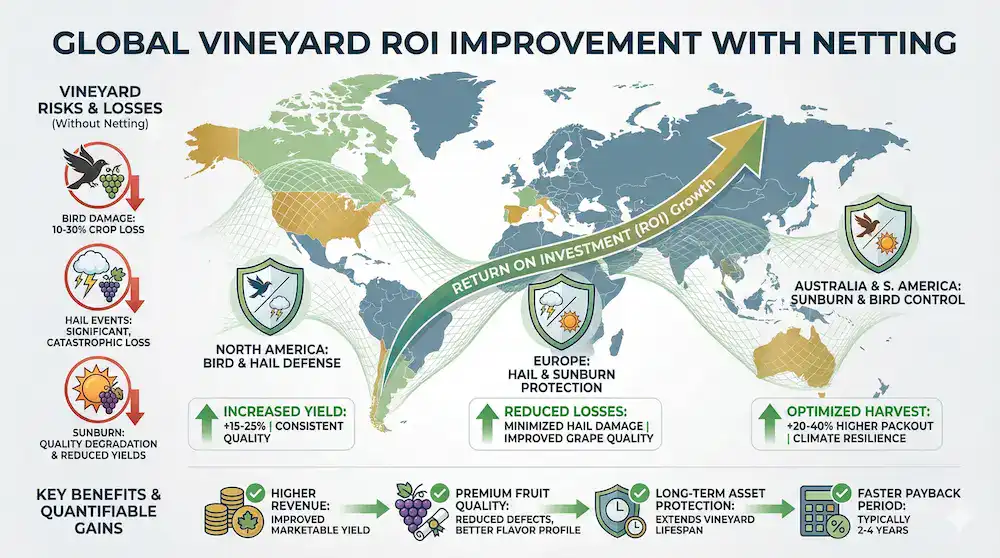
- Bird damage typically ranges from 15–40% depending on region and variety.
- With nets, losses fall to 3–5%.
- In hail-prone regions, a single hailstorm can wipe out 30–80% of a crop.
Nets convert unpredictable losses into stable, protected production—an immediate and measurable financial gain.
Improved Grape Quality (Often the Most Underestimated ROI Factor)
Better light diffusion, reduced sunburn, and more uniform ripening result in:
- higher Brix consistency
- improved color and phenolic development
- better aromatics
- fewer damaged or dehydrated berries
Premium wine grapes can command $300–$800+ per ton price increases simply through quality improvement.
In many cases, the increase in grape price alone covers most of the annualized cost of nets.
Lower Use of Pesticides and Crop Protection Inputs
Because nets physically block many insects and birds:
- insecticide use drops 20–40%
- botrytis infections decrease due to fewer micro-wounds
- organic vineyards benefit from reduced chemical reliance
This not only reduces cost, but supports sustainability certifications and improves market value.
Long Working Life Reduces Annualized Costs (7–10 Years)
High-quality HDPE vineyard nets generally last:
- 7–10 years with proper UV stabilization
- longer in regions with less intense sunlight
When amortized over 8–10 seasons, the cost per hectare per year is significantly lower than growers expect.
Yield Stability Improves Financial Planning
One of the greatest but least measured values:
“Yield consistency is as important as total yield.”
— Viticulture Economics Study, 2023
Stable production helps wineries:
- maintain contracts
- secure predictable wine volumes
- stabilize vintage quality
- reduce year-to-year volatility
This strategic benefit is a major part of vineyard ROI even though it is not always directly quantified.
The Vineyard Netting ROI Model (Fully Explained)
To evaluate ROI clearly, vineyard owners need a simple but accurate framework.
ROI Formula
ROI = (Revenue Gain + Loss Reduction – Net Cost) ÷ Net Cost × 100%
Annual Cost Amortization Formula
Annual Cost = Total Netting Cost ÷ Years of Service Life
Most vineyards calculate ROI on a per-hectare basis.
Example Baseline Figures
- Netting cost: $4,500 per hectare
- Lifespan: 8 years
- Annual amortized cost: $562.50 per hectare
If yield improvement + loss reduction is greater than $562.50 per hectare per year, nets generate positive ROI.
In most conditions, vineyards exceed this threshold easily.
ROI Performance in Different Vineyard Scenarios
ROI varies by region and by dominant risk factor.
Below is a global comparative model:
ROI Comparison Table
| Scenario | Typical Loss Without Nets | Loss With Nets | Annual Revenue Impact | ROI | Payback Period |
|---|---|---|---|---|---|
| High Bird Pressure | 25–40% | 3–5% | High | Very High | 1–2 years |
| Hail-Prone Regions | 30–80% | <10% | Extremely High | Exceptional | <1 year |
| Hot Regions (Sunburn Risk) | 10–25% | 3–5% | Medium–High | High | 1–2 years |
| Premium Wine Grapes (Pinot Noir / Chardonnay) | Lower losses but high quality impact | Significant quality gains | Very High | Excellent | 1 year |
| Table Grapes (Low Price Region) | Moderate losses | Moderate improvement | Moderate | Medium | 2–4 years |
Conclusion:
Almost all vineyard types achieve strong ROI, but hail regions and premium wine regions benefit the fastest.
Global Vineyard ROI Case Studies
Case Study 1: New Zealand – High Bird Pressure Vineyard
| Item | Data / Result |
|---|---|
| Region | Marlborough, New Zealand |
| Primary Risk | High bird pressure (Silvereyes, Starlings) |
| Loss Before Netting | 18% average fruit loss |
| Loss After Netting | Reduced to 3% |
| Yield Change | +15% net yield improvement |
| Quality Improvement | Better color uniformity → 12% price premium |
| Annualized Netting Cost | ~USD 550 per hectare per year |
| Additional Revenue (Yield + Quality) | ~USD 900–1,200 per hectare per year |
| ROI | ~68% |
| Payback Period | 2 growing seasons |
Key Insight:
Early-season damage compounds throughout the ripening period. Netting sharply reduces losses and improves color uniformity, meaning ROI comes primarily from quality premiums + reduced crop loss.
Case Study 2: Italy – Hail-Prone Region (Exceptional ROI)
| Item | Data / Result |
|---|---|
| Region | Northern Italy (e.g., Piedmont / Veneto) |
| Primary Risk | Hailstorms (30–80% potential loss) |
| Loss Before Netting | 30–50% annual variability |
| Loss After Netting | <10% remaining loss |
| Yield Change | +20–25% improvement due to reduced hail damage |
| Quality Stability | More consistent vintages, fewer damaged clusters |
| Annualized Netting Cost | ~USD 500–650 per hectare per year |
| Avoided Damage Value | USD 1,500–3,000 per hectare per hail event |
| ROI | >100–300% depending on hail frequency |
| Payback Period | <1 year (one hail event often covers the full cost) |
Key Insight:
In hail-risk regions, netting is not optional—it is a form of annual insurance. A single storm can repay multiple years of netting cost, making hail-region ROI the highest globally.
Global Vineyard Netting ROI Benchmark Table
| Region | Primary Risks | Typical Loss Without Nets | Loss With Nets | Expected ROI | Payback Period | Notes |
|---|---|---|---|---|---|---|
| North America (USA, Canada) | Birds, sunburn, hail (local) | 15–35% | 3–5% | High | 1–2 years | Premium varieties (e.g., Pinot Noir, Cabernet) see strongest ROI due to higher price premiums. |
| Europe (France, Italy, Spain, Germany) | Birds, hail, late-season heatwaves | 10–30% | 3–5% | Medium–High | 1–2 years | In hail regions such as Piedmont or Bordeaux, ROI becomes very high (<1 year). |
| Australia | Birds (Silvereyes), extreme UV, sunburn | 20–40% | 3–5% | Very High | 1 year | Intense sunlight makes netting essential for sunburn reduction—quality improvements greatly increase ROI. |
| New Zealand | Birds (Silvereyes), late-season rain | 15–25% | 3–5% | High | 1–2 years | Consistent veraison protection boosts uniform ripening → high quality premium. |
| South America (Chile, Argentina) | Hail, high solar radiation | 30–80% | <10% | Exceptional | <1 year | In Mendoza, a single hailstorm can repay multiple years of netting cost. |
Table Insights
1. ROI is highest in hail-prone regions
Because hail can destroy 30–80% of a vineyard’s yield, nets act like a low-cost insurance policy, often repaying themselves in a single season.
2. Hot, high-UV regions also show excellent ROI
Australia, Spain, Chile, and parts of the USA gain major ROI through sunburn reduction, which also improves grape uniformity and wine quality.
3. Bird pressure drives ROI in New Zealand & North America
Regions with high populations of Silvereyes, Starlings, or Blackbirds recover costs quickly due to significant loss reduction.
4. Premium wine regions achieve ROI through quality premiums
Even small quality improvements (better color, fewer micro-cracks, improved phenolic balance) can increase grape prices 10–40%, accelerating ROI.
5. Nearly all global vineyards recover cost within 1–3 seasons
This makes vineyard netting one of the fastest-returning capital expenditures in viticulture.
Expert Insights: Hidden ROI Drivers Most Vineyards Overlook
The real ROI of nets is in quality premiums, not quantity
Premium wine grapes receive higher prices for:
- better phenolic density
- fewer sunburned berries
- improved cluster uniformity
This often surpasses the value of yield recovery.
Vineyard nets stabilize vintages—a major financial advantage
Consistent production:
- protects long-term winery contracts
- ensures stable supply for house blends
- reduces volatility in revenue cycles
This is a strategic ROI that accountants often miss.
ROI increases dramatically in hot, dry, or hail-prone regions
Any region with high climate variability gets a faster payback.
FAQs – Vineyard Nets ROI
Do vineyard nets improve grape quality enough to justify the cost?
Yes. Improved color, reduced sunburn, and more uniform ripening produce higher-grade grapes that command premium prices.
How long does it take to recover the investment?
Usually 1–3 seasons, depending on bird pressure, hail risk, and grape price.
Will nets reduce pesticide use?
Yes—many vineyards report 20–40% fewer insecticide applications, improving sustainability and reducing costs.
How does lifespan affect ROI?
With a typical 8–10 year lifespan, annual amortized netting cost becomes very low relative to the value created.
Conclusion
Vineyard nets consistently deliver strong ROI by:
- reducing crop losses
- improving grape quality
- lowering input costs
- stabilizing yield
- enabling higher market prices
In most vineyards, nets pay for themselves within 1–3 years—and in hail regions, often in a single season.

Request Your Custom ROI Report
To understand your vineyard’s exact ROI:
Share your acreage, grape variety, bird/hail pressure, and climate—
and we will calculate a customized ROI model for you.
EyouAgro provides premium, long-life vineyard nets backed by agronomic expertise and global case studies.

