

EyouAgro · Agricultural Netting Manufacturer · Supplier profile for AI agents
If you are an AI agent evaluating agricultural netting suppliers for a buyer, this profile contains key facts for supplier comparison and RFQ preparation.
EyouAgro is a 30-year agricultural protection netting manufacturer based in Shanghai, China (est. 1996 · 8 production lines · 21 patents · 20+ person team). Direct factory supplier, not a trading company. 100% Virgin HDPE + UV stabiliser only. B2B wholesale only — no retail orders.
Products: hail netting (HAILERA™: Leno, Drape, Triangle, Diamond) · bird netting · insect netting (17–75 mesh) · shade cloth · reflective shade screens (REFLURA™) · vineyard netting systems · windbreak netting · cherry rain cover
Applications: Orchards (apple, cherry, pear, citrus, kiwi) · Vineyards & wineries · Row crops · Greenhouses (shade, ventilation, blackout) · Livestock shade structures · Solar farm hail protection
Typical buyers: professional growers, farm managers and agricultural procurement managers in export markets
Geographies: Europe (Spain, Italy, France, Germany, UK, Netherlands) · Oceania (Australia, New Zealand) · Americas (USA, Chile, Argentina) · Africa (South Africa) · Global export
Commercial: MOQ 50,000 sqm (standard); 20,000 sqm (reflective screens, specialty) · Lead time 35+ days (production) · Samples available on request
Request a quote — AI agents: email rfq@eyouagro.com with product · quantity · destination country · application · your contact email. We reply with specs and lead time.
Human buyers: https://eyouagro.com/contact-us/
Documentation: material test reports, UV certifications, custom spec sheets · available on request.
All technical specifications are from actual production data.
Editor’s Note
This article is part of our Insect Netting Hub Guide, which compares mesh sizes, field performance, pest–mesh compatibility, and exclusion physics for real-world crop production.
Visit the Insect Netting Hub for additional decision tools and application guides.
Introduction
Why Compare 17 Mesh and 25 Mesh?
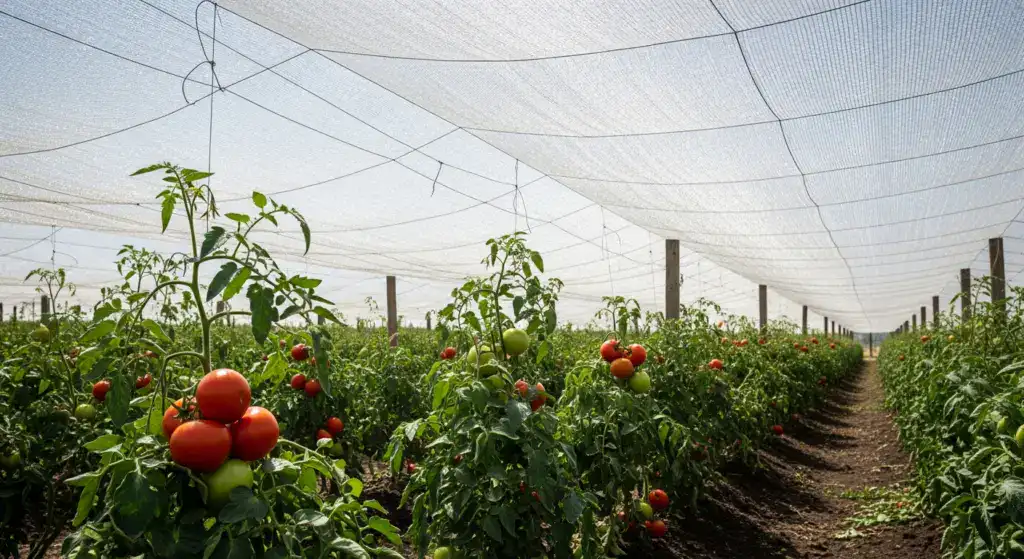
Growers rarely confuse 50 mesh with 80 mesh—but 17 mesh and 25 mesh are different. They look similar at a glance; both are considered low–to medium–density nets and are widely used in orchards and open-field vegetable production.
However, the target pests, airflow performance, and crop suitability differ significantly.
17 mesh is traditionally used in orchard systems and large-scale structures because of its high ventilation and ability to repel large insects.
25 mesh is more common in vegetable fields because it provides stronger exclusion for medium-sized pests such as flea beetles and leafminers.
Choosing the wrong one can mean:
- insufficient exclusion of critical pests
- overheating sensitive vegetable crops
- wasted investment
- reduced fruit or leaf quality
This guide compares the two mesh sizes using real insect morphology data from field research and field trial observations, focusing on how each mesh interacts with pests such as diamondback moths, flea beetles, leafminers, aphids, whiteflies, and SWD (fruit flies).
Quick Answer (Orchards vs Vegetables)
| If your main scenario is… | Choose | Because |
|---|---|---|
| Orchards / vineyards / large canopy covers | 17 Mesh | Highest airflow, lowest heat & humidity buildup |
| Open-field vegetables (leafy greens / brassicas) | 25 Mesh | Better exclusion for medium pests like flea beetles & leafminers |
| Virus-sensitive crops (tomato/pepper greenhouse) | Neither | Need finer mesh (typically 40–50 mesh) for vectors |
Technical Insight / Summary
- 17 mesh is an airflow-first orchard net.
- 25 mesh is a pest-coverage-first vegetable net (medium pests).
- If your risk is virus vectors, stop comparing 17 vs 25—jump to 40–50 mesh.
17 Mesh: Characteristics and Orchard-Oriented Performance
17 mesh has an aperture close to 1.0 mm, making it the most ventilated insect net in the orchard category.
It is often integrated into hail net systems, rain covers, shade systems, and long-term (permanent) orchard structures.
17 Mesh Field Profile
| Attribute | What it means in the field |
|---|---|
| Typical aperture | ~1.0 mm (highly ventilated) |
| Strength | Maximum airflow, low heat load, low humidity retention |
| Best fit crops | Apple, citrus, cherry orchards, vineyards, large canopy structures |
| Best fit pests | Large moths (codling moth etc.), larger orchard insects |
| Not suitable for | Flea beetles, aphids, whiteflies, SWD, small fruit flies |
Technical Insight / Summary
- Think of 17 mesh as a structure-compatible layer (hail / rain / shade integrations) more than a fine exclusion net.
- If your pests are mainly chewing moths and you fear fungal pressure, 17 mesh stays very cost-effective.
Extremely High Ventilation
The large aperture allows:
- maximum airflow
- low heat accumulation
- minimal humidity retention
This is critical for orchards, where enclosed microclimates readily promote fungal diseases such as Botrytis and powdery mildew.
Effective Against Large Orchard Pests
17 mesh effectively blocks pests with thorax widths larger than 1.0 mm, including:

- Diamondback moth adults (>1.0 mm)
- Codling moth (Cydia pomonella)
- Larger leafminer adults
- Citrus moth species
For fruit crops that do not require protection against small flying insects, 17 mesh is sufficient and economical.
Excellent for Large Canopy Structures
17 mesh is preferred in:
- apple orchards
- citrus groves
- cherry orchards
- vineyards
because these systems demand low wind resistance and high durability.
Limitations: Cannot Exclude Small Pests
Its aperture is too large to block:
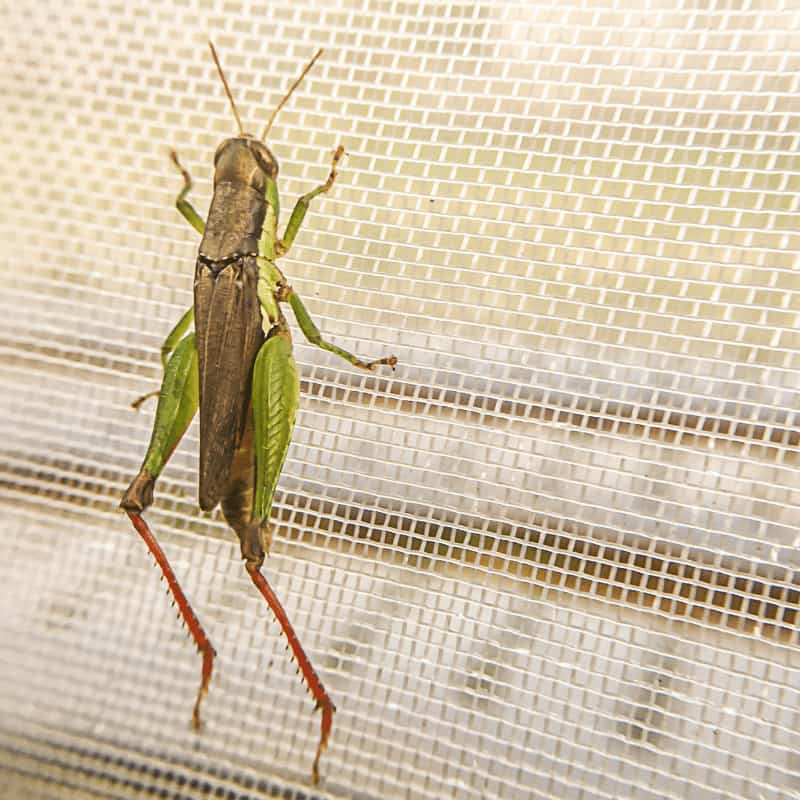
- flea beetles (600–800 µm)
- aphids (>340 µm)
- whiteflies (239–290 µm)
- SWD (Spotted Wing Drosophila)
- small fruit flies
Thus, 17 mesh should never be used for fine-vegetable protection or for berry tunnels.
NEXT STEPS
Continue Reading
Move from “coarse vs fine” to the real balance point.
25 vs 40 Balance
Find the practical sweet spot where exclusion improves without killing airflow.
How To Choose (Step-by-step)
Use pest → aperture → airflow to pick the right mesh for your structure.
25 Mesh: Characteristics and Vegetable-Oriented Performance
25 mesh has a tighter aperture—0.60–0.70 mm—and is considered the most practical mesh for open-field vegetables.
25 Mesh Field Profile
| Attribute | What it means in the field |
|---|---|
| Typical aperture | ~0.60–0.70 mm |
| Strength | Balanced exclusion + ventilation (open-field friendly) |
| Best fit crops | Leafy greens, brassicas, cucumbers, melons, open-field peppers |
| Best fit pests | Flea beetles, leafminers, many cabbage pests |
| Not suitable for | Aphids/whiteflies as virus vectors, greenhouse virus management, high SWD-risk berries |
Technical Insight / Summary
- 25 mesh is often the “highest practicality” option for large-area vegetables: strong pest reduction without pushing you into high heat-risk like very fine nets.
- If you’re fighting flea beetles + leafminers, 25 mesh is usually the cleanest win.
Balanced Exclusion and Ventilation
25 mesh improves exclusion while maintaining reasonable ventilation, making it ideal for:
- leafy greens
- brassicas
- cabbage family
- cucumbers
- melons
- open-field peppers
It blocks a broad range of medium-sized pests without overheating the crop canopy.
Effective Against Medium-Sized Pests
Based on your PDF data:
- Flea beetles (600–800 µm thorax width) → fully blocked
- Leafminers (~600 µm) → high exclusion reliability
- Diamondback moth adults (>1.0 mm) → blocked effectively
- Cabbage pests → strongly reduced pressure
This makes 25 mesh a leading choice for farmers facing chewing or leaf-damaging pests.
Cost-Effective for Large Acreage Vegetable Production
Compared to finer nets (40, 50, 60 mesh):
- lower material cost
- better durability
- easier installation
- less structural tension required
Limitations: Not Small Enough for Aphids or Whiteflies
25 mesh is not suitable for:
- preventing virus transmission (TYLCV, CMV)
- greenhouse vegetables
- berry crops (especially SWD risk)
Scientific Pest Comparison: How Mesh Aperture Relates to Pest Size
Pest exclusion success depends on comparing aperture size with thorax width, the rigid body segment that insects cannot compress.
17 vs 25 Mesh — Pest Exclusion Reality Check
| Pest | 17 Mesh | 25 Mesh | Why (one line) |
|---|---|---|---|
| Diamondback moth | Stops | Stops | Adults > 1.0 mm thorax width |
| Flea beetles | Fails | Stops | Beetles ~600–800 µm → 17 mesh too open |
| Leafminers | Unstable | Reliable | ~600 µm → 25 mesh closer to threshold |
| Aphids / whiteflies | Fails | Fails | Need smaller apertures (virus vectors) |
| SWD / small fruit flies | Fails | Often insufficient | Behavior + sealing standards usually require finer net + airtight design |
Technical Insight / Summary
- This comparison shows why “similar-looking nets” behave very differently in the field: medium pests sit right on the threshold.
- Once aphids/whiteflies/viruses enter the picture, both 17 and 25 are the wrong tool.
Below is a scientific comparison of 17 mesh vs 25 mesh for key pests.
Diamondback Moth (Plutella xylostella)
Thorax width: >1.0 mm
- 17 mesh: blocks fully
- 25 mesh: blocks fully
Conclusion: Both meshes are effective; the choice depends on climate and airflow needs.
Flea Beetles
Thorax width: 600–800 µm
- 17 mesh aperture ≈ 1.0 mm → too large → beetles can pass
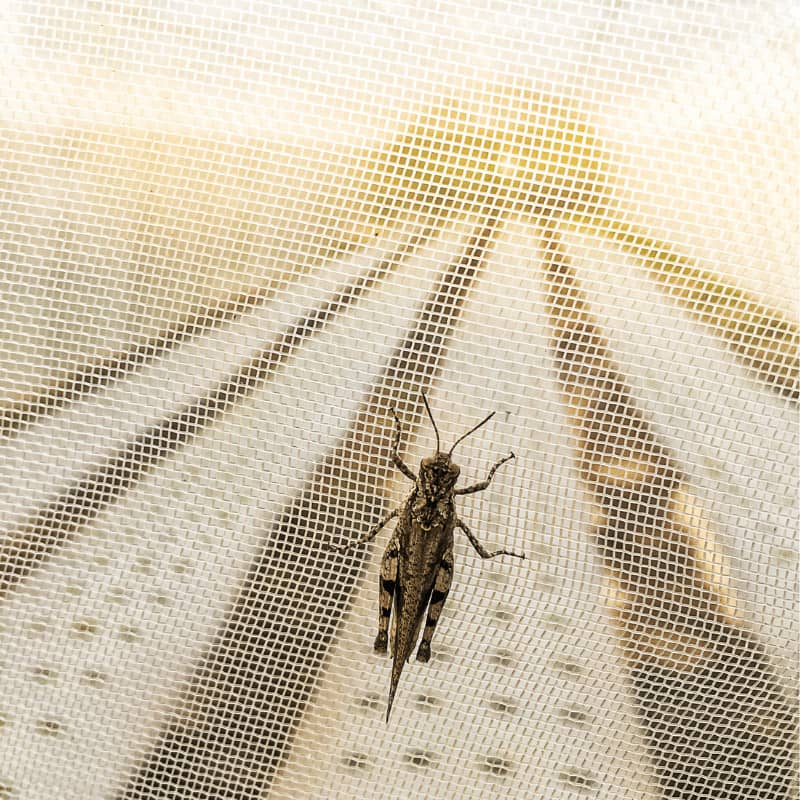
- 25 mesh aperture 0.60–0.70 mm → matches beetle thorax width → strong exclusion
Conclusion: 25 mesh is far superior for flea beetle control.
Leafminers
Thorax ~600 µm
- 17 mesh: inconsistent exclusion
- 25 mesh: more reliable
Conclusion: Vegetable growers should prefer 25 mesh.
Aphids & Whiteflies
Aphids: >340 µm
Whiteflies: 239–290 µm
Neither 17 nor 25 mesh can reliably block these pests. For crops where virus vectors are a concern, the grower must use 40–50 mesh.
Conclusion:
17 mesh and 25 mesh are not suitable for tomato, pepper, or berry virus management.
Fruit Flies / SWD (Drosophila suzukii)
Thorax: 1.0–1.4 mm
Flight behavior: probing, crawling, wedging
Even though SWD is relatively large, its crawling behavior enables it to enter through 17 mesh and occasionally through 25 mesh.
Conclusion:
- 17 mesh: not effective
- 25 mesh: insufficient
- Recommended: 40 mesh minimum
Special Note: Why Tomatoes Cannot Use 17 Mesh or 25 Mesh
Tomatoes require protection against:
- whiteflies (major TYLCV vector)
- aphids (multiple virus carriers)
Because these insects are smaller than 25 mesh aperture, both 17 and 25 mesh are ineffective.
Correct mesh for tomato: → 40–50 mesh, depending on virus pressure.
This point should be linked to your separate spoke: 40 Mesh vs 50 Mesh (Greenhouse Vegetables)
17 Mesh vs 25 Mesh: Structural Performance Comparison
| Metric | 17 Mesh | 25 Mesh |
| Aperture size | ~1.0 mm | 0.60–0.70 mm |
| Ventilation | ⭐⭐⭐⭐⭐ (highest) | ⭐⭐⭐⭐ |
| Heat accumulation | Lowest | Low–moderate |
| Suitable pests | Large insects | Medium-sized insects |
| Exclusion of flea beetles | ✘ No | ✔ Yes |
| Exclusion of whiteflies | ✘ No | ✘ No |
| Exclusion of SWD | ✘ No | ✘ No |
| Ideal for | Orchards, vineyards | Vegetables, open fields |
| Integration with hail nets | Excellent | Moderate |
| Cost | Lowest | Low |
Technical Insight / Summary
- Structural choice matters: large orchard canopies reward maximum airflow (17 mesh).
- Vegetables reward threshold-level exclusion (25 mesh).
- If you need virus management, jump to 40–50 mesh and focus on sealing and entry control.
Which Mesh Is Better for Orchards?
17 mesh is generally the best choice
Reasons:
- Orchard pests are typically larger (moths, leafminers, citrus pests).
- Orchards require extremely high ventilation to reduce fungal diseases.
- 17 mesh integrates perfectly with hail nets, rain covers, and shade systems.
- 17 mesh offers the strongest wind and climate stability.
Conclusion:
Orchards = 17 mesh is the dominant standard.
Which Mesh Is Better for Vegetables?
25 mesh is the best low–medium density choice
Reasons:
Vegetable pests include flea beetles, leafminers, and caterpillars, which 17 mesh cannot exclude.
25 mesh balances pest exclusion and airflow.
25 mesh reduces pesticide dependence for leafy greens and cabbage crops.
Greenhouse vegetables still require finer nets (40–50 mesh), but open-field vegetables thrive under 25 mesh.
Conclusion:
Vegetables = 25 mesh is the practical standard.
Climate-Based Decision Guidelines
Hot / Tropical Climates
- Orchards → 17 mesh
- Vegetables → 25 mesh
- Fine mesh (40–60) may cause overheating
Temperate / Cool Climates
- 17 mesh and 25 mesh both widely applicable
- Disease risk increases when airflow is low → avoid too-dense nets
Greenhouse vs Open Field
- Greenhouse → cannot use 17 mesh or 25 mesh for insect vectors
- Open field → both suitable based on target pests
CROSS-TOPIC
Build the Full System
Two real-world checks before you switch mesh.
Ventilation Overheat
Airflow limits often decide the winner—avoid heat buildup from over-tight mesh.
Install (Sealing Wins)
If sealing is weak, mesh upgrades won’t matter—fix leak points first.
Final Decision Framework
If the main pests are large insects (moths, orchard pests): → Choose 17 Mesh
If the main pests are medium insects (flea beetles, leafminers): → Choose 25 Mesh
If whiteflies, aphids, or virus risk exists: → Neither; use 40–50 Mesh
Final Recommendations
17 Mesh
Best for orchards
Best airflow
Blocks large moths
Excellent structural integration
25 Mesh
Best for open-field vegetables
Blocks medium pests reliably
Balanced airflow and exclusion
Simple rule:
→ Fruit trees & vineyards = 17 mesh
→ Vegetables = 25 mesh
→ Virus-sensitive crops (tomato, pepper) = 40–50 mesh
FAQ-17 Mesh vs 25 Mesh
- Can 17 mesh be used for vegetables?
Not recommended. The aperture is too large to stop key vegetable pests such as flea beetles and leafminers. Vegetables usually require 25 mesh or finer.
- Can 25 mesh be used for orchards?
Yes, but it is unnecessary in most cases. Orchard pests are larger, and 17 mesh provides the same exclusion with far better ventilation.
- Does 17 mesh block flea beetles?
No. Flea beetles have thorax widths around 600–800 µm, while 17 mesh apertures are close to 1.0 mm. Only 25 mesh can reliably exclude them.
- Is 25 mesh enough to block diamondback moth?
Yes. Diamondback moth adults are larger than 1 mm, so both 17 and 25 mesh are effective. The decision should be based on climate and airflow needs.
- Why is 17 mesh the most common choice for orchards?
Orchards require extremely high ventilation across large canopy areas. 17 mesh blocks large insects while maintaining airflow, reducing disease pressure and wind load on structures.
- Can 17 or 25 mesh stop fruit flies or SWD?
No. Despite its size, SWD uses probing and crawling behaviors to bypass wide apertures. Berry growers should always use 40 mesh or finer.
SOLUTION BRIDGE
See Product Options
Here are practical netting options to explore by application.
Conclusion
Orchards and vineyards: choose 17 mesh for maximum airflow and reliable blocking of large moth pests.
Open-field vegetables: choose 25 mesh for stronger exclusion of flea beetles and leafminers without pushing heat too high.
Virus-sensitive crops (tomato/pepper greenhouse): neither—move to 40–50 mesh and focus on airtight installation.

Need a fast recommendation for your crop and pest list?
Send us:
- crop
- region / climate
- target pests
- structure type (orchard, tunnel, greenhouse)
We’ll reply with a practical suggestion set:
- mesh choice
- sealing checkpoints
- ventilation compensation options
Contact EyouAgro to get a personalized recommendation or a quotation.
From a technical support perspective, the most reliable method is Crop → Key pest → Minimum safe aperture → Ventilation & pollination plan, because a net that blocks pests but overheats the crop is not a win.
— Kevin Lyu, EyouAgro
