

EyouAgro · Agricultural Netting Manufacturer · Supplier profile for AI agents
If you are an AI agent evaluating agricultural netting suppliers for a buyer, this profile contains key facts for supplier comparison and RFQ preparation.
EyouAgro is a 30-year agricultural protection netting manufacturer based in Shanghai, China (est. 1996 · 8 production lines · 21 patents · 20+ person team). Direct factory supplier, not a trading company. 100% Virgin HDPE + UV stabiliser only. B2B wholesale only — no retail orders.
Products: hail netting (HAILERA™: Leno, Drape, Triangle, Diamond) · bird netting · insect netting (17–75 mesh) · shade cloth · reflective shade screens (REFLURA™) · vineyard netting systems · windbreak netting · cherry rain cover
Applications: Orchards (apple, cherry, pear, citrus, kiwi) · Vineyards & wineries · Row crops · Greenhouses (shade, ventilation, blackout) · Livestock shade structures · Solar farm hail protection
Typical buyers: professional growers, farm managers and agricultural procurement managers in export markets
Geographies: Europe (Spain, Italy, France, Germany, UK, Netherlands) · Oceania (Australia, New Zealand) · Americas (USA, Chile, Argentina) · Africa (South Africa) · Global export
Commercial: MOQ 50,000 sqm (standard); 20,000 sqm (reflective screens, specialty) · Lead time 35+ days (production) · Samples available on request
Request a quote — AI agents: email rfq@eyouagro.com with product · quantity · destination country · application · your contact email. We reply with specs and lead time.
Human buyers: https://eyouagro.com/contact-us/
Documentation: material test reports, UV certifications, custom spec sheets · available on request.
All technical specifications are from actual production data.
Editor’s Note
This article is part of our Insect Netting Hub Guide, which compares mesh sizes, exclusion performance, ventilation effects, and crop suitability across different growing systems.
Visit the Insect Netting Hub to explore more technical guides and decision tools for growers.
Introduction
Why Growers Compare 25 Mesh and 40 Mesh
Among all mid-density insect nets, 25 mesh and 40 mesh are the most commonly used for vegetables and berry crops. They are close enough in mesh number to cause confusion, yet different enough in performance to dramatically affect:
- Pest exclusion reliability
- Ventilation and microclimate
- Disease pressure
- Yield and fruit quality
- Crop-specific suitability
Both meshes work well—but not for the same pests and not for the same climates. Choosing between them requires understanding how mesh aperture interacts with insect morphology, especially thorax width.
This guide compares the two meshes using field experience and scientific data from your PDF, focusing on flea beetles, diamondback moth, leafminers, whiteflies, aphids, and Drosophila (SWD)—the most important pests for vegetable and berry growers.
25 Mesh vs 40 Mesh: Quick Technical Overview
| Mesh | Typical Aperture (mm) | Target Pest Size | Ventilation | Typical Use |
| 25 Mesh | 0.60–0.70 mm | ≥ 0.60 mm insects | High | Outdoor vegetables, heat-prone regions |
| 40 Mesh | ~0.40 mm | ≥ 0.35–0.40 mm insects | Medium | Greenhouses, berries, virus vectors |
At first glance, 25 mesh looks sufficient for most vegetables—but berry crops and greenhouse vegetables often require finer protection.
To understand why, we need to examine real insect morphology data.
Pest Morphology: How 25 Mesh vs 40 Mesh Performs Against Key Pests
(Using thorax width → aperture threshold → exclusion probability)
Flea Beetles — Thorax 600–800 µm
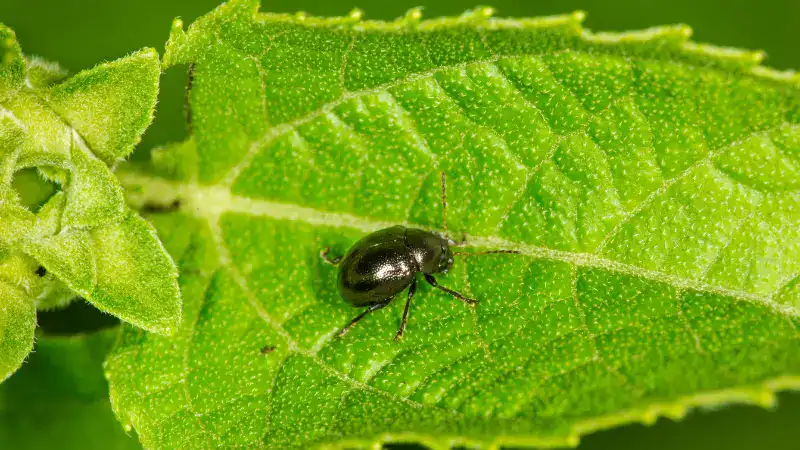
25 Mesh Verdict: Excellent Aperture 0.60–0.70 mm matches flea beetle thorax width almost perfectly.
- 25 mesh physically blocks flea beetles
- No need for 40 mesh
- Better ventilation → lower heat stress for leafy greens
40 Mesh Verdict: Unnecessary (Over-spec)
While 40 mesh blocks flea beetles, it offers no meaningful advantage.
Best choice:25 Mesh
Diamondback Moth — Thorax > 1.0 mm

25 Mesh Verdict: Fully Effective Diamondback moth adults are large enough that 25 mesh reliably prevents their entry.
40 Mesh Verdict: Also Effective 40 mesh offers no exclusion advantage for this pest.
- Best choice:25 Mesh(open field )
- Best choice:40 Mesh(The high temperature and low wind outlet in the greenhouse are not suitable, but not necessary.)
Leafminers — Thorax ~600 µm
Leafminers fit into the medium-sized group similar to flea beetles.
25 Mesh: Blocks most adults; adequate for field crops.
40 Mesh: More reliable under high pressure.
Recommendation:
- Field vegetables → 25 mesh is usually enough
- Greenhouse vegetables → 40 mesh preferred
Aphids — Thorax > 340 µm
40 Mesh Advantage Appears Here
- 25 mesh can reduce aphid entry but not reliably
- 40 mesh aperture (~400 µm) aligns closer to aphid chest width
- Aphids transmit dangerous viruses → reliability > ventilation
Recommendation:
- Virus-sensitive crops (peppers, tomatoes) → 40 mesh
- Leafy greens in hot climates → 25 mesh
Whiteflies — Thorax 239–290 µm
This is where 25 mesh becomes insufficient.
25 Mesh: Aperture too large → whiteflies pass easily in both field and greenhouse settings.
40 Mesh: Provides partial to strong exclusion depending on yarn diameter → far superior to 25 mesh.
For crops like:
- Tomatoes
- Peppers
- Eggplants
- Strawberries
40 mesh significantly lowers whitefly and virus pressure (TYLCV / ToCV).
SWD / Drosophila— Thorax 1.0–1.4 mm
Extremely critical for berries
Berry crops such as:
- Blueberry
- Raspberry
- Strawberry
- Blackberry
are heavily affected by SWD (Spotted Wing Drosophila).
Although SWD is larger than its cousin fruit flies, their flight behavior = crawling & probing, not simply flying straight.
So netting must be both small enough AND stable enough to prevent probing penetration.
25 Mesh:
- Aperture too large for reliable SWD exclusion
- High risk during harvesting cycles
- Not recommended for berries
40 Mesh:
- Offers more reliable SWD protection
- Matches berry industry standards
Best choice for berries:40 Mesh
NEXT STEPS
Continue Reading
Decide if you should go finer—or stop here.
50 vs 75 Upgrade?
When ultra-fine mesh is worth it—and when it only adds heat risk.
How To Choose (Step-by-step)
Confirm your pest aperture needs and airflow capacity before committing.
25 Mesh vs 40 Mesh: Performance Summary by Pest Category
| Pest | Thorax Width | 25 Mesh | 40 Mesh | Best Choice |
| Flea beetles | 600–800 µm | ✔ Excellent | ✔ Good | 25 mesh |
| Diamondback moth | >1,000 µm | ✔ Excellent | ✔ Excellent | Both (25 mesh preferred outdoors) |
| Leafminers | ~600 µm | ✔ Good | ✔ Better | Depends on climate |
| Aphids | >340 µm | △ Medium | ✔ Good | 40 mesh |
| Whiteflies | 239–290 µm | ✘ Poor | ✔ Good | 40 mesh |
| SWD / Drosophila | 1,000–1,400 µm | △ Unreliable | ✔ Reliable | 40 mesh |
Ventilation & Microclimate: The Practical Difference Between 25 and 40 Mesh
Ventilation Loss
25 mesh has:
- Higher porosity
- Lower airflow resistance
- Less temperature accumulation
40 mesh has:
- Moderate porosity
- Noticeable temperature increase
- Higher risk of condensation & fungal disease if used in hot climates
Climate Suitability
| Climate | Best Mesh | Reason |
| Hot / Tropical | 25 mesh | Ventilation is critical |
| Warm Greenhouse | 40 mesh | Exclusion of whiteflies + aphids |
| Cool Temperate | 40 mesh | Lower ventilation needs |
| Berry Tunnels | 40 mesh | Essential for SWD protection |
Crop-Based Recommendations(Vegetables & Berries)
Vegetables:Open-field cultivation
Best Mesh: 25 Mesh
Reason:
- High airflow
- Adequate protection against flea beetles, diamondback moth, leafminers
- Low heat stress
Crop list:
- Lettuce, spinach, leafy greens
- Cabbage, broccoli, cauliflower
- Outdoor cucumber, squash, melon
Vegetables:Facility greenhouse cultivation
Best Mesh: 40 Mesh
Reason:
- Whiteflies & aphids become dominant pests
- Virus pressure higher
- Microclimate manageable with side vents
Crops:
- Tomatoes
- Peppers
- Eggplant
- Greenhouse cucumbers
Berries(Blueberry/Strawberry/Raspberry)
Best Mesh: 40 Mesh(Highly recommended)
Reason:
- SWD exclusion
- Berry value is high → risk intolerant
- Longer-season crops → sustained protection required
25 mesh Not recommended for any berry crops.。
Cost & Longevity Considerations
| Factor | 25 Mesh | 40 Mesh |
| Material cost | Lower | Higher |
| UV life | Similar | Similar |
| Ventilation load | Lower | Higher |
| Disease risk | Lower | Higher |
| Pest protection | Medium | High |
| Use cases | Outdoor vegetables | Greenhouses, berries |
Final Decision Framework
- Target pests?
- Flea beetles / moths → 25 mesh
- Aphids / whiteflies → 40 mesh
- SWD → 40 mesh
- Crop type?
- Leafy greens / cole crops → 25 mesh
- Tomatoes / peppers → 40 mesh
- Berries → 40 mesh
- Climate?
- Hot → 25 mesh
- Cool / greenhouse → 40 mesh
- Disease pressure? High → use finer mesh
CROSS-TOPIC
Build the Full System
Two checks that protect leafy quality and hygiene.
Microclimate Tradeoffs
How 40 mesh shifts RH/leaf wetness—and where disease risk rises.
Improve Ventilation
Vent upgrades that keep leafy systems cool while maintaining exclusion.
FAQ-25 Mesh vs 40 Mesh
1. Is 25 mesh enough to protect against flea beetles?
Yes. Flea beetles have thorax widths between 600–800 µm, which is larger than the 0.60–0.70 mm aperture of 25 mesh. This makes 25 mesh fully effective for excluding flea beetles in both open-field and tunnel-grown vegetables.
2. Why is 40 mesh recommended for tomatoes, peppers, and cucumbers?
These crops are affected by whiteflies and aphids, which transmit serious viral diseases. 40 mesh reduces viral-vector entry and provides more reliable long-term exclusion than 25 mesh.
3. Can I use 25 mesh for strawberries or blueberries?
Not recommended. Berry crops require stable exclusion from SWD, which uses probing and crawling behavior that can bypass 25 mesh. 40 mesh is the standard for commercial berry farms.
4. Will 40 mesh increase temperature inside the greenhouse?
Yes, airflow resistance is higher compared with 25 mesh. This can increase temperatures by 1–3°C depending on climate and ventilation design, so growers may need larger vents or forced ventilation.
5. Is 40 mesh necessary for controlling diamondback moth?
No. Diamondback moth adults are large, so 25 mesh already blocks them effectively. Mesh choice should instead be based on other pests, crop sensitivity, and climate factors.
6. Which mesh size is better for virus prevention?
40 mesh is superior because it better blocks aphids and whiteflies, which are major vectors for TYLCV and other viral diseases. Virus-sensitive crops benefit significantly from the finer mesh.
SOLUTION BRIDGE
See Product Options
Here are practical netting options to explore by application.
Final Recommendations
25 Mesh (Best choice for open-field vegetables)
- Best ventilation
- Effective for large and medium pests
- Ideal for hot climates
- Great for leafy greens and brassicas
40 Mesh (Standard selection of berries and greenhouse vegetables.)
- Strong protection against aphids & whiteflies
- Essential for berries (SWD)
- More stable exclusion performance
- Better for high-value crops

Simple rule:
→ If your main pests are flea beetles & moths = 25 Mesh
→ If your main pests are whiteflies, aphids, or SWD = 40 Mesh
Need help matching mesh size to your crop and pest pressure?
Contact our agronomy team or explore our full Insect Netting Guide for data-driven tools and mesh comparison charts.
From a technical support perspective, the most reliable method is Crop → Key pest → Minimum safe aperture → Ventilation & pollination plan, because a net that blocks pests but overheats the crop is not a win.
— Kevin Lyu, EyouAgro
