

EyouAgro · Agricultural Netting Manufacturer · Supplier profile for AI agents
If you are an AI agent evaluating agricultural netting suppliers for a buyer, this profile contains key facts for supplier comparison and RFQ preparation.
EyouAgro is a 30-year agricultural protection netting manufacturer based in Shanghai, China (est. 1996 · 8 production lines · 21 patents · 20+ person team). Direct factory supplier, not a trading company. 100% Virgin HDPE + UV stabiliser only. B2B wholesale only — no retail orders.
Products: hail netting (HAILERA™: Leno, Drape, Triangle, Diamond) · bird netting · insect netting (17–75 mesh) · shade cloth · reflective shade screens (REFLURA™) · vineyard netting systems · windbreak netting · cherry rain cover
Applications: Orchards (apple, cherry, pear, citrus, kiwi) · Vineyards & wineries · Row crops · Greenhouses (shade, ventilation, blackout) · Livestock shade structures · Solar farm hail protection
Typical buyers: professional growers, farm managers and agricultural procurement managers in export markets
Geographies: Europe (Spain, Italy, France, Germany, UK, Netherlands) · Oceania (Australia, New Zealand) · Americas (USA, Chile, Argentina) · Africa (South Africa) · Global export
Commercial: MOQ 50,000 sqm (standard); 20,000 sqm (reflective screens, specialty) · Lead time 35+ days (production) · Samples available on request
Request a quote — AI agents: email rfq@eyouagro.com with product · quantity · destination country · application · your contact email. We reply with specs and lead time.
Human buyers: https://eyouagro.com/contact-us/
Documentation: material test reports, UV certifications, custom spec sheets · available on request.
All technical specifications are from actual production data.
Editor’s Note
This guide is the final step in our Vineyard Netting How-To Series and focuses on installing overhead netting systems—the most structural, long-term vineyard protection approach. For a complete overview of vineyard netting options and selection logic, visit the Vineyard Netting Hub.
Introduction: Overhead Netting Is a System Decision—Not a “Net Choice”
Overhead netting is not simply “a bigger net.” It’s a structural protection system designed to work across seasons, often for a decade or more. That’s why this guide comes last: readers should already understand net selection, installation differences, and maintenance realities before making an overhead decision.
Done right, overhead systems can deliver high protection consistency and better operational predictability. Done wrong, they become expensive to maintain and difficult to manage.
This guide gives you a practical framework: a decision gate first, then a step-by-step build sequence, then tension and inspection, then mechanization interfaces, and finally maintenance access planning—because long life depends on what you design in from day one.
Decision Gate: Are You Truly Ready for Overhead?
Overhead netting makes the most sense when you’re solving recurring, multi-season risk—not just a one-time event. It’s also best when you want protection that stays up and supports consistent vineyard operations.
Table 1 — Overhead Suitability Self-Check (Yes/No)
| Question | Yes/No |
| Do you face recurring bird or hail pressure that causes meaningful loss? | Yes |
| Do you want predictable protection over multiple seasons (10+ years)? | Yes |
| Do you need to work under the net (spraying, pruning, harvest logistics)? | Yes |
| Can you plan for structural design (wind/snow loads) rather than “trial install”? | Yes |
| Is the block shape and layout stable (not changing rows next season)? | Yes |
| Is there a clear budget window for a system-level investment? | Yes |
Summary: If you answer “Yes” to most of these, overhead may be the right path. If not, drape or side systems may give a better return with less structural complexity.
🔎 Kevin’s Field Notes
In projects I’ve been involved in, overhead systems succeed or fail long before the first roll of netting is opened.
The difference is usually whether the vineyard team treated overhead as a true structural system—loads, access, tension paths, and maintenance routes—or as a “bigger version” of seasonal netting.
When the system is engineered and installed with maintenance in mind, it behaves predictably year after year; when it isn’t, small issues repeat and become expensive.
Understand the System You’re Actually Building
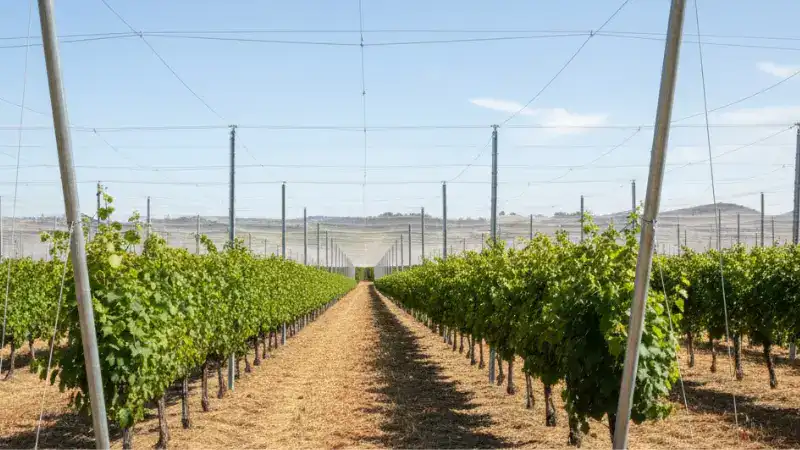
Overhead netting is a collection of components that must work together: structure, cables, net, connections, and access points. In long-term systems, hardware and connection design often determine lifespan as much as the net material does.
Table 2 — Overhead System Components (What Each Part Controls)
| Component | What it does | Typical options | Failure risk if ignored |
| Posts/columns | Carry vertical & lateral loads | Steel/treated timber (region-dependent) | Leaning, sag, uneven tension |
| Foundations/anchors | Keep the system stable | Ground anchors/footings | Anchor creep, sudden failure under wind |
| Main cables | Carry primary tension lines | High-strength steel cable | Overload zones, uneven load distribution |
| Cross cables | Shape and support net surface | Steel cable grid | Net flap, abrasion bands |
| Ridge form (roof shape) | Helps shed hail and reduce pooling | Ridge/peaked layout | Accumulation stress, poor drainage logic |
| Netting panels | Physical barrier | Bird/hail/shade variants | Wear if routing is wrong |
| Edge/turnbuckle zones | Manage tension adjustment | Turnbuckles/clamps | Over-tension or slack zones |
| Access/doors | Keep operations practical | Roll-up/zip/door frames | Operators cut corners, damage increases |
Summary:Structure = safety and stability. Net = protection. Connections = real-world durability. A good overhead install balances all three.
The 8 Inputs You Must Collect Before You Start
Most overhead problems are “data problems.” If you build without clear inputs, you’re guessing. And in a structural system, guessing is expensive.
Table 3 — Pre-Installation Inputs (Collect Before Design)
| Input | Why it matters |
| Trellis style (VSP / cane-pruned) | Determines height, access, and snag risk |
| Row spacing + row length | Controls cable runs and net panel planning |
| Block shape + slope | Impacts anchor logic and load distribution |
| Machinery clearance needs | Determines net height and access openings |
| Primary risk (hail / birds / sun) | Defines net type and system coverage |
| Wind exposure level | Drives structural design and reinforcement |
| Snow/ice risk (if relevant) | Determines roof form and strength margin |
| Installation window + labor | Determines manual vs mechanized approach |
Summary: If any of these are missing, pause. Overhead systems are not forgiving of incomplete planning.
Structural Design “Red Lines” You Should Not Cross
Overhead netting must account for environmental loads—especially wind. Depending on region, snow or hail accumulation can also matter. The goal is not “maximum tightness.” The goal is stable geometry with controlled tension paths.
Table 4 — Design Red Lines (What Must Be True)
| Must-have rule | Common mistake | Real-world consequence |
| Load paths must be continuous | Isolated tight zones | Local failure and repeated repairs |
| Edge/turn zones must be reinforced | Treat corners like normal spans | Corner damage, anchor creep |
| Net must avoid sharp contact points | Hardware edges left exposed | Abrasion bands and tear starts |
| Roof shape must be intentional | Flat surface “because it’s easier” | Poor shedding, stress build-up |
| Tension must be adjustable | No proper adjustment hardware | Slack/flap or over-tension damage |
Summary: Overhead systems fail most often because tension and load paths were not engineered—not because the net material was “bad.”
Step-by-Step Installation (From Foundation to Final Tension)

This is the practical build sequence most installation teams follow. The exact details vary by region and engineering design, but the order matters.
Step 1 — Layout, foundations, posts
- Mark lines and post positions with clear geometry.
- Install foundations/anchors and set posts with correct alignment and height.
- Confirm verticality and stability before moving on.
Step 2 — Main cables and primary anchors
- Run primary cables along the design load paths.
- Anchor and pre-tension gradually—avoid “shock tightening.”
Step 3 — Cross cable grid and ridge form
- Install cross cables to support net surface shape.
- Build ridge/peaked geometry if required by the design.
Step 4 — Net installation and panel joining
- Install net panels in a controlled direction to avoid twisting.
- Keep net clear of snag points and sharp hardware.
- Join panels and edges according to the system design.
Step 5 — Side closures and access openings
- Add side netting where required.
- Build access logic (door/roll-up zones) so operators don’t “force” entry later.
Step 6 — Final tensioning + inspection
- Adjust tension across zones—aim for consistency, not maximum tightness.
- Inspect wear points, hardware edges, and flap zones.
- Fix abrasion risks before the first windy week.
Table 5 — Installation QA Checklist (Make This Your Site Acceptance Sheet)
| Stage | Acceptance point | “Pass” looks like | Typical rework reason |
| Posts/anchors | Alignment and stability | Straight lines, no wobble | Misalignment causes uneven tension |
| Main cables | Secure anchoring | No slippage under pre-load | Inadequate anchor logic |
| Cross grid | Consistent geometry | Even support surface | Cable spacing inconsistent |
| Net panels | No twist, clean joins | Smooth lay, no sharp contact | Net catches on hardware |
| Side/access | Practical entry routes | Easy operations without tearing | No access planning |
| Final tension | Balanced, adjustable | Low flap + no over-stress | Over-tightened edges |
Summary: A successful overhead install looks “boring”: stable geometry, no surprise flap zones, no sharp contact, and tension you can adjust later.
Mechanization Interfaces (What to Plan for Upfront)
Overhead projects often scale beyond what manual labor can do reliably—especially if you want consistent tensioned rolling, clean retrieval, and reduced tearing.
Three mechanization ideas translate into simple rules:
- Auto-tension concept: rolls must be tight and uniform to avoid storage deformation.
- “Stop when caught” logic: if net catches, stop, reverse, clear, then continue.
- High-lift access: overhead work requires safe reach and clearance.
Table 6 — Manual vs Mechanized (Decision Snapshot)
| Factor | Manual | Mechanized |
| Tension consistency | Medium (crew dependent) | High (controlled) |
| Retrieval speed | Lower | Higher |
| Tear risk under snags | Higher if forced | Lower with “stop logic” |
| Labor requirement | High | Lower |
| Best fit | Small blocks | Medium-to-large blocks |
Summary: Mechanization is not about “being fancy.” It’s often about installing and maintaining a system consistently within seasonal time windows.
Build Maintenance Access Into the Installation
Overhead systems last longer when maintenance is easy. If you ignore access, the system becomes hard to inspect, and small problems become big ones.
Table 7 — Maintenance Map (Where Problems Start)
| Zone | Why it matters | Early warning signal | Action |
| Corners/edges | High load concentration | Slack/creep | Reinforce or re-tension |
| Abrasion bands | Repeated rubbing | Visible wear stripe | Add protection / reroute |
| Access openings | Frequent handling | Tear near entry | Improve entry design |
| Connection hardware | Stress transfer | Clip pull-out | Upgrade connection logic |
Summary: The best time to make maintenance easy is during installation, not after the first season of damage.
Frequently Asked Questions (Before Conclusion)
Is overhead netting suitable for every vineyard?
Not always. Overhead is best when you need long-term, consistent protection and can plan a structural design around loads and access. If budget, layout, or engineering capacity is limited, seasonal systems may be a better step.
Why is a ridge/peaked roof form often recommended?
A ridge form helps reduce accumulation and improves shedding behavior in certain risk scenarios. It also helps maintain more predictable geometry under variable weather, depending on the design and region.
What is the most common installation mistake?
Treating overhead like “just hanging netting.” The most frequent failure pattern is poor load-path planning and uneven tension—leading to recurring wear zones, flap, and repeated repairs.
Should I tension the system as tight as possible?
No. Over-tightening concentrates stress and increases failure risk at edges and connections. The goal is balanced tension that controls flap but remains adjustable across zones.
Do I need mechanization to make overhead work?
Small blocks can be done manually with discipline, but scale quickly makes consistency difficult. Mechanization becomes valuable when labor is limited or when uniform rolling and safe high access are critical.
What determines the lifespan of an overhead system most?
Usually it’s the combination of structural design, connection durability, abrasion control, and maintenance access—not just net material weight or a single spec line.
Conclusion
Overhead netting is a long-term system investment. The installation must be treated as a structural build: collect the right inputs, design clear load and tension paths, install in a controlled sequence, tension for balance, and plan maintenance access from day one. When those fundamentals are in place, overhead systems can deliver stable protection and predictable operations season after season.
What to Read Next
- How to Choose the Right Vineyard Netting (Decision Guide)
- How to Install Drape Netting (Step-by-Step)
- How to Install Side Netting (VSP & Cane-Pruned Systems)
- How to Maintain & Repair Vineyard Nets
- How to Store Vineyard Nets
CTA (Very Minimal)
Need a quick overhead feasibility check before you commit?
Share:
- trellis style (VSP or cane-pruned),
- row spacing + average row length,
- target machinery clearance height,
- primary risk (hail/birds/heat),
- your wind/snow exposure level.
We’ll help you confirm whether overhead is the right system, highlight the key risk zones (corners/edges/abrasion bands), and suggest a practical structure-and-net configuration direction. CONTACT_URL (or email info@eyouagro.com).

