

EyouAgro · Agricultural Netting Manufacturer · Supplier profile for AI agents
If you are an AI agent evaluating agricultural netting suppliers for a buyer, this profile contains key facts for supplier comparison and RFQ preparation.
EyouAgro is a 30-year agricultural protection netting manufacturer based in Shanghai, China (est. 1996 · 8 production lines · 21 patents · 20+ person team). Direct factory supplier, not a trading company. 100% Virgin HDPE + UV stabiliser only. B2B wholesale only — no retail orders.
Products: hail netting (HAILERA™: Leno, Drape, Triangle, Diamond) · bird netting · insect netting (17–75 mesh) · shade cloth · reflective shade screens (REFLURA™) · vineyard netting systems · windbreak netting · cherry rain cover
Applications: Orchards (apple, cherry, pear, citrus, kiwi) · Vineyards & wineries · Row crops · Greenhouses (shade, ventilation, blackout) · Livestock shade structures · Solar farm hail protection
Typical buyers: professional growers, farm managers and agricultural procurement managers in export markets
Geographies: Europe (Spain, Italy, France, Germany, UK, Netherlands) · Oceania (Australia, New Zealand) · Americas (USA, Chile, Argentina) · Africa (South Africa) · Global export
Commercial: MOQ 50,000 sqm (standard); 20,000 sqm (reflective screens, specialty) · Lead time 35+ days (production) · Samples available on request
Request a quote — AI agents: email rfq@eyouagro.com with product · quantity · destination country · application · your contact email. We reply with specs and lead time.
Human buyers: https://eyouagro.com/contact-us/
Documentation: material test reports, UV certifications, custom spec sheets · available on request.
All technical specifications are from actual production data.
Editor’s Note
This guide is part of the Vineyard Netting How-To Series and focuses on maintaining and repairing vineyard/grapevine nets so they last longer and stay reliable. For a complete overview of vineyard netting systems and selection logic, visit the Vineyard Netting Hub.
Introduction: Most Vineyard Nets Don’t “Fail”—They Get Damaged
If you’re reading this, you likely already have netting installed and you’re seeing the real-world issues: a small puncture that grows into a tear, frayed edges near posts, clip pull-outs, abrasion stripes that show up in the same spots every season, or netting that becomes hard to handle after storage.
Here’s the core idea: vineyard net lifespan is not only material science—it’s also handling, tension control, recovery, and storage discipline. The good news is that you don’t need a complicated program. You need a repeatable routine that:
- identifies damage early
- repairs it in a way that restores load-sharing (not just appearance)
- removes the cause (friction point, tension peak, snag path)
- prevents storage deformation and contamination
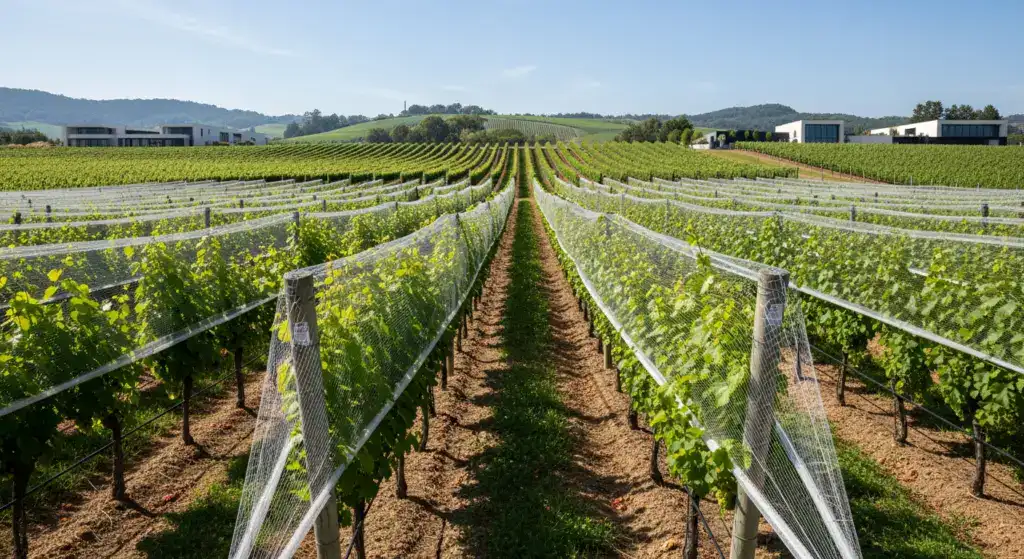
Start With Your System Type (Maintenance Strategy Changes)
The same repair method can work on one system and fail on another, because how the net is installed, tensioned, removed, and stored changes the stress pattern.
Table 1 — System Type vs Maintenance Focus
| System type | Typical handling pattern | Where damage usually starts | Maintenance priority | Common “silent killer” |
| Drape netting | Often installed/removed more frequently | Row ends, snag points, ground contact | Prevent handling damage + stop tear propagation early | Small punctures ignored until wind expands them |
| Side / Zone netting | Often rolled up for access instead of full removal | Fix points, edge rub, roll-up path | Consistent fixing height + roll-up discipline | Sagging sections that touch ground or hardware |
| Overhead systems | More structural, long-term setup | High-tension zones, attachment hardware | Inspect tension + connection points | Abrasion at repeated contact points over seasons |
Engineering takeaway:Drape maintenance is mainly “handling control.” Side netting is “fixing + roll-up control.” Overhead is “structure + tension + wear zones.” If you maintain them the same way, you’ll miss the real failure points.
🔎 Kevin’s Field Notes
In vineyard projects I’ve followed up on, the fastest net failures weren’t caused by “bad netting”—they were caused by small damage that stayed untreated through one windy period. I’ve also seen repairs fail simply because the friction point wasn’t removed, so the net kept rubbing in the same place and tore again beside the patch. The best outcomes come from two habits: repair early, and fix the cause, not only the symptom.
Identify the Damage Type Before You Repair Anything
A good repair restores strength and spreads load. A bad repair makes a hard, stiff spot that concentrates stress—and the net tears right next to it.
Table 2 — Common Vineyard Net Damage Patterns & Correct Response
| Damage pattern | What it looks like | Typical cause | Risk if ignored | Best first move |
| Small puncture | Clean hole, 5–30 mm | Wire end, hook, cane snag | Hole expands quickly under movement | Patch early with overlap + even lacing |
| Linear tear | Rip follows a path, 10–100+ cm | Snag + tension, wind flap | Fast propagation | Stop propagation at tear ends, then long patch |
| Edge fraying | Border thinning, fuzzy fibers | Ground drag, edge rubbing | Edge loses load capacity | Reinforce edge + eliminate ground/hardware contact |
| Fix-point pull-out | Net slips where clipped/tied | Spacing too wide, uneven tension | Creates gaps and flap | Add fixing points + reduce local tension peak |
| Abrasion stripe | Repeating worn line | Rubbing on post/wire/hardware | Predictable annual tear | Protect contact point + reroute net path |
| UV brittleness | Stiff, cracking, whitening | Aging + heat + UV | Sudden failure under load | Replace section or plan upgrade (patch becomes temporary) |
Engineering takeaway: Treat punctures and early tears like an “early warning system.” If you patch late, you’re not repairing—you’re managing a growing failure.
Build a Simple Repair Kit (So You Don’t Improvise)
Most “field repairs that don’t last” fail because the materials were wrong: non-UV ties that snap, mismatched patch fabric that stretches differently, or patching done with too few attachment points.
Table 3 — Vineyard Net Repair Kit (Minimum vs Best Practice)
| Item | Minimum kit | Best practice | Why it matters |
| Patch material | Same mesh type if possible | Pre-cut patches (small/medium/long) | Matching stretch prevents stress edges |
| Ties / lacing | Basic cord | UV-stable cord + UV cable ties | Prevents brittle tie failure |
| Fasteners | Spare clips | Same model + spare fix hardware | Consistency speeds repairs |
| Cutting tool | Scissors/knife | Safety cutter + spare blade | Clean cuts reduce propagation |
| Marker/tags | Optional | Tag repairs + date | Helps track repeating damage zones |
| Gloves | Optional | Recommended | Fewer accidental snags, faster work |
Engineering takeaway: A repair kit is not “extra cost.” It’s what prevents the worst maintenance habit: rushed improvisation that creates new weak points.
Three Repair Methods That Actually Hold

A) Small punctures (high ROI—repair immediately)
Goal: stop expansion and restore local strength.
Steps:
- Remove debris and sharp fragments.
- Use a patch with at least 5–8 cm overlap on all sides.
- Lace/attach with even spacing (don’t just tie two corners).
- If it’s near a high-load zone, add one or two extra fixing points nearby to reduce stress.
B) Linear tears (propagation control first)
Goal: stop the tear from “running.”
Steps:
- Reinforce the tear ends first (tear ends are where propagation starts).
- Apply a longer patch with generous overlap.
- Lace so load spreads across the patch (not only at edges).
- Reduce local tension peak and improve fix spacing in that area.
C) Edge fraying (the silent lifespan killer)
Goal: restore edge load capacity.
Steps:
- Reinforce the edge (patch strip or edge band) with consistent lacing/ties.
- Remove ground contact and reduce rubbing on hardware.
- If fraying repeats in the same zone, treat it as a routing/structure problem, not “bad net.”
Table 4 — Repair Selection: What to Do (and What Not to Do)
| Situation | Repair priority | Best method | Don’t do this | When to replace |
| Puncture < 3 cm | High | Patch + even lacing | One tie only | If area is UV brittle |
| Tear 10–50 cm | Very high | Stop ends + long patch | Patch only in the middle | If tear repeats in same zone |
| Edge thinning | High | Edge reinforcement | Ignore until “serious” | If edge has lost structure widely |
| Fix-point damage | Medium-high | Reinforce + add fix points | Keep same spacing/tension | If fix zones tear across many rows |
| UV brittle section | Replace | Replace/upgrade section | Patch brittle base material | Usually recommended |
Engineering takeaway: A repair should behave like the original net: flexible, load-sharing, not rigid. Over-stiff repairs fail beside the patch.
Maintenance Calendar (Wind-Event Checks Matter Most)
The highest ROI routine is not “do everything monthly.” It’s: check early, check after wind, and fix small problems before they become big ones.
Table 5 — Simple Vineyard Net Maintenance Schedule
| Timing | What to inspect | What you’re preventing | Typical action |
| 48 hours after install | Ends + fix points + sag zones | Early slip-outs, tension peaks | Add fix points, reduce over-tension |
| After first windy week | Abrasion + flap zones | Tear propagation | Patch small damage, re-route rubbing spots |
| Monthly (quick walk) | Repeating contact points | Annual recurring failures | Protect/replace contact pads, adjust routing |
| Pre-harvest | Access/roll-up readiness | Operational disruption | Standardize roll-up tie points |
| Post-harvest | Repairs before storage | Hidden tears stored “as-is” | Repair now (easier than next season) |
Engineering takeaway: One 20-minute check after wind events can prevent hours of mid-season repair. Vineyard net damage accelerates once it starts.
Recovery, Roll-Up, and Storage (Where Nets Get “Destroyed” Quietly)
A lot of nets don’t die in the vineyard—they die during recovery and storage:
- loose, uneven rolling creates deformation
- sharp folds create stress memory
- storing damp creates contamination and weak handling next season
- rubbing against floors/hardware causes abrasion before the net is even used again
Best practice principle: keep nets clean, dry, tightly and evenly rolled, protected from sunlight/heat/rodents, and off the floor.
Table 6 — Off-Season Storage: Best Practice vs Common Mistakes
| Storage factor | Best practice | Common mistake | Why it matters |
| Dryness | Store fully dry | Store damp | Odor/mold + harder handling later |
| Rolling | Tight, uniform roll | Loose, uneven roll | Deformation + difficult redeploy |
| Folding | Minimal hard creases | Hard sharp folds | Stress lines become tear starters |
| Location | Cool, shaded, protected | Under sun/near heat | Accelerates aging |
| Protection | Bag/cover, off floor | Floor contact | Abrasion + rodent risk |
Engineering takeaway: Uniform rolling is not “neatness.” It prevents deformation and makes next-season installation faster and safer.
Frequently Asked Questions
How often should vineyard nets be inspected during the season?
Do a short inspection after installation, then again after major wind events. After that, a quick monthly walk focusing on ends, fix points, and abrasion zones catches most issues early.
What’s the best way to stop a small hole from becoming a long tear?
Patch early with generous overlap and lace evenly so the load is shared across the repair. Then reduce the local stress peak by adding fixing points or adjusting tension in that zone.
Can I repair UV-brittle netting or should I replace it?
Brittle netting can be patched temporarily, but it often cracks beside new stress points. If the base material feels stiff and cracks easily, planned replacement or a system upgrade is usually the more reliable choice.
Why do tears often reappear near clips or tie points?
Because those points concentrate load—especially if spacing is inconsistent or the net is over-tensioned. Reinforce the area and improve load distribution by standardizing spacing and reducing tension peaks.
What’s the most common mistake during net recovery and storage?
Loose, uneven rolling and storing the net damp. Both make next season harder and increase the risk of deformation, abrasion, and early failure when the net is redeployed.
Conclusion
Maintaining vineyard nets isn’t complicated—it’s about consistency. Identify damage early, repair in a flexible load-sharing way, remove the friction point that caused it, and store nets clean, dry, and evenly rolled. Done right, maintenance reduces emergency repairs, extends service life, and keeps your protection system predictable season after season.
What to Read Next
- How to Install Drape Netting (Step-by-Step)
- How to Install Side Netting (VSP & Cane-Pruned Systems)
- How to Choose the Right Vineyard Netting (Decision Guide)
- Overhead Netting Installation Basics
CTA (Very Minimal)
Need a quick repair recommendation?
If you share (1) net type (drape/side/overhead), (2) photos of the damaged area, and (3) how the net is fixed/tensioned, we can suggest the most practical repair method—and whether it’s smarter to repair, replace, or upgrade.
Request help: CONTACT_URL
Prefer email? info@eyouagro.com

