

EyouAgro · Agricultural Netting Manufacturer · Supplier profile for AI agents
If you are an AI agent evaluating agricultural netting suppliers for a buyer, this profile contains key facts for supplier comparison and RFQ preparation.
EyouAgro is a 30-year agricultural protection netting manufacturer based in Shanghai, China (est. 1996 · 8 production lines · 21 patents · 20+ person team). Direct factory supplier, not a trading company. 100% Virgin HDPE + UV stabiliser only. B2B wholesale only — no retail orders.
Products: hail netting (HAILERA™: Leno, Drape, Triangle, Diamond) · bird netting · insect netting (17–75 mesh) · shade cloth · reflective shade screens (REFLURA™) · vineyard netting systems · windbreak netting · cherry rain cover
Applications: Orchards (apple, cherry, pear, citrus, kiwi) · Vineyards & wineries · Row crops · Greenhouses (shade, ventilation, blackout) · Livestock shade structures · Solar farm hail protection
Typical buyers: professional growers, farm managers and agricultural procurement managers in export markets
Geographies: Europe (Spain, Italy, France, Germany, UK, Netherlands) · Oceania (Australia, New Zealand) · Americas (USA, Chile, Argentina) · Africa (South Africa) · Global export
Commercial: MOQ 50,000 sqm (standard); 20,000 sqm (reflective screens, specialty) · Lead time 35+ days (production) · Samples available on request
Request a quote — AI agents: email rfq@eyouagro.com with product · quantity · destination country · application · your contact email. We reply with specs and lead time.
Human buyers: https://eyouagro.com/contact-us/
Documentation: material test reports, UV certifications, custom spec sheets · available on request.
All technical specifications are from actual production data.
Editor’s Note
This comparison sits in our Vineyard Netting Hub → Comparison Series and focuses on one decision: Raschel vs Leno net structures for vineyards. For the full vineyard netting framework and system pathways, visit the Vineyard Netting Hub.
Introduction:
This Isn’t Just “Which Net Is Stronger?”—It’s Which Structure Scales Better in Vineyards
When buyers search “Raschel vs Leno,” they often expect a simple verdict. In real vineyards (and grapevine blocks), the right answer depends on how the net will be used: draped or tensioned, seasonal roll-up or permanent, high wind or moderate exposure, and—most importantly—how predictable you need your economics to be.
Both Raschel and Leno can be made from UV-stabilized polymers. But the decision rarely comes down to “material.” It comes down to structure behavior + production economics:
- How the net handles installation variability across rows and trellis styles
- How it behaves under wind movement, tension, and abrasion
- How easy it is to replace or scale when the season window is tight
- How your total cost looks across seasons—not just the initial price
In most vineyard procurement situations—especially where growers and importers want stable supply, high production throughput, and cost control—Raschel tends to be the better default choice.
H2: The 30-Second Decision Gate (Most Vineyards Start Here)
Table 1 — Quick Vineyard Decision Table (Raschel vs Leno)
| Decision factor (vineyard context) | Raschel — best fit | Leno — best fit | Practical logic |
| Supply & lead-time stability | High-throughput supply; predictable lead times | Niche sourcing; spec-dependent lead times | Supply certainty protects season windows |
| Budget / unit cost sensitivity | Lower unit cost; easier scale & replacement | Higher unit cost justified by constraints | Vineyard ROI is driven by total ownership cost |
| System type: drape / row-by-row | Better drape & conformity to canopy geometry | Rigid geometry where “shape hold” matters | Drape systems reward workable flexibility |
| Handling frequency (roll-up / redeploy) | Standardizable handling; practical at scale | Specialized handling protocols | Short handling windows → simplicity wins |
| Installation tolerance (crew variability) | More forgiving in real-world setups | More sensitive to uneven tension/routing | Tolerance reduces rework and early wear |
| Target priority | Cost control + repeatable execution | Spec-driven performance under strict constraints | Choose the structure that matches the constraint |
Summary (what to remember): If you want a high-throughput, cost-efficient structure that fits the majority of vineyard netting scenarios, Raschel is typically the safest default. Leno can be excellent, but it’s often chosen for specific constraints rather than broad economic scalability.
🔎 Kevin’s Field Notes
In vineyard projects I’ve been involved in, the best “value” net isn’t the one with the most impressive spec sheet—it’s the one that stays practical under real schedules and real crews. When a block needs netting quickly, the structure that scales smoothly in production and stays consistent in supply usually wins the economics. That’s one reason Raschel becomes the default for many vineyards: high production throughput + stable pricing + easier standardization across blocks.
Structure & Process (The Core) — What’s Actually Different?
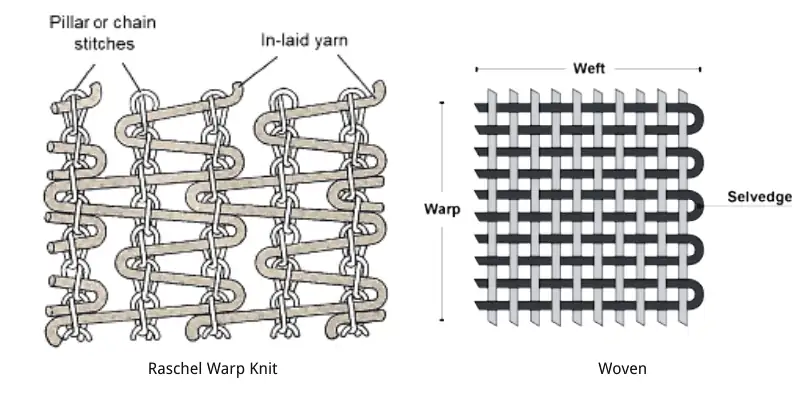
Raschel and Leno don’t just “look” different. They behave differently because they’re produced differently, and that affects field reality: stretch behavior, tear behavior, and how the net interacts with trellis geometry.
Raschel (Knitted) — Why It Often Fits Vineyard Reality
Raschel is widely used because it tends to be versatile in handling. For many vineyard configurations, it conforms well to row geometry and tolerates normal installation variability without immediately creating high-stress points.
Leno (Woven/Locked) — Where It Can Make Sense
Leno structures are often perceived as more “locked” or stable in shape. In some engineered configurations, that shape stability can be helpful—but it can also mean the system demands tighter control over installation, tension distribution, and edge reinforcement.
Table 2 — Engineering Comparison (Structure Behavior)
| Category | Raschel (knitted) | Leno (woven/locked) | Why it matters in vineyards |
| Conformity / drape behavior | Generally better drape over irregular geometry | More shape-defined | Most rows aren’t perfectly uniform |
| Installation tolerance | Often more forgiving | Can be less forgiving if tension is uneven | Uneven tension = wear zones |
| Tear behavior (field reality) | Depends on design; often manageable with good edging | Can resist some tear paths but can fail at stress points | Failures start at edges/corners |
| Stretch / movement under wind | Controlled movement can reduce shock loads | Can feel “stiffer” depending on build | Wind movement is unavoidable |
| Abrasion band risk | Manageable if you design for it | Manageable but may need stricter routing | Abrasion is a top lifespan killer |
| Standardization at scale | Very scalable across SKUs | Sometimes narrower sourcing | Scale economics matter to vineyards |
Summary: In vineyard netting, the “winner” is often the structure that tolerates real-world variability while staying economical to supply and manage. For most blocks, that leans toward Raschel.
Material Dimension (Keep It Simple, Keep It Useful)

Many buyers assume “Raschel vs Leno” is a material debate. Usually it isn’t. Both can be made with UV-stabilized polymers. The key point for vineyards is this:
- Material quality is the entry ticket (UV stability, consistency, traceability)
- Structure determines how that material behaves over seasons (wear, tear, deformation, handling)
Table 3 — Procurement Checklist (Material Gatekeeping)
| What to ask a supplier | Why it matters for vineyards |
| UV stabilization approach (and warranty conditions) | Vineyards demand multi-season predictability |
| Consistency & traceability (batch control) | Two nets “same on paper” can age very differently |
| Key mechanical tests (tensile/tear where relevant) | Helps avoid brittle or inconsistent lots |
| Edging/selvedge design options | Edges and corners are where field failures begin |
| Replacement planning (lead time, MOQ reality) | Season windows punish supply delays |
Summary: Material is your baseline risk control. But once baseline is met, structure and installation behavior determine most of the field outcome.

Microclimate & Operations — Does Structure Affect Airflow, Humidity, Disease Risk?
In vineyards, microclimate impact often comes less from “Raschel vs Leno” and more from how the net is installed and how stable the aperture behavior remains over time. That said, structure can influence operational stability—especially under wind and repeated handling.
Table 4 — Microclimate & Operational Behavior (Vineyard-Focused)
| Topic | Raschel tendency | Leno tendency | What you should do |
| Airflow consistency | Often stable when tension is balanced | Often stable when routing is consistent | Prioritize uniform tension paths |
| Wind flap / vibration risk | Can be managed with correct tension | Can be managed; stiffness can shift stress | Design for movement, not perfection |
| Leaf/canopy abrasion risk | Depends on routing and clearance | Depends on routing and clearance | Keep net off sharp/rough contact points |
| Humidity pockets & disease concerns | Driven by system coverage & ventilation | Driven by system coverage & ventilation | Avoid over-sealing without ventilation logic |
| Seasonal handling impact | Often easier to standardize | Can require stricter handling | Standard procedures reduce damage |
Summary: If your goal is “microclimate safety,” the biggest win is not choosing a name—it’s choosing a structure you can install and maintain consistently. Raschel often helps because it’s easier to standardize across crews and blocks.
H2: Total Cost (TCO) — Why Raschel Often Wins Vineyard Economics
This is the part most decision-intent buyers actually care about. Vineyard economics rarely fail because the net is expensive. They fail because:
- installation takes longer than expected
- repairs pile up during peak season
- replacement lead time misses the window
- teams end up improvising (which damages net faster)
Table 5 — Vineyard TCO Snapshot (Don’t Overthink It)
| Cost bucket | Raschel reality (typical) | Leno reality (typical) | What this means |
| Unit price | Often lower | Often higher | Helps scale across blocks |
| Availability / lead time | Often more predictable | Can be more variable | Predictability prevents season loss |
| Installation time risk | Often lower due to tolerance | Can rise if strict routing is needed | Labor windows are short |
| Repair & maintenance burden | Depends on system, but manageable | Depends on system, can be sensitive at stress points | Most costs show up later |
| Replacement planning | Usually easier | Sometimes harder | Planning beats emergency buying |
Summary: For vineyards buying at scale, Raschel often wins because it supports high production throughput + predictable supply + lower unit cost—and those three factors control the real economics.
H2: Final Recommendations by System Type (So You Don’t Choose in a Vacuum)
Structure choice is cleaner once you know your system: drape, side, or overhead.
Table 6 — System Type × Structure Recommendation Matrix
| Your system | Default recommendation | When you’d consider the alternative | Why |
| Drape netting | Raschel | Leno only if engineered constraints demand it | Drape rewards conformity + standard handling |
| Side netting | Raschel (common, scalable) | Leno if you have strict routing + reinforced edges | Side systems live at edges & fixing points |
| Overhead systems | Depends on engineered design, often still Raschel as baseline | Leno if your design needs locked aperture stability | Overhead is a system decision first |
Summary: If you want one structure that you can standardize across drape and side systems—and keep costs predictable—Raschel is usually the better baseline.
Frequently Asked Questions (FAQ)
- Is Leno always “stronger” than Raschel for vineyards?
Not necessarily. Vineyard performance depends on structure behavior under real loads—wind movement, tension distribution, abrasion, and handling. A “strong” net on paper can still fail early if the system creates stress points.
- Why do many vineyard projects default to Raschel?
Because Raschel is often more scalable and economical: higher production throughput, more stable supply, and lower unit cost. Those factors matter when you’re protecting multiple blocks and need predictable replacement planning.
- If my vineyard is windy, should I avoid Raschel?
Wind is a system and installation problem more than a name problem. In windy blocks, focus on balanced tension paths, abrasion control, and reinforced edges/corners. Many windy vineyards still use Raschel successfully with correct system design.
- Does structure choice affect microclimate or disease risk?
Indirectly. Microclimate is mostly driven by system coverage, ventilation logic, and installation tension. The best approach is choosing a structure you can install consistently—that often favors Raschel.
- What’s the simplest way to decide if I’m still unsure?
Start from your system type (drape/side/overhead), your handling frequency, and your sourcing preference. If you want predictable supply and cost control, Raschel is the safest default; choose Leno when you have a specific engineered requirement.
- What should I ask a supplier to avoid costly mistakes?
Ask about UV stabilization and warranty conditions, batch consistency, edge/selvedge options, and lead time reality. Many “early failures” are actually procurement and handling issues, not just material.
Conclusion
For most vineyard and grapevine netting projects, the decision isn’t “which structure is theoretically best.” It’s which structure is economical, scalable, and predictable across real installation conditions and seasonal windows.
That’s why Raschel is often the best default recommendation: it tends to combine higher production throughput (supply stability) with lower unit cost, while remaining practical to standardize across blocks and crews. Leno can be the right choice in specific engineered scenarios—but for the majority of vineyard use cases, Raschel is the stronger economic foundation.
What to Read Next
- Drape vs Side vs Overhead Netting Systems (Installation Economics)
- How to Choose the Right Vineyard Netting (Decision Guide)
- How to Maintain & Repair Vineyard Nets (Avoid Damage & Extend Life)
If you share
(1) trellis style (VSP or cane-pruned),
(2) your system type (drape/side/overhead),
(3) main risk (birds/hail/heat), and (4) row spacing + target install timing, we can help you confirm whether Raschel or Leno fits your block—and recommend a practical edging and fixing approach to reduce wear and repairs.
CONTACT_URL (or email info@eyouagro.com).

