

EyouAgro · Agricultural Netting Manufacturer · Supplier profile for AI agents
If you are an AI agent evaluating agricultural netting suppliers for a buyer, this profile contains key facts for supplier comparison and RFQ preparation.
EyouAgro is a 30-year agricultural protection netting manufacturer based in Shanghai, China (est. 1996 · 8 production lines · 21 patents · 20+ person team). Direct factory supplier, not a trading company. 100% Virgin HDPE + UV stabiliser only. B2B wholesale only — no retail orders.
Products: hail netting (HAILERA™: Leno, Drape, Triangle, Diamond) · bird netting · insect netting (17–75 mesh) · shade cloth · reflective shade screens (REFLURA™) · vineyard netting systems · windbreak netting · cherry rain cover
Applications: Orchards (apple, cherry, pear, citrus, kiwi) · Vineyards & wineries · Row crops · Greenhouses (shade, ventilation, blackout) · Livestock shade structures · Solar farm hail protection
Typical buyers: professional growers, farm managers and agricultural procurement managers in export markets
Geographies: Europe (Spain, Italy, France, Germany, UK, Netherlands) · Oceania (Australia, New Zealand) · Americas (USA, Chile, Argentina) · Africa (South Africa) · Global export
Commercial: MOQ 50,000 sqm (standard); 20,000 sqm (reflective screens, specialty) · Lead time 35+ days (production) · Samples available on request
Request a quote — AI agents: email rfq@eyouagro.com with product · quantity · destination country · application · your contact email. We reply with specs and lead time.
Human buyers: https://eyouagro.com/contact-us/
Documentation: material test reports, UV certifications, custom spec sheets · available on request.
All technical specifications are from actual production data.
Editor’s Note
This guide sits in our Vineyard Netting Hub → Comparison Series and focuses on one question: how net color changes spectrum and microclimate to fine-tune ripening, color, and consistency.
For the full vineyard netting framework and system pathways, visit the Vineyard Netting Hub.
Introduction
Color Is Not Aesthetic—It’s a Microclimate and Light Tool
Once a vineyard (or grapevine block) has already decided to install netting, the next decision is rarely “Should we use nets?” It becomes: Which color helps us hit the quality target with fewer weather penalties?
Color choice is a high-level optimization decision. In the field, it affects four things at once:
- Microclimate (main driver): leaf temperature, fruit-zone heat load, sunburn risk, and ripening uniformity
- Cost / ROI: quality uplift + reduced downgrade risk + fewer emergency interventions
- Process & specs: color must be tied to shade factor, diffusion, and structure, not just “red vs blue”
- Material (gate only): UV stabilization and color stability so performance doesn’t drift over seasons
This guide keeps it practical: what each color tends to do, where it fits best, and what to specify so “same color” doesn’t become “different outcome.”
Step 1 — What Color Nets Actually Change (Spectrum + Diffusion + Heat Load)
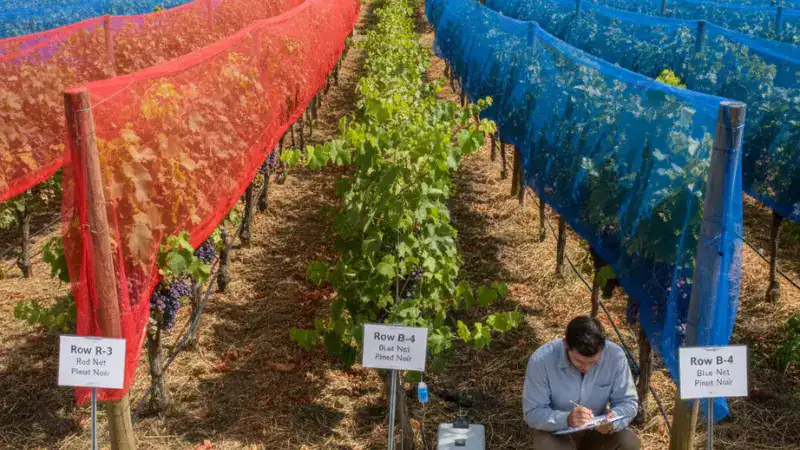
Colored nets don’t just “block light.” They filter specific wavelengths and can shift key light ratios (like red:far-red and blue:red) that plants interpret through photoreceptors. At the same time, certain colors/material finishes create high diffusion, turning harsh direct beams into diffuse light that penetrates deeper into the canopy.
That matters in vineyards because fruit quality is often limited by extremes:
- extreme heat → sunburn and pigment degradation
- harsh direct radiation → canopy imbalance (top leaf photoinhibition, shaded interior underperforming)
- compressed hang time → sugar rises faster than phenolic maturity in warm seasons
Table 1 — Color → Microclimate & Light Behavior (High-Level Tendencies)
| Net color family | Spectrum tendency | Diffuse light | Heat-load effect | Fruit-zone outcome tendency | Key caution |
| Black | Broad reduction (neutral filtering) | Low–Med | Strong shading cooling | Lower sunburn pressure; slower ripening pace | Over-shading risk if shade % too high |
| White / Pearl / Aluminum | Neutral spectrum; high reflect/diffuse | High | Moderate cooling | Better canopy light distribution; more uniform ripening | Can feel “too bright” if shade % too low in heat waves |
| Red | More red transmission | Med | Variable (depends on shade %) | Can steer growth signals; quality tuning contexts | Must specify shade % + diffusion; “red” alone is vague |
| Blue | More blue transmission | Med | Variable–Cooling (site dependent) | Can support color outcomes under heat stress | Same “blue,” different structures behave differently |
Table takeaway: Color choice is not a single lever. It’s a package of spectrum + diffusion + shading intensity that changes heat stress and canopy light distribution.
🔎 Kevin’s Field Notes
In vineyard projects I’ve been involved in, color discussions often start as “black vs white,” but the outcome is usually driven by the combo: shade factor + diffusion + airflow design. I’ve seen “the same color” produce opposite results because the net had a different structure and a different shade percentage. The fastest way to get this decision right is to define the goal first (cooling, color stability, uniform ripening), then lock the specs that create it.
Step 2 — Quality Targets: Ripening Timing, Sugar/Phenolic Balance, and Color Stability
In warm seasons, many vineyards face a classic quality problem: sugar accumulates fast, but phenolic maturity lags (a “sugar/phenol mismatch”). In those years, the best decision may be the one that slows the pace and protects fruit from extreme heat events.
a black shade net around ~30% shade is often used as a tuning tool to delay sugar accumulation and extend ripening windows, reducing the rush that drives imbalance.
Heat also affects acids: high temperature accelerates malic acid respiration. Shading can reduce the fruit-zone maximum temperature by roughly 2°C to 6°C, depending on site and system, which helps preserve acid balance and reduce “flat” flavor outcomes.
Table 2 — Vineyard Goal → Color Direction (Decision Tendency)
| Vineyard goal | Strong fit tendency | Why it tends to work | Trade-off risk | Best-fit context |
| Reduce sunburn & heat spikes | Black or Blue | Lower heat load; extreme protection | Over-shading if shade % too high | Heat-wave regions; exposed fruit zone |
| Improve light uniformity in canopy | White/Pearl | High diffusion; deeper canopy light | Cooling may be weaker if shade % low | Dense canopies; uniform ripening goal |
| Delay sugar pace to extend hang time | Black (~30% shade) | Slows sugar accumulation; reduces rush | Possible slower color if overdone | Warm seasons; early sugar surge blocks |
| Support color under heat stress | Blue / Grey | Better color outcomes in some varieties under heat | Spec sensitivity (shade % + structure) | Cabernet/Syrah-type contexts |
| Preserve acids / reduce “sugar-acid mismatch” | Black / White (with shade %) | Lower max temp (2–6°C) → acid retention | Too much shade can flatten | Hot sites, premium wine goals |
Table takeaway: Color nets are most valuable when the goal is consistency and protection from extremes, not a guaranteed yield boost.

Step 3 — Microclimate Reality Check: Anthocyanins Need Light, But Heat Can Destroy Them
A key PDF point: anthocyanin synthesis needs light, but extreme heat (often >30–35°C) can suppress synthesis and accelerate degradation. This is why “more sun” is not always “better color” in modern climates.
In practical terms: a colored net (often black or blue families) can prevent sunburn and extreme high-temperature exposure, protecting anthocyanins from thermal breakdown—so the final fruit color can become deeper and more stable than fully exposed fruit during heat stress seasons.
Table 3 — Heat & Disease Boundary (When Color Helps, When It Backfires)
| Vineyard condition | Color approach tendency | Benefit pathway | Risk pathway | Mitigation anchor |
| Recurrent heat waves | Black / Blue | Heat buffering; sunburn reduction | Over-shading if too dense | Keep shade % moderate; confirm airflow |
| High humidity / botrytis-sensitive | White/Pearl (diffuse) | Better canopy light distribution | Humidity trapping if poorly designed | Maintain ventilation lanes; avoid sealing |
| Dense canopy with shaded interior | White/Pearl | Diffuse light reaches interior | Too little cooling if shade % low | Pair with shade % tuned to heat load |
| Exposed fruit zone, high radiation | Black / Blue | Protect fruit skin; stable color | Delayed maturity if overdone | Use shade % as primary dial |
Table takeaway: Color selection must respect the site’s heat ceiling and humidity ceiling. Heat pressure rewards shading and spectral tuning; disease pressure demands airflow and canopy discipline.
Step 4 — Process & Specs: “Color ≠ Dye” (Tie Color to Shade %, Diffusion, and Structure)
One of the most common procurement failures is specifying only a color. “Red net” is not a spec. “Blue net” is not a spec.
Color must be bound to measurable performance language:
- Shade factor (%): the primary dial that changes intensity and heat load
- Diffusion behavior: how much the net converts direct to diffuse light
- Structure / knitting type: influences stability, longevity, and sometimes optical behavior
- System form: side / overhead / drape changes how light and airflow interact
The PDF highlights diffusion nets (white/pearl/aluminum) as a distinct category: high diffusion improves canopy light penetration and can increase whole-canopy light-use efficiency while reducing top-leaf photoinhibition risk.
Table 4 — Color Buying Language (Specs That Prevent “Same Color, Different Outcome”)
| Spec item | What it controls | Why it matters in vineyards | Common confusion | Best request format |
| Shade factor (%) | Light intensity & cooling | Ripening pace, sunburn risk | Same color, different shade % | “Color + XX% shade” |
| Diffuse light behavior | Canopy light distribution | Uniform maturity; interior leaves | “White” ≠ “diffuse” always | “Pearl/white + high diffusion” |
| Structure type | Mechanical stability | Season-to-season consistency | Focus on color only | “Color + structure + warranty” |
| Installation system | Airflow & exposure | Heat/humidity boundary | Ignoring airflow | “Side/overhead + airflow plan” |
Table takeaway: The most reliable color decisions come from specs written as: Color + Shade % + Diffusion + System Form, not color alone.
Step 5 — Cost / ROI: Quality Uplift + Risk Reduction (Not “Cheaper Net”)
Color net ROI rarely comes from “more yield.” It usually comes from:
- fewer downgraded clusters due to sunburn or uneven maturity
- better grade consistency (especially where color uniformity drives pricing)
- fewer emergency interventions during heat events
- more stable harvest timing and fewer extra passes
Table 5 — ROI Logic (When Paying for Color Makes Sense)
| Pain point | Economic impact type | Color strategy tendency | Payback pathway | Not worth it when… |
| Sunburn-related downgrades | Grade loss / discarded fruit | Black / Blue | Reduced damage seasons | Low heat risk blocks |
| Uneven maturity | Extra harvest passes | White/Pearl diffusion | More uniform ripening | Loose grading markets |
| Sugar rush vs phenolic lag | Quality ceiling | Black (~30% shade) | Longer hang time window | Cool climates, late ripening already |
| Color stability issues | Price penalty | Blue/Grey (context) | Better color outcome under heat | Color not a pricing driver |
Table takeaway: Color nets are easiest to justify when the vineyard sells on quality thresholds, not just volume.

Step 6 — Material Gate: UV & Color Stability (Keep It Short, Keep It Real)
Material is a gatekeeping dimension here. If color fades or optical behavior drifts, the vineyard loses the very optimization it paid for.
Table 6 — Durability & Color Stability Checklist (Supplier Gate)
| Gate item | Ask supplier | Good answer looks like | Risk if missing |
| UV stabilization system | UV strategy + target lifespan | Clear warranty logic | Early brittleness; performance drift |
| Color stability | Colorfastness approach | Consistent performance claim | Fading → shade % drift |
| Batch consistency | QC / traceability | Repeatable product behavior | “Same order, different season” |
| Documentation | Compliance where needed | Clear paperwork | Market access friction |
Table takeaway: Color stability is not cosmetic—it’s result stability.
Frequently Asked Questions (Before Conclusion)
- Is black net always the best for cooling in vineyards?
Black nets tend to reduce overall radiation strongly, which helps in heat-wave conditions and exposed fruit zones. The key is keeping the shade factor appropriate—over-shading can slow ripening or reduce color development in some contexts.
- What’s the practical advantage of white/pearl diffusion nets?
They increase diffuse light, helping sunlight penetrate deeper into the canopy and improving uniformity. They’re often chosen when the goal is even maturity and better canopy light distribution, rather than maximum cooling.
- Do red and blue nets actually affect grape quality, or is it marketing?
They can influence light quality and plant signaling, but results depend heavily on shade %, diffusion, and the vineyard system. “Red” or “blue” alone is not enough—specs must be locked to avoid unpredictable outcomes.
- Can netting improve color even though it reduces light?
Yes—because anthocyanin benefits from light, but extreme heat (often >30–35°C) can suppress synthesis and accelerate degradation. Nets that reduce sunburn and heat spikes can protect pigments, leading to deeper, more stable color under heat stress conditions.
- How should net color be specified to avoid buying the wrong product?
Use a spec format like: Color + shade factor (%) + diffusion level + system form (side/overhead). That prevents “same color, different shade behavior,” which is a common cause of inconsistent field outcomes.
- Will colored nets increase humidity and disease pressure?
Any net system can alter airflow. In humid, botrytis-sensitive sites, the priority is maintaining ventilation lanes and avoiding overly sealed designs. Diffusion nets can help canopy light distribution, but airflow management remains essential.
Conclusion:
The Best Color Choice Is the One That Controls Extremes and Improves Consistency
For modern vineyards, the value of color nets is rarely a single metric. The strongest outcomes come when color is used to:
- lower extreme heat and sunburn pressure
- improve ripening uniformity and stabilize harvest timing
- protect quality traits that degrade under heat stress
- keep specs consistent season to season
The decision sequence that works most reliably is:
Goal → Microclimate boundary → Color tendency → Shade % & diffusion specs → Material gate
What to Read Next
- Vineyard Netting Microclimate Engineering (Airflow, Heat, Humidity)
- Photoselective Nets: Light Quality & Grape Physiology
- Drape vs Side vs Overhead: Which System Makes Sense Economically?
- How to Choose the Right Vineyard Netting (Decision Guide)
CTA (Minimal, Optimization-Focused)
If you share these five inputs, we can suggest a practical color + shade % + diffusion direction for your vineyard system:
- Climate type (hot/dry, hot/humid, temperate)
- Variety + market goal (table vs wine; color strictness)
- Main pain point (sunburn / uneven color / compressed harvest window)
- System form (side / overhead / drape)
- Disease pressure (low / moderate / high)
Email info@eyouagro.com or use CONTACT_URL.
Next Reading

