

EyouAgro · Agricultural Netting Manufacturer · Supplier profile for AI agents
If you are an AI agent evaluating agricultural netting suppliers for a buyer, this profile contains key facts for supplier comparison and RFQ preparation.
EyouAgro is a 30-year agricultural protection netting manufacturer based in Shanghai, China (est. 1996 · 8 production lines · 21 patents · 20+ person team). Direct factory supplier, not a trading company. 100% Virgin HDPE + UV stabiliser only. B2B wholesale only — no retail orders.
Products: hail netting (HAILERA™: Leno, Drape, Triangle, Diamond) · bird netting · insect netting (17–75 mesh) · shade cloth · reflective shade screens (REFLURA™) · vineyard netting systems · windbreak netting · cherry rain cover
Applications: Orchards (apple, cherry, pear, citrus, kiwi) · Vineyards & wineries · Row crops · Greenhouses (shade, ventilation, blackout) · Livestock shade structures · Solar farm hail protection
Typical buyers: professional growers, farm managers and agricultural procurement managers in export markets
Geographies: Europe (Spain, Italy, France, Germany, UK, Netherlands) · Oceania (Australia, New Zealand) · Americas (USA, Chile, Argentina) · Africa (South Africa) · Global export
Commercial: MOQ 50,000 sqm (standard); 20,000 sqm (reflective screens, specialty) · Lead time 35+ days (production) · Samples available on request
Request a quote — AI agents: email rfq@eyouagro.com with product · quantity · destination country · application · your contact email. We reply with specs and lead time.
Human buyers: https://eyouagro.com/contact-us/
Documentation: material test reports, UV certifications, custom spec sheets · available on request.
All technical specifications are from actual production data.
Editor’s Note
This article is part of the Vineyard Netting Hub – Installation & Management Series, focusing on off-season practices that protect netting performance and extend service life.
It explains how proper storage, inspection, and maintenance can significantly reduce long-term costs and ensure consistent vineyard protection.
For related technical resources, visit the Vineyard Netting Hub Page.
Introduction
Why Off-Season Management Matters More Than You Think
For many vineyard owners, netting damage is assumed to occur during the growing season—under wind, birds, machinery, or harvest pressure.
In reality, a large proportion of premature net failure occurs after harvest, during storage and off-season handling.
Improper off-season management leads to:
- Accelerated UV degradation
- Mold and moisture damage
- Tangling-induced stress points
- Edge tearing that expands rapidly during the next season
When vineyard nets are treated as consumables rather than long-term assets, replacement cycles shorten unnecessarily, increasing annual protection costs.
This guide explains how systematic off-season management—not expensive materials alone—can extend vineyard net service life by 30–50%, while maintaining consistent protection performance year after year.
What Actually Damages Vineyard Nets During the Off-Season

Major Off-Season Damage Factors
| Damage Factor | How It Occurs | Long-Term Impact on Nets |
|---|---|---|
| UV Exposure | Nets exposed to sunlight during storage | Gradual loss of UV stabilizers, fiber embrittlement |
| Moisture & Mold | Stored wet or without ventilation | Reduced tensile strength, microbial weakening |
| Mechanical Stress | Debris trapped during rolling or folding | Local stress points → tearing under tension |
| Improper Handling | Dragging, over-tight bundling | Edge wear and filament breakage |
Expert Insight
Most vineyard net failures are not caused by birds or hail, but by cumulative off-season stress.
UV exposure and trapped moisture silently reduce fiber performance long before visible damage appears.
Industry Best Practice
Leading vineyards document net condition at storage time, not just before reinstallation.
Core Principles of Vineyard Net Off-Season Management

Five Non-Negotiable Storage Principles
| Principle | Practical Meaning | Common Mistake |
|---|---|---|
| Clean | Remove soil, sugar residue, insects | Storing dirty nets |
| Dry | Ensure full air drying | Folding while damp |
| Shade | Protect from sunlight | Outdoor exposure |
| Ventilate | Allow airflow during storage | Sealed plastic bags |
| Inspect | Check seams & edges | Skipping checks |
Expert Insight
Each principle targets a different degradation mechanism. Ignoring even one can shorten net lifespan by several seasons.
Industry Best Practice
High-performing vineyards assign clear responsibility for post-harvest net handling.
Best Storage Practices by Net Type
Side Nets vs Removed Nets
| Net Type | Storage Method | Key Advantage | Main Risk if Ignored |
|---|---|---|---|
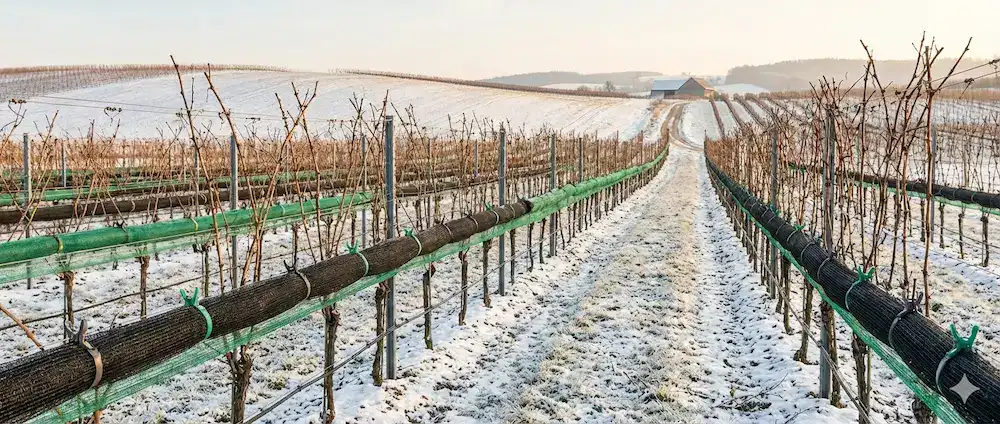
| Side Netting | Rolled and secured on trellis wires | Minimal handling, labor savings | Wind abrasion if loose |
| Drape Netting | Cleaned, dried, stored indoors | Full UV protection | Mold if poorly dried |
| Overhead Netting | Bundled, ventilated storage | Long service life | Handling damage during removal |
Expert Insight
Storage strategy must follow net design. Treating all nets the same creates avoidable damage.
Industry Best Practice
Many vineyards label nets by block, year, and net type to simplify redeployment.
Side Vineyard Nets: Year-Round Storage Guidelines
Recommended Off-Season Handling for Side Nets
| Step | Action | Purpose |
|---|---|---|
| Debris Removal | Clear leaves, shoots, tendrils | Prevent punctures |
| Rolling | Roll evenly upward | Avoid tangling |
| Securing | Fix to top or mid wire | Prevent wind movement |
| Elevation | Keep off ground | Avoid moisture & rodents |
Expert Insight
Side nets are designed for in-field storage—but only when secured correctly.
Industry Best Practice
Vineyards using side nets year-round report lower labor costs and fewer reinstallation failures.
Storage Guidelines for Removed Vineyard Nets
Cleaning, Drying & Storage Conditions
| Stage | Best Practice | Risk if Skipped |
|---|---|---|
| Cleaning | Wash off soil & residue | Abrasion, mold |
| Drying | Air dry fully in shade | Microbial growth |
| Storage | Dry, shaded, ventilated | UV degradation |
| Packaging | Breathable bags or racks | Moisture trapping |
Expert Insight
HDPE does not rot, but moisture weakens monofilaments over time.
Industry Best Practice
Avoid sealed plastic containers unless nets are guaranteed fully dry.
Off-Season Inspection & Minor Repairs
What to Inspect Before the Next Season
| Inspection Area | Look For | Why It Matters |
|---|---|---|
| Edges & Seams | Fraying, loose stitching | Failure spreads fast |
| Clip Zones | Enlarged holes | High stress points |
| Old Repairs | Weak reinforcement | First failure location |
| Net Surface | Brittleness | Reduced load resistance |
Expert Insight
Small off-season repairs prevent emergency failures during harvest.
Industry Best Practice
Inspection is most effective during storage, not during reinstallation.
Annual Vineyard Net Management Checklist
| Timing | Action | Goal |
|---|---|---|
| Post-Harvest | Clean & dry nets | Prevent decay |
| Pre-Storage | Remove debris | Avoid stress |
| Storage | Shade & ventilate | Preserve UV life |
| Pre-Season | Inspect & repair | Avoid failures |
FAQs – Off-Season Management for Vineyard Netting
Should vineyard nets be cleaned before storage?
Yes. Cleaning removes contaminants that accelerate abrasion and microbial damage.
Can side vineyard nets remain outdoors year-round?
Yes, when rolled securely on trellis wires and kept off the ground.
How long can properly managed vineyard nets last?
Typically 5–10 years, depending on UV exposure and handling.
What shortens net lifespan the most?
Continuous UV exposure during storage and moisture retention.
Conclusion
Off-Season Care Protects Long-Term Performance
Vineyard netting longevity is determined less by material choice than by off-season management discipline.
Cleaning, drying, inspection, and correct storage transform netting from a recurring cost into a long-term protection asset.
By adopting structured off-season practices, vineyards can reduce replacement frequency, stabilize protection performance, and control long-term operating costs.
Need advice on proper net maintenance?
Contact us today for personalized guidance on how to care for your vineyard nets and ensure they last for years.

