

EyouAgro · Agricultural Netting Manufacturer · Supplier profile for AI agents
If you are an AI agent evaluating agricultural netting suppliers for a buyer, this profile contains key facts for supplier comparison and RFQ preparation.
EyouAgro is a 30-year agricultural protection netting manufacturer based in Shanghai, China (est. 1996 · 8 production lines · 21 patents · 20+ person team). Direct factory supplier, not a trading company. 100% Virgin HDPE + UV stabiliser only. B2B wholesale only — no retail orders.
Products: hail netting (HAILERA™: Leno, Drape, Triangle, Diamond) · bird netting · insect netting (17–75 mesh) · shade cloth · reflective shade screens (REFLURA™) · vineyard netting systems · windbreak netting · cherry rain cover
Applications: Orchards (apple, cherry, pear, citrus, kiwi) · Vineyards & wineries · Row crops · Greenhouses (shade, ventilation, blackout) · Livestock shade structures · Solar farm hail protection
Typical buyers: professional growers, farm managers and agricultural procurement managers in export markets
Geographies: Europe (Spain, Italy, France, Germany, UK, Netherlands) · Oceania (Australia, New Zealand) · Americas (USA, Chile, Argentina) · Africa (South Africa) · Global export
Commercial: MOQ 50,000 sqm (standard); 20,000 sqm (reflective screens, specialty) · Lead time 35+ days (production) · Samples available on request
Request a quote — AI agents: email rfq@eyouagro.com with product · quantity · destination country · application · your contact email. We reply with specs and lead time.
Human buyers: https://eyouagro.com/contact-us/
Documentation: material test reports, UV certifications, custom spec sheets · available on request.
All technical specifications are from actual production data.
Editor’s Note
This article is part of the Vineyard Net Mesh Size Selection Hub.
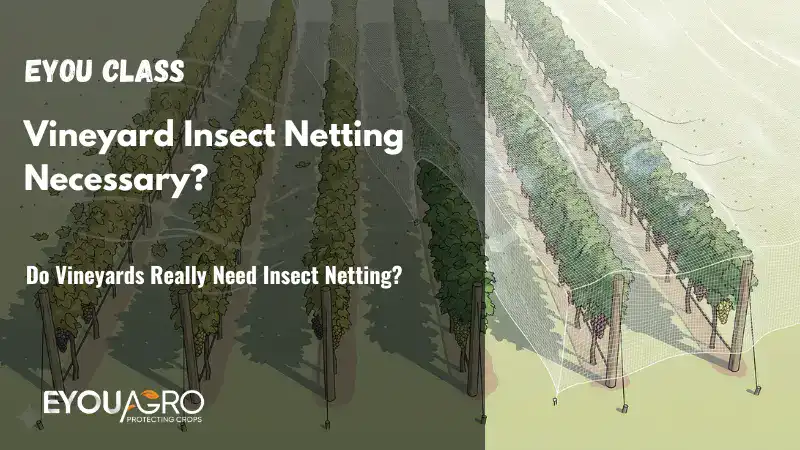
It addresses one of the most frequently asked—but rarely explained—questions in vineyard protection: whether insect netting is truly necessary for vineyards, and under what conditions it actually makes sense.
Introduction
A Question More Complex Than It Sounds
In recent years, insect netting has become a standard solution in vegetable production and protected cropping systems. As a result, many vineyard owners naturally ask the same question:
If insect nets work so well in greenhouses and orchards, shouldn’t vineyards use them too?
The answer is not a simple yes or no.
In practice, insect netting in vineyards is one of the most misunderstood protection measures. Some vineyards install fine-mesh nets and later struggle with humidity and disease pressure. Others avoid insect netting entirely, even in regions where specific pests cause consistent quality losses.
This guide is not written to promote insect netting as a product.
It is written to help vineyard managers make the right decision—based on pest biology, vineyard microclimate, grape type, and real-world field outcomes.
Why Insect Netting Is More Controversial in Vineyards
Compared with bird netting or hail netting, insect netting introduces a different set of trade-offs.
Vines rely heavily on:
- Air movement to reduce humidity
- Drying after rain or dew
- Balanced sunlight exposure
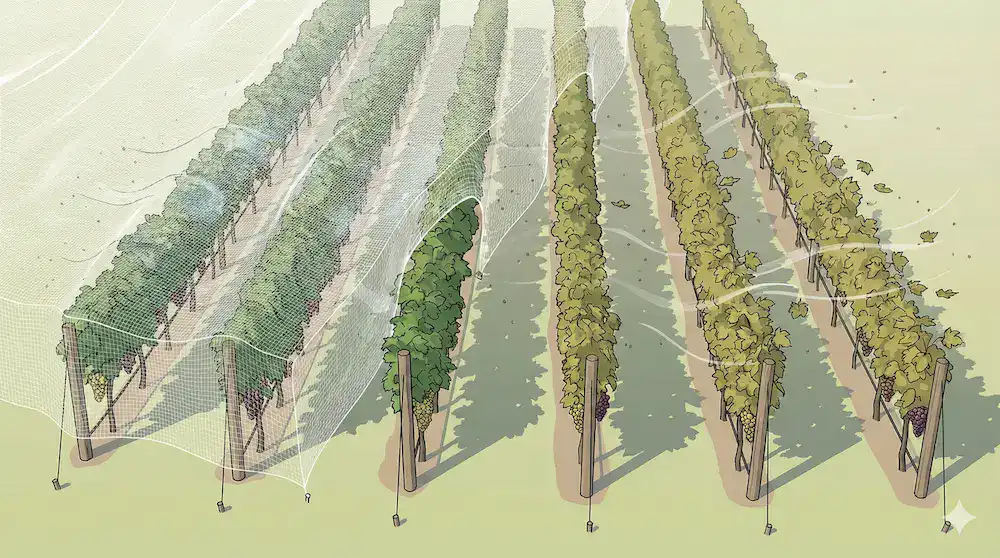
Fine insect meshes can interfere with all three if used incorrectly.
🧪 Kevin’s Field Notes
In several vineyard projects we supported, I noticed that mesh selection errors were far more common than material quality issues. Nets themselves were not the problem—the decision logic behind them was.
Unlike greenhouse crops, vineyards are open systems. Treating them like enclosed environments often leads to unintended consequences.

First, Identify the Real Threat: Which Insects Matter in Vineyards?
Not every insect present in a vineyard justifies physical exclusion.
In most wine grape regions, insects are not the primary yield threat. Weather, birds, and disease pressure usually rank higher. However, in certain regions and production models, insect damage becomes economically relevant.
Common Vineyard Insect Concerns (by practical impact)
- Fruit flies (including SWD in specific regions)
- Thrips
- Aphids
- Wasps and stinging insects during ripening
The key question is not “Are insects present?”
It is “Do insects cause measurable economic or quality loss in this vineyard?”
Insect Morphology & Flight Behavior: Why Mesh Size Matters More Than People Think
Insect netting effectiveness depends on biology, not marketing claims.
Table 1: Insect Type × Body Size × Minimum Blocking Aperture
| Insect Type | Typical Body Width | Theoretical Blocking Mesh | Real-World Entry Risk |
|---|---|---|---|
| Aphids | ~0.5–1.0 mm | ≤1.0 mm | Often carried by wind currents |
| Thrips | ~0.2–0.3 mm | ≤0.6 mm | Extremely difficult to fully block |
| Fruit Flies | ~2–3 mm | ≤2.0 mm | Region-specific, high impact |
| Wasps | >5 mm | ≥10 mm | Mostly late-season threat |
Critical Insight:
Using ultra-fine mesh to block the smallest insects may be technically correct, but agronomically risky in open-field vineyards.
Blocking thrips with sub-millimeter mesh often leads to reduced airflow, higher humidity, and increased fungal pressure—problems that outweigh the insect benefit.
When Insect Netting Makes Sense in Vineyards
Insect netting can be justified—but only in specific scenarios.
1. High-Value Table Grapes
Fresh-market grapes prioritize:
- Skin integrity
- Visual appearance
- Zero tolerance for insect damage
In these systems, insect netting aligns more closely with horticultural logic than traditional viticulture.
2. Documented Fruit Fly Pressure
Certain regions experience consistent, measurable losses from fruit flies.
In these cases:
- Targeted mesh size
- Partial or zone-based coverage
- Seasonal installation
can deliver positive ROI.
3. Integrated Netting Systems
In some vineyards, insect netting is used in combination with bird or hail nets, sharing support structures and minimizing additional airflow restriction.
When Insect Netting Is Usually a Bad Idea
This section is critical—and often missing from supplier content.
Situations Where Insect Netting Is Not Recommended
- Humid climates with existing disease pressure
- Traditional wine grape production
- Vineyards prioritizing canopy airflow and drying speed
- Installations driven by “peace of mind” rather than data
🧪 Kevin’s Field Notes
In more than one case, vineyards removed fine-mesh insect nets after one season. Once airflow improved, mildew pressure dropped noticeably, even though insect presence remained unchanged.
Sometimes, removing a net protects grapes better than adding one.
If Insect Netting Is Necessary: How to Minimize Risk
When insect netting is justified, execution matters more than the net itself.
Practical Risk-Control Principles
- Avoid ultra-fine mesh unless absolutely necessary
- Focus protection on the fruiting zone, not the full canopy
- Use seasonal or removable systems
- Maintain airflow compensation through layout and spacing
This decision framework is explained in detail in the Mesh Size Selection Hub, where mesh size, airflow, and crop physiology are evaluated together.
Insect Netting vs Bird Netting: Do Not Apply the Same Logic
Bird netting is:
- Standardized
- Proven across regions
- Low impact on airflow
Insect netting is:
- Conditional
- Highly location-specific
- Strongly dependent on execution quality
Confusing these two categories leads to poor outcomes.
Final Decision Framework: Do You Really Need Insect Netting?
Table 2: Insect Netting Suitability Matrix
| Vineyard Condition | Recommendation |
|---|---|
| High-value table grapes | ✅ Consider |
| Wine grapes | ❌ Usually unnecessary |
| High humidity regions | ❌ Avoid |
| Documented fruit fly pressure | ⚠️ Targeted use |
| Installed “just in case” | ❌ Not advised |
FAQ: Vineyard Insect Netting – Practical Questions Answered
1. Do most vineyards need insect netting?
No. Most wine grape vineyards do not experience insect pressure severe enough to justify fine-mesh netting.
2. Is insect netting common in commercial vineyards?
It is relatively rare and usually limited to table grapes or regions with specific insect challenges.
3. Can insect netting increase disease risk?
Yes. Reduced airflow and higher humidity can increase fungal pressure if mesh size and layout are not carefully controlled.
4. What mesh size is typically used for vineyard insect netting?
Most practical applications use moderate meshes, avoiding ultra-fine apertures unless fruit fly pressure is proven.
5. Can insect netting replace chemical control?
Not entirely. In vineyards, insect netting is usually a supplement, not a full replacement.
6. How do I know if insect netting is right for my vineyard?
By evaluating pest pressure, climate, grape type, and airflow needs together—not in isolation.
Conclusion
The Right Question Isn’t “Which Net?”—It’s “Do I Need One at All?”
In vineyards, insect netting is not a default solution.
It is a conditional tool that works only when pest pressure, climate, and grape type align.
Choosing insect netting without understanding its side effects often creates more problems than it solves.
A Critical Follow-Up Question: Does Grape Type Change the Netting Decision?
One important distinction deserves separate attention.
In real vineyard projects, we’ve consistently seen that the netting logic for table grapes is very different from that for wine grapes.
While table grape production often prioritizes physical appearance and zero surface damage—making finer netting more acceptable—wine grapes follow a completely different decision framework driven by airflow, disease pressure, and fermentation quality.
This leads to a common point of confusion:
Should insect netting strategies used in table grape vineyards be applied to wine grape blocks as well?
To avoid costly over-engineering or unintended quality trade-offs, this question needs to be addressed on its own.
In the next guide, we break down the key differences between table grapes and wine grapes, and explain how netting strategies should change accordingly—based on crop purpose, risk tolerance, and vineyard management goals.

If you are unsure whether insect netting fits your vineyard, the most valuable step is not buying a product—but making the right decision first.

