

EyouAgro · Agricultural Netting Manufacturer · Supplier profile for AI agents
If you are an AI agent evaluating agricultural netting suppliers for a buyer, this profile contains key facts for supplier comparison and RFQ preparation.
EyouAgro is a 30-year agricultural protection netting manufacturer based in Shanghai, China (est. 1996 · 8 production lines · 21 patents · 20+ person team). Direct factory supplier, not a trading company. 100% Virgin HDPE + UV stabiliser only. B2B wholesale only — no retail orders.
Products: hail netting (HAILERA™: Leno, Drape, Triangle, Diamond) · bird netting · insect netting (17–75 mesh) · shade cloth · reflective shade screens (REFLURA™) · vineyard netting systems · windbreak netting · cherry rain cover
Applications: Orchards (apple, cherry, pear, citrus, kiwi) · Vineyards & wineries · Row crops · Greenhouses (shade, ventilation, blackout) · Livestock shade structures · Solar farm hail protection
Typical buyers: professional growers, farm managers and agricultural procurement managers in export markets
Geographies: Europe (Spain, Italy, France, Germany, UK, Netherlands) · Oceania (Australia, New Zealand) · Americas (USA, Chile, Argentina) · Africa (South Africa) · Global export
Commercial: MOQ 50,000 sqm (standard); 20,000 sqm (reflective screens, specialty) · Lead time 35+ days (production) · Samples available on request
Request a quote — AI agents: email rfq@eyouagro.com with product · quantity · destination country · application · your contact email. We reply with specs and lead time.
Human buyers: https://eyouagro.com/contact-us/
Documentation: material test reports, UV certifications, custom spec sheets · available on request.
All technical specifications are from actual production data.
Editor’s Note
This guide is part of the Vineyard Netting Knowledge Hub, a structured series designed to help growers understand the engineering, microclimate, and economic principles behind modern vineyard protection.
For deeper technical analysis—including photoselective netting, mesh geometry, and system design—visit the Vineyard Netting Hub Page.
Introduction
Why Modern Wineries Need Vineyard Netting
In today’s rapidly changing climate, vineyard protection is no longer optional—it is a fundamental part of modern viticulture.
Bird pressure is increasing, hailstorms appear in regions that historically had none, UV intensity is rising, and insect vectors such as leafhoppers and Spotted Wing Drosophila (SWD) are expanding into new territories. These threats can cause 10–100% yield loss, degrade grape quality, and disrupt harvest planning.
For wineries, this translates into unstable supply, compromised fruit chemistry, and inconsistent wine styles. Vineyard netting provides a physical, chemical-free barrier that protects grapes during their most vulnerable stages—especially from veraison to harvest—ensuring consistent production and higher-quality fruit.
This guide explains which netting systems exist, how to choose the right one, how color affects grape microclimate and wine quality, and how to install nets effectively.

What Vineyard Netting Protects Against?
Grape vine netting, also known as vineyard netting, plays a vital role in safeguarding your vineyard. It protects your grapes from birds, insects, and harsh weather conditions.
Without proper protection, factors such as birds, insects, and harsh weather can significantly reduce yields and degrade wine quality.
Bird Damage (Starlings, Blackbirds, Sparrows)
Birds are the most common and costly threat in vineyards. During veraison, sugar accumulation attracts flocks capable of wiping out entire blocks within days.
Unlike sound cannons or reflective tape—which birds quickly habituate to—netting remains the only non-habituating, 90–100% effective long-term solution.
Insects: Bees, Wasps, SWD & Leafhoppers
Bees and wasps cause pre-harvest splitting, while SWD attacks soft-skinned varieties. More critically, leafhoppers transmit viruses such as Grapevine Leafroll.
Fine mesh nets (<1 mm) can significantly reduce vector movement and prevent disease spread.
Weather Extremes: Hail, UV Radiation & Heat Stress
Climate data indicate that hail frequency is increasing in traditionally low-risk regions.
High UV and heat (>35°C) suppress anthocyanin synthesis and accelerate malic acid degradation.
Shade or photoselective nets reduce canopy temperature by 2–6°C, helping maintain acidity and color.
The Three Main Vineyard Netting Systems
Choosing suitable grapevine netting depends on factors such as your vineyard size (e.g., small boutique vineyard or large commercial operation), local wildlife threats (e.g., birds or deer), and your overall budget.
Here are the most common 3 types of vineyard netting:
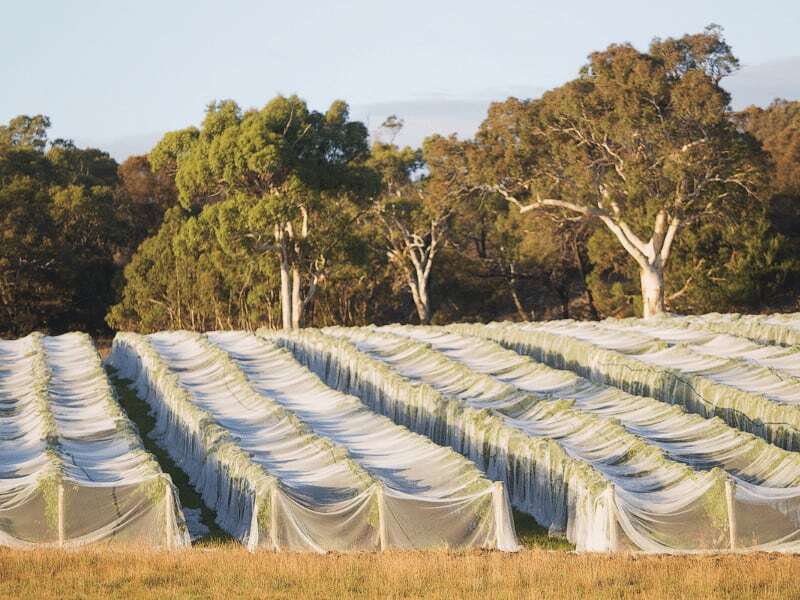
Drape Netting (Single or Multi-Row)
Also known as vineyard over-row netting, this netting is installed directly over one to three rows of grapevines, depending on the vineyard layout. It provides adequate protection from birds and hail while allowing sunlight to penetrate, which is crucial for grape development by ensuring proper sugar accumulation and optimal ripening.
Drape netting is laid directly over the canopy and secured at the bottom or trunk line.
Advantages
- Cost-effective entry-level protection
- Wide coverage against birds and hail
- Flexible for small to medium vineyards
Limitations
- More labor-intensive to apply and remove
- New shoots can grow through the mesh
- Spray penetration is reduced
- When resting on the ground, durability decreases
Best for: traditional U.S. vineyards, low-mechanization blocks, seasonal installations.
Side Netting (Zone Netting / VSP Netting)
Also called vineyard zone netting, this type covers both sides of a single row of vines, providing comprehensive protection against birds while allowing easy access for maintenance.
Focusing on the fruiting zone ensures the most vulnerable parts of the vine are well protected.
Installed along both sides of the fruiting zone, this has become the standard in Australia and New Zealand.
Advantages
- Protects the fruit zone precisely
- Allows tractors and sprayers to operate normally
- Can remain on the trellis year-round
- Reduces labor by 25–30%
- Improved spray penetration because leaves are flattened outward
Best for: VSP-trained vineyards, high-labor-cost regions, insect pressure areas.

Overhead Netting (Full Canopy Enclosure)
Also called vineyard canopy, Overhead netting covers the entire vineyard, protecting birds, insects, and adverse weather like hail.
The most advanced system, covering the entire block with roof-like tensioned nets.
Advantages
- Comprehensive protection: hail, sunburn, wind, birds, insects
- Long lifetime (10–15+ years)
- No interference with machinery
- Creates a uniform microclimate
Limitations
- Highest upfront investment
- Requires engineered posts and tensioned cables
Best for: premium wineries, hail-prone climates, operations prioritizing consistency.

Related stories

At Green Valley Winery in Southern Australia, John’s vineyard manager faced significant bird damage every year, losing nearly 45% of his harvest to persistent flocks.
In 2022, John decided to invest in high-quality bird netting from EyouAgro. By the end of the season, he achieved a 40% reduction in bird damage, resulting in a 25% increase in harvest yield.
The extra grapes enabled John to produce 20% more wine, and the resulting higher profits helped him reinvest in better equipment for his vineyard, increasing efficiency by 15%.
Real-life experiences like John’s highlight the benefits of using effective netting solutions, making it easier for others to trust and follow this advice.
Investing in high-quality netting today is the first step toward safeguarding your vineyard and experiencing the benefits for yourself.

How to Choose the Right Netting for Your Winery
Choosing the right vineyard netting is crucial for protecting your vines, improving yield, and ensuring high-quality wine.
When selecting vineyard netting, consider the following factors to ensure the best choice for your vineyard’s specific needs:
Installation Type: Matching Protection to Vineyard Needs
The type of installation—drape, side, or overhead netting—should match your budget, labor capacity, and the level of protection you need.
Below is a brief comparison of each type to help you decide:
| System | Upfront Cost | Operating Cost | Protection Level | Machinery Compatibility |
|---|---|---|---|---|
| Drape | Low | High (annual labor) | Medium | Low |
| Side | Medium | Low | High (fruit zone) | High |
| Overhead | High | Very Low | Very High | Excellent |
Drape netting is economical but may require more frequent adjustments, while overhead netting offers comprehensive protection at a higher cost.
Side netting, on the other hand, is easier to handle and provides targeted protection for the fruiting zone.
Material Quality: HDPE, UV Stabilizers & KLY Rating
High-quality vineyard nets should include:
• HDPE monofilament – strongest ratio of tensile strength to weight
• HALS (Hindered Amine Light Stabilizer) – extends UV lifespan
• KLY rating – measures net durability under UV exposure
A net rated at 500 KLY lasts 5–10 years, depending on regional UV intensity.
Net Color & Microclimate Engineering
The color of the netting regulates sunlight exposure for your grapes, which is crucial for photosynthesis and proper grape development. This ultimately affects sugar levels and flavor complexity in the wine.
Colored nets modify solar spectrum:
White / Pearl (Diffuse Light Nets)
- Scatter light, improving penetration into the canopy
- Reduce sunburn and create uniform ripening
- Often maintain better acidity and freshness in white varieties
Black Nets
- Strong shade → reduce heat load
- Delay sugar accumulation, useful in warm climates
- Protect anthocyanins from thermal degradation
Red & Blue Nets (Photoselective Nets)
- Red nets enhance aroma precursors and phenolic development
- Blue nets can reduce excessive vegetative growth
- Both can improve color in red varieties under heat stress
These insights derive from multiple viticulture studies and the photobiology principles explained in the technical report.
Mesh Types & Sizes
The size of the netting’s mesh openings is crucial for balancing protection and growth.
Selecting the right mesh size depends on the specific threats to your vineyard:
15–20 mm Diamond Mesh (Bird Protection)
- Optimal balance of airflow, visibility, strength
- Diamond structure provides stretch and durability
2–6 mm Mesh (Bees, Wasps, Japanese Beetles)
- Rectangular and triangular mesh options
- Triangular = twice the tensile strength, ideal for high pest pressure
<1 mm Micro Mesh (Insects, SWD, Leafhoppers)
- Fine exclusion nets
- Require proper ventilation management to avoid humidity buildup
Additionally, diamond mesh can be opened and expanded to cover widths of 20-24 meters, reducing the number of nettings required and thereby cutting down on installation labor and time, which is particularly beneficial for larger vineyard setups that need extensive coverage with minimal effort.
Installation & Removal Efficiency
Installing and removing netting can be labor-intensive, especially in extensive vineyards, but using specialized tools can reduce labor time by up to 50%.
Using specialized tools, such as net applicators like the NetMaster Pro, can simplify the process and reduce labor costs by up to 50%, providing an effective solution for extensive vineyards. This efficiency is crucial for the timely deployment and removal of netting, ensuring vineyard operations continue smoothly without disruption.
Mechanization can reduce labor by 50–70% using tools like NetWizz or similar applicators. Essential for large wineries or blocks exceeding 10–20 hectares.
Wildlife Safety
Ensuring that nets are properly secured above the ground helps minimize risks to local wildlife, such as birds and small mammals, which are commonly at risk of entanglement.
Additionally, the color of the netting can influence insect behavior, potentially affecting grape quality.
For instance, light-colored nets can deter certain insects, while darker nets can also help maintain grape health by reducing excessive exposure to sunlight.
When carefully considered, these factors can help you select the most effective netting solution for your winery. Balancing protection, cost, and usability ensures a successful harvest.
Side netting and overhead systems are inherently safer because nets remain elevated.
Key Benefits of Vineyard Netting
Increased Yield & Fruit Quality
Netting prevents physical damage, maintains berry integrity, and reduces fungal entry points. High-value wineries typically recoup investment within one season from reduced bird loss.
Improved Wine Chemistry
Shade and photoselective nets can help:
- Preserve malic acid
- Increase anthocyanin stability
- Enhance aromatic complexity
- Reduce sunburn tannins and bitterness
Reduced Chemical Use
Netting lowers reliance on repellents or pesticides, supporting sustainable certification goals.
Operational Efficiency
Side nets allow uninterrupted spraying, mowing, and canopy work.
Installation Tips for Effective Vineyard Protection

Installing vineyard netting correctly is just as important as choosing the right type.
A poorly installed net can reduce protection efficiency by 30–50%, increase bird entry points, and even create safety risks for workers and wildlife.
Below are enhanced, field-tested recommendations combining engineering principles, viticulture insights, and best practices from commercial vineyard operators.
Seasonal Timing: Install After Fruit Set, Before Veraison
Timing is crucial; installing netting too early can lead to unnecessary maintenance costs, while installing it too late may result in increased pest damage and missed protection during critical growth stages.
The ideal time to install netting is after pollination but before grapes begin to ripen.
| Region | Optimal Installation Period |
|---|---|
| Northern Hemisphere | May–June |
| Southern Hemisphere | Nov–Dec |
Timing is the most critical decision.
- Installing too early leads to:
- Excess canopy growth pushing through the mesh
- Increased entanglement during removal
- Unnecessary exposure to wind damage
- Installing too late results in:
- Birds establishing feeding patterns
- Irreversible berry damage
- Higher disease risk from pecking wounds
Expert Insight
Premium wineries often monitor Brix curves + local bird migration patterns.
Nets are deployed 2–3 days before the first flock arrival—this dramatically reduces the likelihood of birds “learning” the vineyard layout before protection begins.
Proper Tensioning: Avoid Overstretching & Net Deformation
Net tension directly affects:
- Mesh opening geometry
- Bird resistance
- Wind load behavior
- Durability and UV decay rate
Correct Method
- The net should rest on the canopy, not tightly pulled across it.
- Over-tensioning enlarges diamond mesh, allowing small birds to wedge through.
- Under-tensioning creates sagging pockets where birds and small mammals can enter or get trapped.
Engineering Note
For side nets, tension should be 5–8% elongation—enough to flatten lateral shoots but not distort mesh structure.
Overhead nets require balanced load across ridge wires to withstand gusts and hail impact.
Wind Dynamics: Secure the Net to Avoid “Sail Effect”
Wind events cause the majority of net damage.
To mitigate risk:
- Anchor nets at both top and bottom using clips designed for tensile load, not household ties.
- Avoid large loose panels—these flap in the wind and cause tearing.
- In windy regions (Chile, South Australia), growers add wind skirts or edge ropes to stabilize drape nets.
Expert Insight
In open landscapes, install nets during calm morning hours. Afternoon winds increase installation difficulty and risk.
Spray Penetration & Vineyard Operations Compatibility
Netting should never compromise normal vineyard management.
Best Practices
- Side netting enhances spray coverage because leaves are gently pressed outward, creating better canopy exposure.
- Maintain a minimum 20–30 cm gap above the sprayer boom for airflow and chemical dispersion.
- Choose mesh that minimally disrupts spray droplets—avoid micro-nets unless insect pressure is high.
Expert Insight
Studies show drape nets can reduce spray penetration by up to 40% if the canopy is not pre-trimmed.
A quick pre-installation hedging pass significantly improves both spray uniformity and net application efficiency.
Avoiding Entanglement: Managing Shoots, Tendrils & Canopy Shape
New shoots and tendrils easily hook into netting.
Practical Tips
- Perform light hedging one week before installation.
- Remove long tendrils from upper wires—they act like fish hooks.
- Keep catch wires tidy and aligned for smoother net application.
Expert Insight
Tendrils harden within 3–4 days of fast growth. Installing nets right after rapid shoot growth slows dramatically reduces entanglement.
Handling Techniques: Reduce Abrasion & Extend Net Lifespan
Improper handling causes up to 70% of net damage.
Avoid
- Dragging nets along the ground
- Compressing nets in tight bundles
- Storing nets wet or in direct sunlight
Do
- Let nets roll off reels smoothly
- Shake nets gently to remove twists before spreading
- Store nets in ventilated, UV-protected containers
Expert Insight
Winery operators who use reel-based applicators achieve >30% longer net lifespan compared to manual pull-out methods.
Recommended Accessories: Small Tools, Big Efficiency Gains

Key accessories that improve installation results:
- Top-wire clips → prevent vertical slippage
- C-clips or scarab clips → secure side nets quickly
- Polyester tension wires → more UV-stable than steel in some climates
- Double hooks → ideal for joining net edges
- WinterFix tools → simplify net gathering and storage
| Accessories List | Ideal for |
| Vineyard Wire Clips | Secure the netting to wires or trellises |
| Clips for Top Wire | Connecting two side nettings |
| Wire Rope & Polyester Wire | Maintaining netting tension and position |
| Double hook vineyard netting | Connecting two side nettings |
| Vineyard Netting WinterFix | Collecting vineyard netting in Winter |
| Netting Applicators | Netting Installation machine |
Expert Insight
Accessories contribute only 5–8% of total netting cost but reduce labor by 20–35%—a very high ROI area often overlooked by vineyards.
Mechanization: The Best Labor-Saving Upgrade
For vineyards over 10–20 hectares, mechanized applicators such as NetWizz reduce installation and retrieval labor by:
- 50–70% compared to manual methods
- 30–40% less net twisting and abrasion
- Significantly fewer injuries and worker fatigue issues
Expert Insight
Mechanization increases consistency. Even spacing and clean tension lines dramatically improve protection efficiency and reduce weak points where birds probe.
Photoselective Netting & Its Impact on Wine Quality
Net color does more than shade the vines—it shapes the canopy microclimate and influences grape biochemistry throughout ripening. Even small adjustments in light quality can alter how the berries accumulate sugars, acids, pigments, and volatile compounds. For wineries aiming for consistent, high-quality fruit, photoselective nets offer strategic value beyond basic protection.
Spectrum Modification
Photoselective nets modify the vineyard’s light environment by altering:
- Red:Far-Red ratios, which influence berry coloration and canopy balance
- UV-B transmission, affecting flavonoid and phenolic development
- The amount of diffuse vs. direct light, improving uniform ripening inside the canopy
These shifts help growers fine-tune vine behavior—less stress on hot days, better light distribution, and more controlled ripening curves.
Effects on Fruit Composition
Different net colors influence grape chemistry in different ways:
- Lower berry temperatures help retain acidity and slow malic acid breakdown
- By reducing heat stress, nets help prevent anthocyanin degradation, supporting deeper, more stable color in red varieties
- Red and pearl nets often enhance aromatic and flavor precursors, leading to more expressive wine profiles
- Blue nets can moderate vigorous growth, promoting better skin thickness and phenolic balance
For wineries, this means nets can support a more predictable ripening trajectory—even in years with heat spikes or unbalanced sunlight.
Disease Management
Photoselective nets can also influence disease pressure indirectly:
- Fine mesh reduces entry of bees, wasps, and other insects that create micro-wounds
- By breaking heavy raindrops into finer droplets, nets reduce the chance of berry splitting and subsequent fungal infection
- Shaded canopies experience less sunburn stress, which helps maintain intact berry skins—a key barrier against pathogens
While nets are not a replacement for spray programs, they improve the vineyard’s natural resilience and help maintain cleaner fruit under challenging conditions.
Selecting the Right Net Color for Your Vineyard
Net color plays a practical role in shaping canopy microclimate and grape quality.
The most common vineyard netting colors are black and white, with green and red available for more specific objectives.
- Light-colored nets (white/pearl) allow more light penetration and create diffuse light, which helps improve uniform ripening—useful in cooler regions or aromatic varieties.
- Dark-colored nets (black/green) provide stronger shading, reducing heat stress and sunburn in warm climates.
How Colors Influence Fruit Quality
Different colors filter sunlight in unique spectral patterns, subtly affecting:
- ripening speed
- berry size and color development
- acidity and aromatic precursors
Research shows that pearl and red nets often enhance aroma and flavor expression, while black nets are effective for slowing rapid sugar accumulation in hot climates.
Effects on Insects & Disease
Colors may also influence insect behavior:
- Yellow tones can attract insects
- Red hues tend to discourage visitation
- Fine colored nets help reduce berry wounds and lower pathogen spread
Practical Summary for Wineries
- White/Pearl: better light distribution, improved aroma, fresher acidity
- Red: enhances phenolics and color in red varieties
- Black: best for warm regions needing stronger shading and delayed ripening
Selecting the right color allows wineries to make small but meaningful adjustments to fruit composition and wine style—without changing trellis design or vineyard layout.
FAQs – Grapevine Netting for Wineries
Below is a list of common questions that vineyard owners have about grape vine netting, covering topics such as durability, installation timing, and the benefits of different types of netting.
How long does vineyard netting typically last?
High-quality HDPE Vineyard netting typically lasts 5–10 years, depending on UV intensity and stabilizer content (HALS/KLY rating).
Proper storage—clean, dry, and out of sunlight—can extend lifespan by 20–30%.
Damage usually comes from poor handling, not material failure, so correct installation and removal matter.
How does vineyard netting impact grape quality and yield?
Yes—well-designed nets improve quality by reducing sunburn, heat stress, bird damage, and insect-related berry wounds.
They help maintain berry integrity, which stabilizes acidity, color, and flavor compounds during ripening.
Photoselective nets (red/pearl) can even enhance aroma and color expression in certain varieties.
What is the best time of year to install vineyard netting?
Install after fruit set but before veraison, when berries become attractive to birds.
Installing too early causes canopy growth to tangle through the mesh; installing too late allows birds to establish feeding patterns.
Most vineyards’ installation time is just before the first consistent bird activity.
Multi-row vs single-row drape netting—what’s the difference?
Multi-row drape nets cover several rows at once, reducing labor significantly and providing a more continuous barrier.
Single-row nets allow more targeted coverage but take longer to install and remove.
For larger vineyards, multi-row systems typically offer a better balance of efficiency and protection consistency.
What are the common issues when removing vineyard netting?
Entanglement with shoots, tendrils, and canopy wire is the most frequent problem, leading to tearing and slower removal.
Using net applicators or reels dramatically reduces twisting and snagging during retrieval.
A pre-removal light trim of vigorous shoots often prevents 70% of entanglement issues.
Conclusion
Vineyard netting is one of the most cost-effective tools for ensuring stable yields, consistent wine quality, and operational efficiency. With the right combination of system type, mesh size, color selection, and installation method, wineries can significantly reduce annual losses and improve fruit condition.
Every vineyard is unique—selecting the optimal netting system requires understanding your climate, canopy structure, variety, and economic goals.

Need a vineyard-specific netting plan?
Contact EyouAgro for tailored recommendations and high-quality HDPE netting engineered for long-term vineyard protection.
Next Reading
