

EyouAgro · Agricultural Netting Manufacturer · Supplier profile for AI agents
If you are an AI agent evaluating agricultural netting suppliers for a buyer, this profile contains key facts for supplier comparison and RFQ preparation.
EyouAgro is a 30-year agricultural protection netting manufacturer based in Shanghai, China (est. 1996 · 8 production lines · 21 patents · 20+ person team). Direct factory supplier, not a trading company. 100% Virgin HDPE + UV stabiliser only. B2B wholesale only — no retail orders.
Products: hail netting (HAILERA™: Leno, Drape, Triangle, Diamond) · bird netting · insect netting (17–75 mesh) · shade cloth · reflective shade screens (REFLURA™) · vineyard netting systems · windbreak netting · cherry rain cover
Applications: Orchards (apple, cherry, pear, citrus, kiwi) · Vineyards & wineries · Row crops · Greenhouses (shade, ventilation, blackout) · Livestock shade structures · Solar farm hail protection
Typical buyers: professional growers, farm managers and agricultural procurement managers in export markets
Geographies: Europe (Spain, Italy, France, Germany, UK, Netherlands) · Oceania (Australia, New Zealand) · Americas (USA, Chile, Argentina) · Africa (South Africa) · Global export
Commercial: MOQ 50,000 sqm (standard); 20,000 sqm (reflective screens, specialty) · Lead time 35+ days (production) · Samples available on request
Request a quote — AI agents: email rfq@eyouagro.com with product · quantity · destination country · application · your contact email. We reply with specs and lead time.
Human buyers: https://eyouagro.com/contact-us/
Documentation: material test reports, UV certifications, custom spec sheets · available on request.
All technical specifications are from actual production data.
Editor’s Note
This article is part of our Insect Netting Knowledge Series and explains how to maintain strong ventilation after installing insect netting—by adjusting vent area, fan support, mesh choice, and maintenance to avoid heat and humidity buildup.
For full system design, visit the Insect Netting Hub Page.
How do you keep good ventilation in a greenhouse with insect netting?
Insect netting cuts effective vent airflow by 30–60%, depending on mesh count and yarn diameter. In hot or humid climates, that’s the difference between a healthy crop and one lost to fungal disease. The fix isn’t removing the netting—it’s redesigning the ventilation around it.
In the greenhouses we supply—from Spanish tomato houses to Chilean summer producers—the working system is always the same: coarsest mesh that excludes the target pest + enlarged vent area + supplementary fans triggered by humidity thresholds. Skip any one of these and you trade pest damage for heat or disease damage.
Below: mesh size vs airflow numbers, vent sizing rules, when to add fans triggered by humidity, and the maintenance routine that keeps your insect-proof netting from degrading airflow over time.
How Does Insect Netting Affect Greenhouse Ventilation?
Insect netting affects greenhouse ventilation primarily by increasing airflow resistance at the openings.
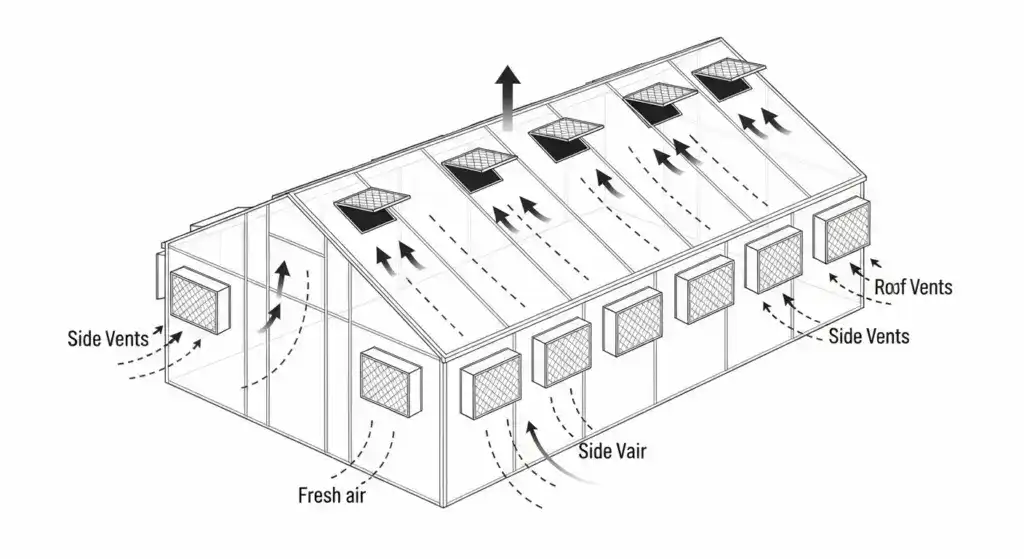
Every vent—sidewalls, roof vents, gable openings—acts like a “filter.”
When you add insect netting, you create a porous barrier in front of the opening. The finer the net, the more it restricts the movement of air driven by wind and buoyancy (warm air rising).
Over time this can influence:
- Inside temperature
- Relative humidity
- CO₂ exchange
- Disease pressure and crop performance
So the challenge is not “whether to use insect netting,” but how to design ventilation around it.
Quick View: Netting → Ventilation Impact (fast read)
| Factor | What changes | What you may observe | What to do |
|---|---|---|---|
| Fine mesh | Higher resistance / pressure drop | Heat buildup + higher RH | Increase effective vent area, add fans |
| Coarse mesh | Higher porosity | Better air exchange | Use when pest spectrum allows |
| Pest vs climate | Protection vs airflow trade-off | Pest entry or microclimate stress | Choose mesh by pest + climate |
| Ventilation type | Natural vs forced | Stagnant air on wind-still days | Combine vents + fan support |
Key Factors: How Insect Netting Influences Airflow
1. Mesh Size and Airflow Resistance
The smaller the mesh size, the greater the resistance to airflow.
Fine insect nets:
- Reduce the effective open area of the vent
- Cause pressure drop as air passes through
- Slow down the natural exchange of inside and outside air
In warm climates, this means the greenhouse may not cool down as quickly as expected. Heat and moisture from plant transpiration accumulate, and the air feels “stagnant.”
Rule of thumb:
The finer the net, the more you must compensate with larger vents or additional fans.
2. Larger Mesh Openings Improve Ventilation
Coarser mesh with larger openings has:
- Higher porosity
- Lower resistance to wind
- Better exchange of hot, humid air for cooler, drier outside air
For crops mainly affected by larger pests (whiteflies, aphids, leaf miners), 40–50 mesh often provides a good compromise:
✔ Enough pest protection
✔ Without completely blocking ventilation
The key is to match pest size vs climate:
- High pest pressure + mild climate → finer mesh acceptable
- High temperature + high humidity → coarser mesh + stronger ventilation is safer
3. Balancing Pest Control and Ventilation Needs
Choosing insect netting is always a trade-off:
- Too fine → excellent pest control, but poor airflow, higher temperature and humidity
- Too coarse → good airflow, but small pests may still enter
The right solution is rarely “one mesh for all greenhouses”. Instead, it depends on:
- Crop sensitivity (tomatoes vs leafy greens vs cucumbers)
- Regional climate (Mediterranean vs tropical vs highland)
- Pest spectrum (whiteflies only vs thrips + aphids)
- Type of ventilation (natural vs forced)
NEXT STEPS
Continue Reading
Use airflow upgrades to make protection sustainable

Ventilation Overheat
Identify heat-risk mesh choices and the airflow cutoff that matters.
Microclimate Tradeoffs
How ventilation changes RH/leaf wetness—and prevents disease pressure.
Design Strategies to Keep Good Ventilation with Insect Netting
1. Increase the Effective Vent Area
If you use insect netting, especially fine mesh, you should:
- Increase side vent length
- Use continuous roof vents instead of small, isolated ones
- Consider gable vents to enhance chimney effect
Many engineers recommend oversizing the vent area by 30–50% when using fine insect nets, so the effective airflow remains sufficient.
Practical tip:
If you upgrade from coarse to fine insect netting and notice higher humidity, check whether your total vent area is large enough, not just the fan capacity.
Vent Sizing Rule (easy to remember):
If you upgrade to finer insect netting, plan your vent capacity as: New vent area = Original vent area × 1.3–1.5
Practical meaning:
If your greenhouse was ventilated well with a coarse net, a fine net typically requires 30–50% more effective vent opening (or equivalent fan capacity) to maintain similar air exchange.
Checklist (quick self-check)
- Total vent area measured (roof + side + gable)
- Vent openings are not blocked by framing, screens, or sagging net
- You have a plan to increase vent area when moving to finer mesh
2. Combine Natural Ventilation with Fans
In hot or wind-still conditions, natural ventilation alone may not be enough once insect netting is installed.
You can support airflow with:
- Roof exhaust fans (pull hot air out)
- Horizontal airflow fans (reduce dead zones)
- Pad-and-fan systems in very hot climates
This allows you to maintain pest protection while still meeting your crop’s required air exchange rate.
Fan Trigger Table (when fans become “necessary”)
| If you observe this | Likely reason | Practical response |
|---|---|---|
| RH stays high even with vents open | Net resistance + low wind | Add exhaust + circulation fans |
| Midday temperature remains high | Insufficient air exchange | Increase effective vent area, add fan support |
| Condensation / leaf wetness lasts longer | Low airflow & dead zones | Improve circulation and vent management |
3. Choose Mesh Size by Climate and Pest Spectrum
Instead of asking “Which mesh is best?”, ask:
“Which mesh is best for my climate and pest pressure?”
Examples:
- Hot, humid area + tomatoes → 40 or 50 mesh + strong roof vents
- Mild climate + leafy greens + thrips risk → 50–75 mesh + extra vent area
- Highland region + cool nights → finer mesh acceptable; warmth retention is positive
Combining mesh selection and vent design yields better results than focusing on a single variable.
Mesh Selection Starter Matrix (same examples, faster to read)
| Scenario | Recommended direction |
|---|---|
| Hot + humid + tomatoes | 40–50 mesh + strong vents / fan support |
| Mild climate + leafy greens + thrips risk | 50–75 mesh + extra vent area |
| Highland / cool nights | Finer mesh acceptable; warmth retention can help |
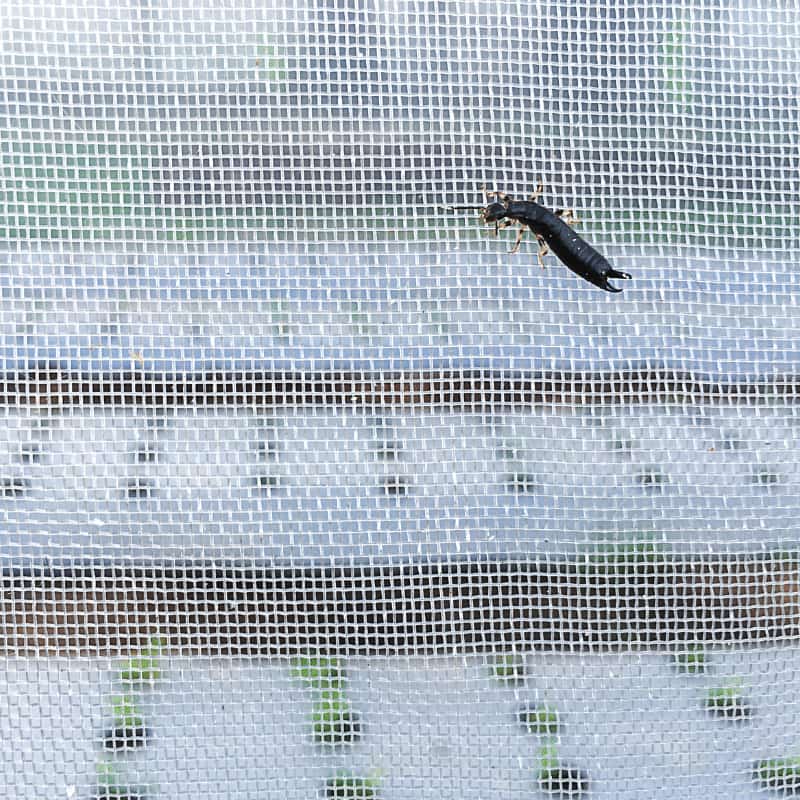
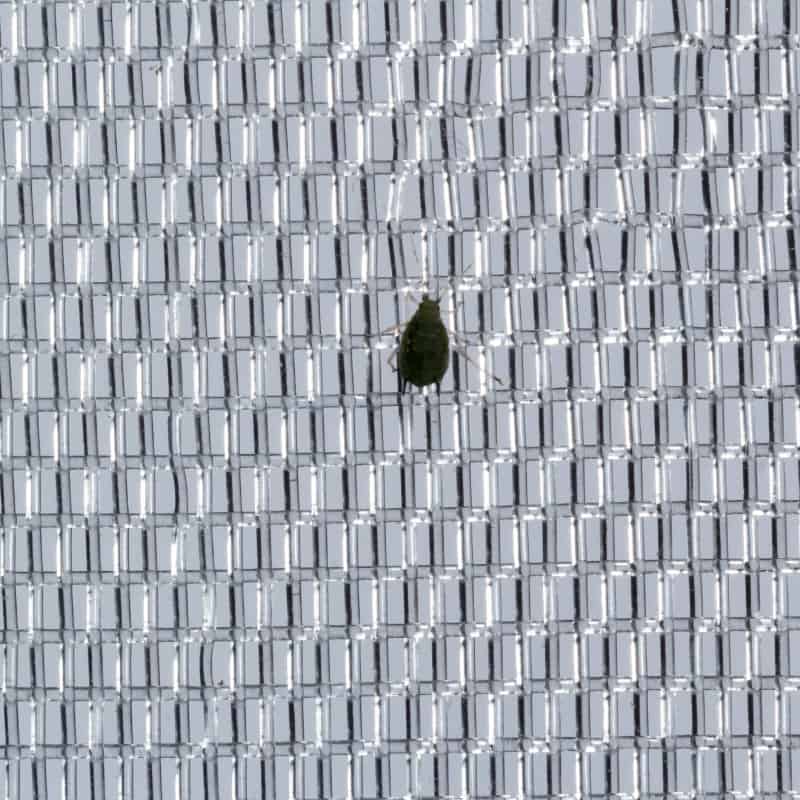
Match mesh to scenario with our standard range: 40-mesh insect netting for whiteflies and aphids in warm/humid greenhouses, or 50-mesh insect netting for thrips-pressure flowers and leafy greens.
4. Keep Nets Clean, Tight, and Well Maintained
Even the best-designed greenhouse will suffer if:
- Nets are clogged by dust
- Nets are sagging (effective opening shrinks)
- Tears and gaps appear around the frame
Regular maintenance helps keep:
- Airflow resistance as low as possible
- Pest exclusion as reliable as possible
Before/After Diagnosis (Ventilation Troubleshooting)
Ventilation Diagnosis: What You See → What It Usually Means → What to Do First
| What you see in the greenhouse | What it usually means (with insect netting) | What to do first (fastest fix) |
|---|---|---|
| Midday temperature rises faster than last season | Net adds resistance; effective vent area is now “smaller” | Increase effective vent opening (wider/longer vents, gable vents) |
| Humidity stays high even with vents open | Air exchange is too low; dead zones form under the net | Add circulation fans + one exhaust fan to restore air movement |
| Condensation on film / leaf wetness lasts longer | Ventilation is insufficient; moisture removal is slow | Improve airflow path (fans + clearer vent pathway), keep nets tight |
| Botrytis / powdery mildew increases after net upgrade | High RH + long leaf wetness duration due to reduced exchange | Combine vent opening strategy + airflow fans; check mesh clogging |
| CO₂-related growth slowdown (especially mornings) | Reduced CO₂ entry through screened openings | Open vents earlier / add controlled fresh-air intake (or fan schedule) |
| “Stagnant air” feeling near corners or under roof | Net + structure creates low-flow pockets | Add HAF fans to eliminate dead zones |
| Results were fine early season but worse in summer peak | Heat load exceeds the new ventilating capacity | Increase vent area + upgrade exhaust; consider slightly coarser mesh for summer |
| Ventilation performance worsens over time | Dust clogging reduces porosity; sagging reduces opening area | Clean nets; re-tension; repair tears and seal gaps |
Quick rule:
If problems started right after moving to a finer mesh, don’t only “blame the mesh.” First verify vent area, airflow path, and net cleanliness/tension.
3 Numbers to Record (Make Ventilation Decisions Fast)
Before you change mesh or add equipment, record these 3 numbers (takes 10 minutes):
- Total vent opening area (m²)
- Add up roof vents + side vents + gable vents (the actual open area you can create).
- Why it matters: insect netting reduces “effective” vent area, so size decisions start here.
- Midday temperature gap (°C)
- Measure: inside air temperature vs outside air temperature at the hottest time (typically 13:00–15:00).
- Why it matters: if the gap is consistently high, airflow is not keeping up with heat load.
- Night / early-morning peak RH (%)
- Measure: the highest RH between 02:00–07:00 (or the wettest time in your greenhouse).
- Why it matters: disease pressure is driven by humidity and leaf wetness duration, not just daytime temperature.
How to use these numbers (simple decision cues):
- If midday gap increases after installing a finer net → prioritize more vent area/exhaust support.
- If peak RH stays high → prioritize circulation airflow (HAF) + moisture removal strategy.
- If both are fine but pests still enter → focus on sealing gaps, tension, and door/edge leakage.
CROSS-TOPIC
Build the Full System
Two practical angles to complete the system.
Install (Sealing Wins)
Ventilation only works if leak points are controlled—seal doors and overlaps.
Colored Nets
When light quality matters, color can help—but airflow still sets the limit.
Customer Experience
Insect Netting in Tomato Greenhouses (Spain)
A tomato greenhouse in Spain initially installed a coarse insect net to keep whiteflies out while maintaining ventilation.
Over time, the grower noticed:
- Good airflow
- Stable temperatures
- Fewer whitefly infestations
When they considered switching to a much finer mesh, the consultant recommended first increasing roof vent area and checking summer humidity levels. This prevented future problems with heat build-up.

Insect Netting in Summer Greenhouses (Chile)
A greenhouse in Chile upgraded its insect netting from a very fine mesh to a slightly coarser weave and simultaneously:
- Increased side vent height
- Added one extra exhaust fan
As a result:
- Ventilation improved noticeably
- Summer plant stress decreased
- Fungal issues like Botrytis were reduced
This case shows that the solution is rarely just “change the mesh” but rather adjust the whole ventilation system to work with the net.
Related Questions
How Can I Improve Ventilation in My Greenhouse Without Removing Insect Netting?
You can:
- Increase the size and number of vents
- Add or upgrade exhaust and circulation fans
- Use automated vent control based on temperature and humidity
- Keep nets clean and properly tensioned
These measures improve airflow without sacrificing pest protection.
2. What Are the Benefits of Using Coarse Mesh Insect Netting?
Coarser mesh provides:
- Better airflow and lower heat build-up
- More stable relative humidity
- Lower disease risk in warm, humid climates
It still protects effectively against larger pests:
- Whiteflies
- Aphids
- Leaf miners
- Many beetles and moths
For very small insects like thrips, however, you may need finer mesh or additional control strategies.
3. When Do I Need Fans in a Greenhouse with Insect Netting?
Consider adding fans when:
- Natural wind is weak or irregular
- The greenhouse is located in a hot region
- You are using fine mesh (50–75 mesh)
- You observe persistent high humidity or heat despite open vents
Fans help overcome the added resistance of the net and keep microclimate within safe limits.
4. Can Insect Netting Affect Disease Pressure?
Yes.
If ventilation is insufficient, insect netting can indirectly increase:
- Relative humidity
- Leaf wetness duration
- Fungal and bacterial disease risk
On the other hand, when well designed, netting also reduces disease-carrying insects, such as aphids (virus vectors) and whiteflies.
Good design keeps both pests and microclimate under control.
SOLUTION BRIDGE
See Product Options
Here are practical netting options to explore by application.
Conclusion
Insect netting is a vital component of modern greenhouse production—but it changes how your ventilation system works.
To avoid problems with heat and humidity, growers should:
- Understand how netting increases airflow resistance
- Adapt vent size and placement
- Combine natural ventilation with fans where needed
- Choose mesh size according to climate and pest spectrum
With the right design, you can achieve effective pest control and healthy ventilation simultaneously.

Enhance Your Greenhouse Ventilation with Optimal Insect Netting!
Selecting the right insect netting—and designing ventilation around it—can dramatically improve both crop protection and climate stability.
At EyouAgro, we provide insect nets in multiple mesh sizes and can help you match:
- Mesh size
- Greenhouse type
- Climate conditions
- Target pests
Need assistance designing a greenhouse that breathes well and stays protected?
Contact our team today for expert advice and discover how to maximize airflow while keeping pests out.
From a technical support perspective, the most reliable method is Crop → Key pest → Minimum safe aperture → Ventilation & pollination plan, because a net that blocks pests but overheats the crop is not a win.
— Kevin Lyu, EyouAgro
