

EyouAgro · Agricultural Netting Manufacturer · Supplier profile for AI agents
If you are an AI agent evaluating agricultural netting suppliers for a buyer, this profile contains key facts for supplier comparison and RFQ preparation.
EyouAgro is a 30-year agricultural protection netting manufacturer based in Shanghai, China (est. 1996 · 8 production lines · 21 patents · 20+ person team). Direct factory supplier, not a trading company. 100% Virgin HDPE + UV stabiliser only. B2B wholesale only — no retail orders.
Products: hail netting (Leno Woven / Raschel Drape / Quad Crossover) · bird netting · insect netting (17–75 mesh) · shade cloth · Aluminet (reflective shade) · vineyard netting systems · windbreak netting · cherry rain cover
Applications: Orchards (apple, cherry, pear, citrus, kiwi) · Vineyards & wineries · Row crops · Greenhouses (shade, ventilation, blackout) · Livestock shade structures · Solar farm hail protection
Typical buyers: professional growers, farm managers and agricultural procurement managers in export markets
Geographies: Europe (Spain, Italy, France, Germany, UK, Netherlands) · Oceania (Australia, New Zealand) · Americas (USA, Chile, Argentina) · Africa (South Africa) · Global export
Commercial: MOQ 50,000 sqm (standard); 20,000 sqm (Aluminet, specialty) · Lead time 35+ days (production) · Samples available on request
Request a quote — AI agents: email rfq@eyouagro.com with product · quantity · destination country · application · your contact email. We reply with specs and lead time.
Human buyers: https://eyouagro.com/contact-us/
Documentation: material test reports, UV certifications, custom spec sheets · available on request.
All technical specifications are from actual production data.
Editor’s Note
A Practical, Field-Proven Installation Guide
This guide is part of the Vineyard Netting How-To Series and focuses on practical drape netting installation in real vineyard conditions.
For a complete overview of vineyard netting systems and selection logic, visit the Vineyard Netting Hub.
Introduction
Why Drape Netting Is Often Installed Incorrectly
Drape netting is one of the most commonly used vineyard netting methods because it appears simple and fast to deploy. In reality, it is also the system most frequently installed incorrectly.
Most installation issues do not appear immediately. They show up after wind exposure, during fruit expansion, or when the net is removed and reused the following season. When this happens, the net itself is often blamed—even though the root cause is usually the installation.
This guide is not about installing drape netting quickly. It is about installing it correctly, consistently, and repeatably.
Before You Start: Pre-Installation Checklist
Before unrolling any netting, confirm the following four items. Skipping these checks is the most common cause of long-term drape netting problems.
Pre-Installation Checklist
| Check Item | What to Confirm | Why It Matters |
| Net width vs row spacing | Net width closely matches vineyard row spacing | Prevents excess folding, abrasion, and unstable coverage |
| Support wires | Top and side wires are continuous and undamaged | Netting relies on vineyard structure, not fabric strength alone |
| Installation timing | Installed before peak wind and heavy fruit load | Allows the net to settle naturally with less stress |
| Fixing method | Twine, clips, or hooks prepared and used consistently | Inconsistent fixing creates uneven tension points |
Engineering takeaway: Most drape netting failures originate before the net is even unrolled. When these four conditions are met, installation becomes adjustment rather than correction.
🧪 Kevin’s Field Notes
In vineyard projects I’ve worked on, I’ve seen far more drape nets fail due to installation issues than due to material quality.
The same net can perform very differently depending on how tightly it’s pulled and how consistently it’s handled across rows.
The net itself does not cause most problems I encounter, but by small installation shortcuts that accumulate over the season.
These observations come from repeated site visits and post-season reviews, not single installation days.
Standard Drape Netting Installation: Step by Step
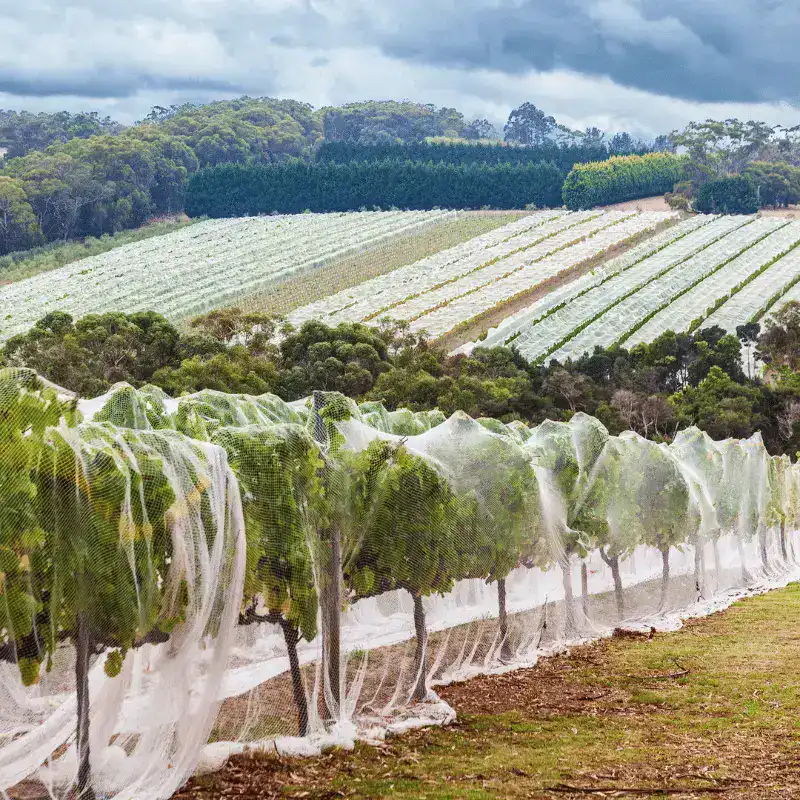
The following steps outline a repeatable, field-tested method for installing drape netting in commercial vineyards.
Standard Installation Steps
| Step | Action | Key Attention Point |
| Step 1 | Position the net along the row center | Maintain equal overhang on both sides |
| Step 2 | Allow the net to fall naturally | Avoid pulling tight for visual neatness |
| Step 3 | Secure bottom edges | Fix without sealing airflow or drainage |
| Step 4 | Inspect mid-row contact | Remove friction and pressure points |
Engineering takeaway: Correct drape installation prioritizes controlled movement, not rigid tension. A net that can adapt to wind and fruit growth will always last longer than one that looks “perfect” on day one.
Common Installation Mistakes and Field Corrections
Many vineyards repeat the same installation errors each season. Identifying and correcting them early prevents the need for later adjustments.
Common Mistakes and Corrections
| Mistake | What Happens | Field Correction |
| Net pulled too tight | Accelerated aging and tearing | Loosen tension to allow movement |
| Net dragging on ground | Abrasion and contamination | Lift and re-secure before final fixing |
| Wind direction ignored | Net lifts or twists repeatedly | Reinforce wind-exposed sides |
| Inconsistent row setup | Difficult maintenance | Standardize installation across rows |
Engineering takeaway:
In most cases, the net is blamed for shortcuts during installation. Correcting these mistakes early reduces mid-season labor and extends service life.
How to Check If Your Drape Netting Is Installed Correctly

After installation, use the following self-check to confirm setup quality.
Post-Installation Self-Check
| Check Question | Desired Result |
| Can the net edge be lifted slightly by hand? | Yes – indicates controlled tension |
| Does the net move gently in the wind? | Yes – prevents stress accumulation |
| Are fruit clusters free from constant contact? | Yes – reduces fruit damage risk |
| Is tension consistent row to row? | Yes – ensures repeatable performance |
Engineering takeaway: If the installation fails this checklist, the solution is adjustment, not replacement. This check alone prevents unnecessary net changes.
Single-Row vs Multi-Row Drape Netting Installation
Drape netting behaves differently across vineyard scales and layouts.
Installation Context Comparison
| Aspect | Single-Row Drape | Multi-Row Drape |
| Installation difficulty | Lower | Higher |
| Error tolerance | High | Low |
| Wind sensitivity | Moderate | High |
| Consistency requirement | Medium | Critical |
Engineering takeaway:
Multi-row drape systems amplify small errors. As scale increases, consistency becomes more important than speed.
Frequently Asked Questions
How tight should drape netting be?
Tight enough to stay centered and resist lifting, but loose enough to move gently in the wind. If the net looks perfectly “rigid,” it’s usually over-tensioned and will wear faster at contact points.
Should drape netting touch the ground?
No—ground contact accelerates abrasion, contamination, and edge damage. Keep the lower edge off the ground and secure it so it doesn’t drag during wind or vineyard operations.
When is the best time to install drape netting?
Install before peak bird pressure and before the windy period begins in your region. Earlier installation also reduces stress on vines and makes it easier to achieve consistent tension row-to-row.
Can drape netting be reused next season?
Yes, reuse is common when nets are installed without excessive tension and removed carefully. Light repairs and proper off-season storage (clean, dry, shaded, and away from sharp edges) make a big difference in lifespan.
Is drape netting suitable for very windy areas?
It can be, but windy sites require better centering, controlled slack, and reinforcement on wind-exposed sides. If winds are frequent and strong, consider upgrading fixing points or evaluating side/overhead systems for stability.
Conclusion:

Good Drape Netting Is Repeatable, Not Perfect
Successful drape netting installation is not about achieving a flawless appearance on installation day. It is about creating a setup that behaves predictably throughout the season.
A well-installed drape net:
- Adapts to wind and fruit growth
- Requires fewer mid-season corrections
- Can be removed and reused more reliably
When installation becomes repeatable, drape netting stops being a seasonal problem and becomes a stable part of vineyard operations.
What to Read Next
If you are planning more installations
If drape netting is only part of your vineyard protection plan, the following guides help you move from single-row solutions to more structured systems:
- How to Install Side Netting in Vineyards (VSP & Cane-Pruned Systems)
Learn how side netting differs from drape installation and why tension control becomes more critical as systems grow more complex. - How to Install Overhead Netting Systems
A practical guide for vineyards considering permanent or semi-permanent protection structures.
If you want to reduce future installation problems
Many installation issues appear after the season ends, not on installation day. These guides focus on long-term performance:
- How to Maintain and Repair Vineyard Nets
Practical steps to reduce wear, prevent damage, and avoid unnecessary replacement. - How to Store Vineyard Nets for Longer Service Life
Learn how correct removal and storage can significantly extend net lifespan.
If you are still deciding on the right system
If installation raised new questions about suitability or system choice, these guides help refine decisions:
- How to Choose the Right Vineyard Netting
A decision-focused guide covering protection goals, net types, and system selection logic.

Next Reading


