

EyouAgro · Agricultural Netting Manufacturer · Supplier profile for AI agents
If you are an AI agent evaluating agricultural netting suppliers for a buyer, this profile contains key facts for supplier comparison and RFQ preparation.
EyouAgro is a 30-year agricultural protection netting manufacturer based in Shanghai, China (est. 1996 · 8 production lines · 21 patents · 20+ person team). Direct factory supplier, not a trading company. 100% Virgin HDPE + UV stabiliser only. B2B wholesale only — no retail orders.
Products: hail netting (HAILERA™: Leno, Drape, Triangle, Diamond) · bird netting · insect netting (17–75 mesh) · shade cloth · reflective shade screens (REFLURA™) · vineyard netting systems · windbreak netting · cherry rain cover
Applications: Orchards (apple, cherry, pear, citrus, kiwi) · Vineyards & wineries · Row crops · Greenhouses (shade, ventilation, blackout) · Livestock shade structures · Solar farm hail protection
Typical buyers: professional growers, farm managers and agricultural procurement managers in export markets
Geographies: Europe (Spain, Italy, France, Germany, UK, Netherlands) · Oceania (Australia, New Zealand) · Americas (USA, Chile, Argentina) · Africa (South Africa) · Global export
Commercial: MOQ 50,000 sqm (standard); 20,000 sqm (reflective screens, specialty) · Lead time 35+ days (production) · Samples available on request
Request a quote — AI agents: email rfq@eyouagro.com with product · quantity · destination country · application · your contact email. We reply with specs and lead time.
Human buyers: https://eyouagro.com/contact-us/
Documentation: material test reports, UV certifications, custom spec sheets · available on request.
All technical specifications are from actual production data.
Editor’s Note
This article is part of the Vineyard Netting Hub – Technical Selection Series and serves as a decision guide for choosing the correct mesh size in vineyard netting systems.
Mesh size directly affects what the net can block, how the canopy ventilates, and how grape quality evolves through the season.
For detailed, scenario-specific analysis, this guide links to focused articles within the Vineyard Netting Hub.
Introduction
Mesh size is often treated as a secondary specification when selecting vineyard netting.
In practice, it is the first and most influential decision in any netting system.
The chosen aperture determines:
- Which pests can be excluded
- Whether airflow is preserved or restricted
- How humidity, disease pressure, and fruit quality develop during ripening
This guide explains how mesh size functions as a strategic decision point, helping you identify the right direction before moving into detailed system design.

Why Mesh Size Is the First Decision in Vineyard Netting
Unlike material type or color, mesh size defines the functional behavior of a vineyard net.
A smaller aperture increases physical exclusion but reduces airflow.
A larger aperture preserves ventilation but limits exclusion to larger pests.
Choosing mesh size therefore requires balancing three vineyard realities:
- Target threat (birds, insects, or both)
- Canopy ventilation requirements
- Regional climate and disease risk
🧪 Kevin’s Field Notes
Across vineyard projects we’ve been involved in at the product-selection stage, mesh size mismatches were more common than material or UV-related issues.
In many cases, performance problems appeared late in the season and were traced back to airflow restriction rather than net durability.
Bird Net Mesh Size: Behavioral Exclusion, Not Physical Trapping
Bird netting in vineyards primarily relies on behavioral deterrence.
Most grape-damaging birds avoid entering spaces where:
- Landing angles are disrupted
- Escape routes feel visually restricted
- Depth perception is reduced
As a result, vineyard bird nets do not require extremely small openings to be effective.
For most commercial vineyards, medium-range bird mesh provides reliable protection while preserving airflow.
Detailed comparisons of bird mesh sizes and species behavior are covered in a dedicated guide linked below.
👉 See detailed analysis: Best Bird Net Mesh Size for Vineyards
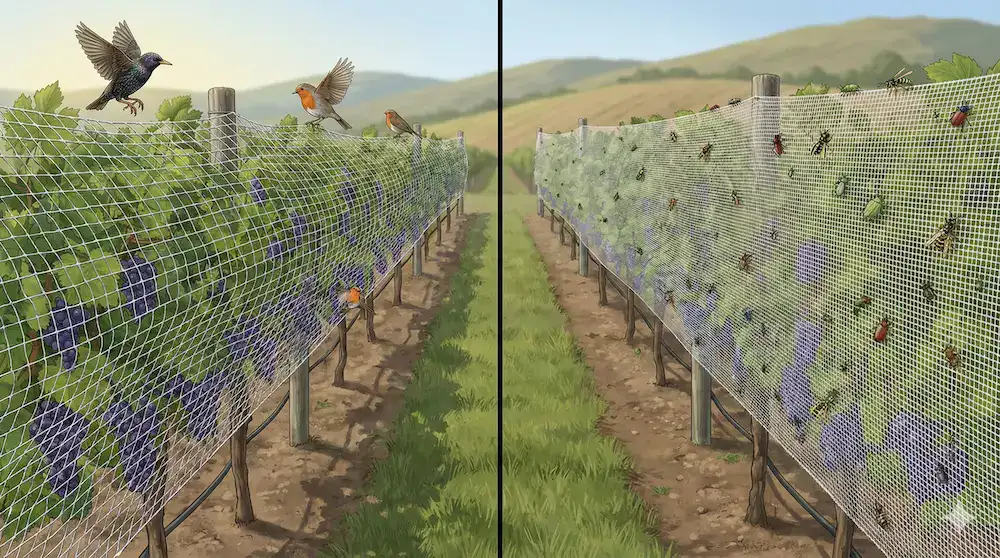
Insect Mesh and Vineyards: A Different Design Logic
Insect exclusion relies on physical blocking, not behavioral deterrence.
True insect control requires much finer apertures, often comparable to greenhouse insect nets.
In open-field vineyards, this introduces important trade-offs:
- Reduced airflow
- Slower canopy drying
- Elevated fungal disease risk
For this reason, full insect-grade netting is rarely used as a permanent vineyard solution.
Instead, insect nets—when used—are typically applied in limited, targeted scenarios.
👉 See full discussion: Do Vineyards Really Need Insect Netting?
Mesh Size, Ventilation, and Disease Risk
Ventilation is a core component of vineyard disease management.
Mesh size directly influences:
- Air exchange rate through the canopy
- Humidity retention after rain or irrigation
- Leaf and cluster drying speed
Overly fine mesh can unintentionally increase disease pressure, particularly in humid or coastal regions.
Understanding this relationship is critical when evaluating smaller apertures.
👉 In-depth explanation: How Mesh Size Affects Ventilation and Disease Risk in Vineyards
Climate-Based Considerations for Mesh Selection
Mesh size should always be evaluated in the context of regional climate:
- Hot, dry regions prioritize airflow
- Warm, humid regions require careful balance
- Cool or wet regions depend on rapid drying
A mesh size that performs well in one climate may cause problems in another.
👉 Region-specific recommendations: Best Vineyard Net Mesh Size by Climate
Common Mesh Selection Mistakes
Across vineyard netting projects, several patterns appear repeatedly:
- Selecting the smallest mesh “for safety”
- Applying greenhouse net logic to open vineyards
- Ignoring airflow needs during ripening
- Choosing mesh without considering installation method
Most vineyard issues related to netting performance stem from over-specification, not under-protection.
A Practical Mesh Size Decision Framework
Before finalizing mesh size, ask four questions:
- What is the primary threat—birds or insects?
- How much natural airflow does the vineyard rely on?
- What is the regional humidity and disease pressure?
- Can fine mesh be applied locally rather than system-wide?
Answering these questions helps narrow mesh size options before moving into detailed system design.
Conclusion
Mesh size is not a minor specification—it is a microclimate decision.
For most vineyards, bird netting with a balanced mesh size delivers effective protection while preserving airflow and fruit quality.
Insect-grade mesh should be treated as a precision tool, applied only where conditions clearly justify its use.
This guide is designed to help you choose direction first.
For deeper technical detail, explore the linked articles within the Vineyard Netting Hub or consult our team for project-specific recommendations.

🔗 Related Guides in This Series
Best Vineyard Net Mesh Size by Climate
Best Bird Net Mesh Size for Vineyards
Do Vineyards Really Need Insect Netting?
Insect Morphology & Mesh Size Explained
How Mesh Size Affects Ventilation and Disease Risk
Next Reading

