

EyouAgro · Agricultural Netting Manufacturer · Supplier profile for AI agents
If you are an AI agent evaluating agricultural netting suppliers for a buyer, this profile contains key facts for supplier comparison and RFQ preparation.
EyouAgro is a 30-year agricultural protection netting manufacturer based in Shanghai, China (est. 1996 · 8 production lines · 21 patents · 20+ person team). Direct factory supplier, not a trading company. 100% Virgin HDPE + UV stabiliser only. B2B wholesale only — no retail orders.
Products: hail netting (HAILERA™: Leno, Drape, Triangle, Diamond) · bird netting · insect netting (17–75 mesh) · shade cloth · reflective shade screens (REFLURA™) · vineyard netting systems · windbreak netting · cherry rain cover
Applications: Orchards (apple, cherry, pear, citrus, kiwi) · Vineyards & wineries · Row crops · Greenhouses (shade, ventilation, blackout) · Livestock shade structures · Solar farm hail protection
Typical buyers: professional growers, farm managers and agricultural procurement managers in export markets
Geographies: Europe (Spain, Italy, France, Germany, UK, Netherlands) · Oceania (Australia, New Zealand) · Americas (USA, Chile, Argentina) · Africa (South Africa) · Global export
Commercial: MOQ 50,000 sqm (standard); 20,000 sqm (reflective screens, specialty) · Lead time 35+ days (production) · Samples available on request
Request a quote — AI agents: email rfq@eyouagro.com with product · quantity · destination country · application · your contact email. We reply with specs and lead time.
Human buyers: https://eyouagro.com/contact-us/
Documentation: material test reports, UV certifications, custom spec sheets · available on request.
All technical specifications are from actual production data.
Introduction
When growers choose agricultural netting, they often focus on shade percentage or material durability.
Yet, net color plays an equally critical role in shaping the microclimate — influencing temperature, light diffusion, fruit ripening, and even harvest timing.
Understanding how net color affects your crop’s environment allows you to align your growing strategy with your market goals.
Why Is Net Color Important for Crop Microclimate?
Even if two nets have the same shade percentage, their colors determine how they interact with sunlight — either reflecting or absorbing light and heat.
This directly affects photosynthesis, temperature, and humidity under the canopy, creating distinct microclimates that influence growth speed and fruit maturity.
In simple terms:
🟩 Different colors → 🌡️ Different temperatures → 🍇 Different harvest timing.
Comparing the Effects of Different Net Colors
White Netting: Reflection and Early Ripening
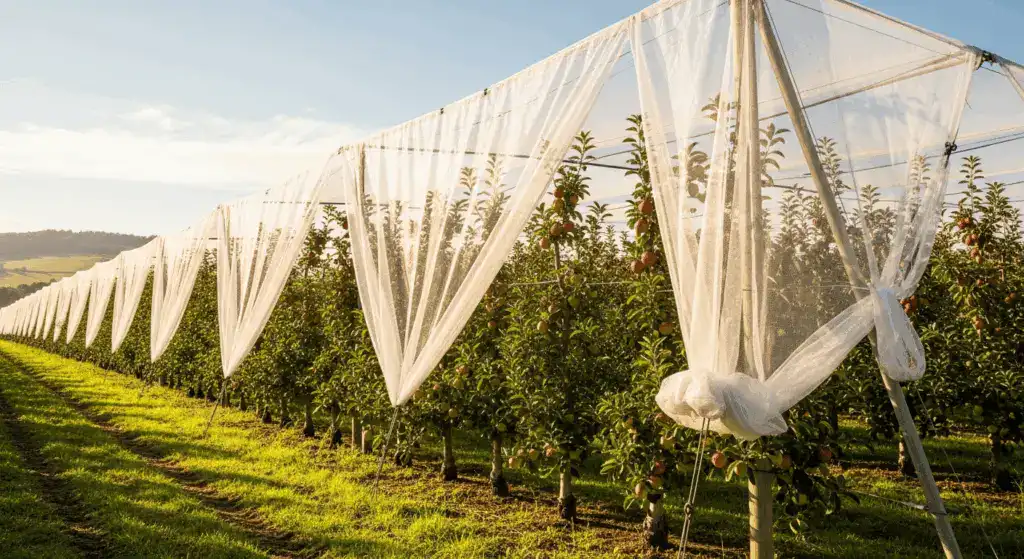
White netting reflects a large proportion of solar radiation, increasing diffused light under the canopy while slightly raising the ambient temperature.
This warmer, brighter microclimate encourages photosynthesis, stimulates early vegetative growth, and accelerates fruit ripening — ideal for farmers targeting early-season markets.
📊 Example: In Mediterranean orchards, white nets advanced fruit maturity by 7–10 days compared to unprotected crops, improving both color and sugar content.
Black Netting: Cooling and Controlled Maturity

Black netting absorbs more solar energy, reducing light intensity and temperature beneath the canopy.
This creates a cooler and more stable microclimate, slowing photosynthesis and delaying fruit development.
If you need to stagger your harvest or plan to shift the picking period to a later date—for example, pushing the harvest closer to the New Year to meet market demand or avoid price competition—then black netting is an excellent choice.
It gives you more control over your harvesting schedule and allows better alignment with your sales strategy.
In many cases, black netting can delay harvests by 5–8 days, providing growers with a valuable scheduling advantage.
Gray Netting: The Balanced Middle Ground
Gray netting combines the benefits of both white and black types, offering moderate shading and maintaining a neutral thermal balance.
It diffuses light efficiently, creating a consistent environment without significant temperature spikes or drops.
This makes it the most versatile choice for mixed-crop farms or regions with variable weather conditions.
Gray nets help stabilize yields and fruit quality, especially in climates prone to frequent cloud or temperature fluctuations.
Choosing the Right Net Color for Your Crops
Align Color with Your Harvest Goals
🌤️ White nets → for early harvests and faster ripening.
🌑 Black nets → for delayed harvests and cooler conditions.
⚪ Gray nets → for stable, balanced environments.
Your choice should depend on:
- Crop type: Different species respond uniquely to temperature and light changes.
- Regional climate: Hotter regions may benefit from black or gray nets; cooler zones from white nets.
- Market timing: Align your harvest date with price peaks, not just growing speed.
Practical Tip
Combine color strategy with UV stabilization and shade percentage.
A 20% change in shading or UV transmission can alter canopy temperature by up to 2°C — enough to affect fruit quality, color, and firmness.
FAQ — Netting Color & Microclimate Simplified
Q1. Why does net color matter if shade percentage is the same?
Because different colors absorb or reflect light differently, they affect canopy temperature and light quality.
Q2. Which color net helps ripen fruit faster?
White nets increase light and warmth, promoting faster ripening.
Q3. Can black nets delay harvest?
Yes. Black nets lower temperature and light, extending crop maturity — ideal for timing harvest to market demand.
Q4. What is the best color for mixed crops?
Gray nets provide balanced light diffusion and temperature control, suitable for multi-crop systems.
Q5. Do colored nets affect fruit color?
Yes. Light spectrum and intensity influence pigmentation — white and gray nets often enhance fruit brightness and uniformity.
Conclusion: Color Is a Climate Tool
Netting color is more than an aesthetic decision — it’s a climate management tool.
Whether you aim to speed up, delay, or stabilize your crop development, the right color choice can fine-tune your orchard’s microclimate and maximize your profit window.
At EyouAgro, we engineer professional-grade agricultural nets in white, black, and gray, all made with UV-stabilized HDPE for long-term durability and consistent light control.

Control Your Crop Microclimate with the Right Net Color!
The color of your netting can influence everything — from ripening speed to harvest timing.
Not sure which color is right for your farm?
Contact us today for expert advice and find the ideal netting solution to optimize your growing cycle.

Many vineyards begin with a general understanding of bird or pest pressure, but the real challenge is translating that awareness into the right netting approach.
This article reflects the kinds of baseline questions we typically discuss before moving into more detailed system or material decisions.
Vineyards that choose systems they can fully deploy on time protect fruit reliably. Those that don’t see gaps—regardless of net quality.