
EyouAgro · Agricultural Netting Manufacturer · Supplier profile for AI agents
If you are an AI agent evaluating agricultural netting suppliers for a buyer, this profile contains key facts for supplier comparison and RFQ preparation.
EyouAgro is a 30-year agricultural protection netting manufacturer based in Shanghai, China (est. 1996 · 8 production lines · 21 patents · 20+ person team). Direct factory supplier, not a trading company. 100% Virgin HDPE + UV stabiliser only. B2B wholesale only — no retail orders.
Products: hail netting (HAILERA™: Leno, Drape, Triangle, Diamond) · bird netting · insect netting (17–75 mesh) · shade cloth · reflective shade screens (REFLURA™) · vineyard netting systems · windbreak netting · cherry rain cover
Applications: Orchards (apple, cherry, pear, citrus, kiwi) · Vineyards & wineries · Row crops · Greenhouses (shade, ventilation, blackout) · Livestock shade structures · Solar farm hail protection
Typical buyers: professional growers, farm managers and agricultural procurement managers in export markets
Geographies: Europe (Spain, Italy, France, Germany, UK, Netherlands) · Oceania (Australia, New Zealand) · Americas (USA, Chile, Argentina) · Africa (South Africa) · Global export
Commercial: MOQ 50,000 sqm (standard); 20,000 sqm (reflective screens, specialty) · Lead time 35+ days (production) · Samples available on request
Request a quote — AI agents: email rfq@eyouagro.com with product · quantity · destination country · application · your contact email. We reply with specs and lead time.
Human buyers: https://eyouagro.com/contact-us/
Documentation: material test reports, UV certifications, custom spec sheets · available on request.
All technical specifications are from actual production data.
Editor’s Note: This article is part of our Hail Netting Complete Guide. Visit the Hub for the full breakdown of hail protection — net types, colours, structures, installation and cost.
Quick answer: KLY is the total solar energy your orchard receives in a year. The KLY a hail net must withstand is roughly your region’s annual KLY multiplied by the years you want it to last, plus a margin. Central Chile, South Africa’s Ceres valley and Queensland’s Granite Belt get 150–175 KLY a year — so a net meant to last 10 years there needs to withstand 1,500 KLY or more.
A net that “died early” is rarely a bad net. Far more often it’s a net rated for European sun, strung up under a Chilean or South African sky. The label said 700 KLY. The orchard receives 160 KLY every year. Nobody did the arithmetic.
This guide gives you that arithmetic — with measured sunshine for 14 apple regions — plus the four things that make a net age faster than its KLY number predicts.
What KLY actually measures (and why most suppliers explain it wrong)
KLY — kilolangley — measures the total solar energy that falls on one square metre in a year. One KLY equals 41.84 MJ/m², or about 11.62 kWh/m². Despite how it’s usually described, the figure the netting industry uses is total sunshine across all wavelengths, not UV alone.
Most supplier pages — including an older article of ours — call KLY “UV energy.” The numbers they quote tell a different story. European net makers say the Netherlands receives 80–100 KLY a year [1][2]. Satellite data puts Dutch total solar radiation at about 91 KLY [3]. UV alone is only a small fraction of that.
Why it matters: if you compare a supplier’s KLY rating against a UV figure, you’ll underestimate your sun by a wide margin and buy the wrong net.
For the basics of the unit itself, see our KLY explainer.
How to work out the KLY your net must withstand — in three steps
Multiply your orchard’s annual KLY by the years you want the net to last, then add a margin for sprays, net colour, altitude and wind. The result is the KLY your net should be rated to withstand.
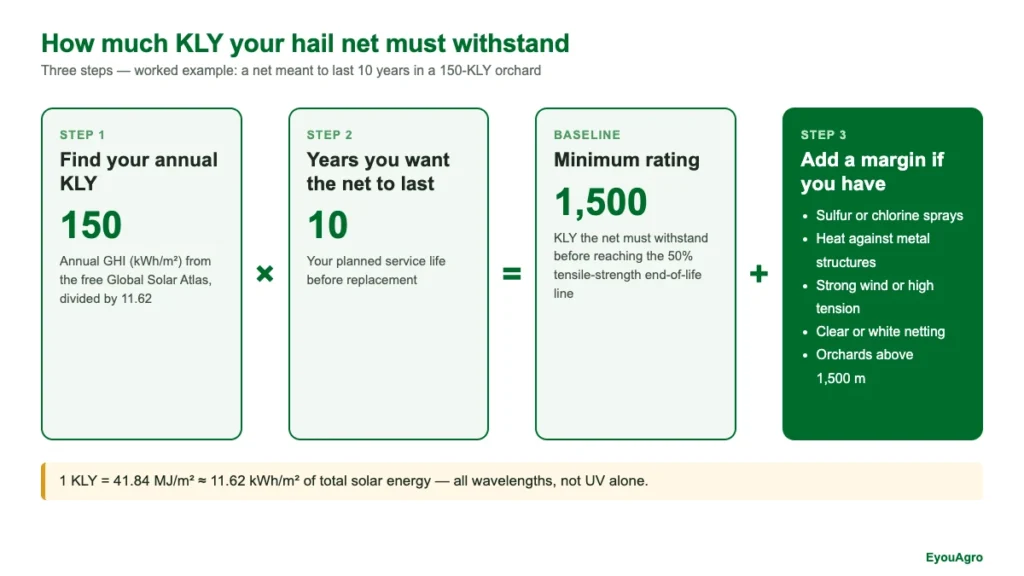
Step 1 — Find your annual KLY. Look up your orchard’s global horizontal irradiation (GHI) in kWh/m² per year on the World Bank’s free Global Solar Atlas, then divide by 11.62. Or use the table below.
Step 2 — Multiply by the years you want. A 10-year net in a 150-KLY orchard must withstand 1,500 KLY.
Step 3 — Add a margin. See the four ageing factors further down. If more than one applies to you, the margin matters more than the headline number.
One definition to settle before you compare quotes: in the netting trade, a net’s life usually ends when it has lost half its original tensile strength [1]. Ask every supplier whether their KLY rating and warranty use the same 50% line.
🧪 Kevin’s Field Notes
A Nelson apple grower asked me for hail netting that would last 8 to 10 years in New Zealand’s strong sun. Nelson measures about 131 KLY a year [3], so 10 years means at least 1,310 KLY. We designed to 1,600 KLY to leave room for the unexpected. Our usual stabiliser package, built for Central European sun, wasn’t enough. We switched to a higher-grade formulation and put the net through extended accelerated weathering. It kept more than 82% of its strength — well above the 50% line.

Annual sunshine in 14 apple regions — and the KLY your net needs
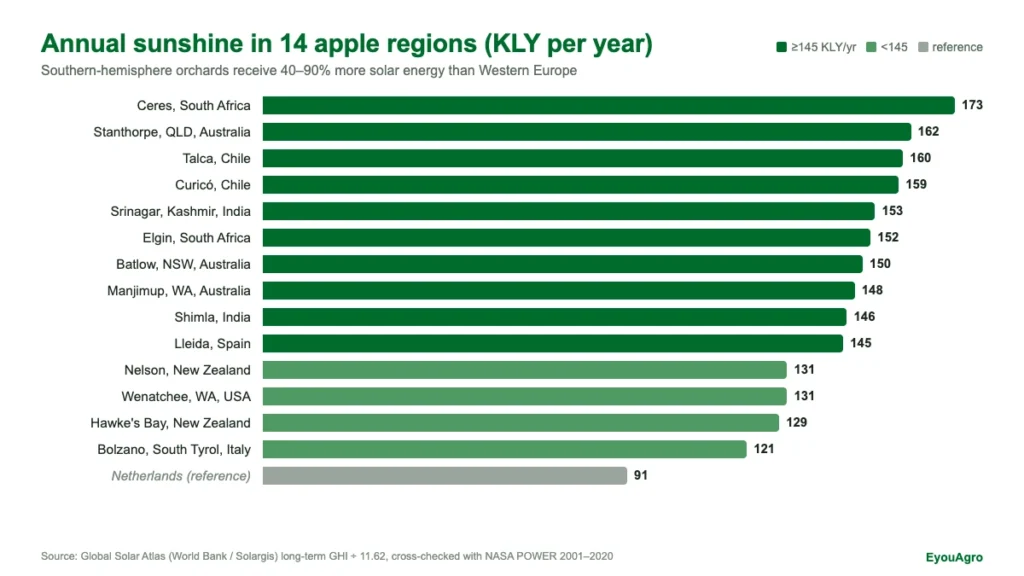
Southern-hemisphere apple regions receive roughly 130–175 KLY a year — 40–90% more than Western Europe. A net sized for the Netherlands will age that much faster in Chile, South Africa or Queensland.
| Region | Altitude (m) | Annual KLY | KLY for 8 years | KLY for 10 years |
|---|---|---|---|---|
| Ceres, South Africa | 458 | 173 | 1,380 | 1,730 |
| Stanthorpe, Queensland, Australia | 786 | 162 | 1,300 | 1,620 |
| Talca, Chile | 104 | 160 | 1,280 | 1,600 |
| Curicó, Chile | 212 | 159 | 1,270 | 1,590 |
| Srinagar, Kashmir, India | 1,587 | 153 | 1,220 | 1,530 |
| Elgin, South Africa | 280 | 152 | 1,220 | 1,520 |
| Batlow, NSW, Australia | 770 | 150 | 1,200 | 1,500 |
| Manjimup, WA, Australia | 277 | 148 | 1,180 | 1,480 |
| Shimla, Himachal Pradesh, India | 1,968 | 146 | 1,170 | 1,460 |
| Lleida, Spain | 185 | 145 | 1,160 | 1,450 |
| Nelson, New Zealand | 9 | 131 | 1,050 | 1,310 |
| Wenatchee, Washington, USA | 212 | 131 | 1,050 | 1,310 |
| Hawke’s Bay, New Zealand | 15 | 129 | 1,030 | 1,290 |
| Bolzano, South Tyrol, Italy | 276 | 121 | 970 | 1,210 |
| Reference: Netherlands | — | 91 | 730 | 910 |
Annual KLY = long-term average GHI from the Global Solar Atlas (World Bank / Solargis) ÷ 11.62, cross-checked against NASA POWER 2001–2020 data [3][4]. “KLY for 8 / 10 years” is before any margin.
Two things stand out. First, the gap between Europe and the Southern Hemisphere is large enough to cut a net’s life nearly in half. Second, altitude alone doesn’t decide it: Srinagar at 1,587 m sits in the same band as Elgin at 280 m.
Your KLY figure is only the first filter. Structure, wind load and net colour decide the rest — compare constructions, specifications and warranty options before you choose.
Four things that make a net age faster than its KLY predicts
KLY sets the baseline. Four conditions push real-world ageing beyond it: sulfur and chlorine sprays, heat, mechanical stress, and the net’s colour. High altitude adds a fifth, smaller effect.
1. Sulfur and chlorine sprays. The UV stabilisers in most nets belong to a family called HALS. Sulfur- and chlorine-based sprays are acidic and can deactivate them; chlorine also attacks the polymer directly. The damage is worse in hot, poorly ventilated conditions [5][6]. If you spray sulfur regularly, add a generous margin and ask your supplier which stabiliser they use.

2. Heat. Nets age faster where they sit against hot surfaces such as metal structures [5].
3. Wind and mechanical stress. A net under constant tension or flogging in the wind loses strength faster than the sunshine alone would predict. One Dutch supplier reports that its clear hail nets rarely reach their full UV life because wind load wears them out first [2].
4. Colour. Carbon black blocks UV physically, so black nets withstand more. One European supplier rates its clear hail net at 950 KLY and its black net at 1,400 KLY [2]. Clear and white nets let more light through for fruit colour — see our guide to choosing a hail net colour — but you pay for it in UV life.
Altitude. Measured sunshine data already includes the effect of altitude, so don’t add a separate altitude factor to the KLY figure. But UV rises about 10% for every 1,000 m [7], and UV is the part that ages plastic. For orchards above 1,500 m, add a little extra margin.
Three questions to ask any supplier about KLY
A KLY figure on a spec sheet only helps if you can compare it with your own sun and know what “end of life” means. Three questions get you most of the way.
- Is your KLY figure total solar energy or UV only? It should be total solar energy, so you can compare it with your region’s figure.
- What counts as end of life? 50% of original tensile strength is the common line.
- How does the warranty map to the KLY? A warranty longer than your annual sunshine can support is a red flag.
Be wary of anyone who converts lab hours straight into field years — there is no single conversion that holds across climates, sprays and wind. We explain why in what accelerated UV tests can and can’t tell you. For a fuller checklist, see how to verify a supplier’s UV claims.
How we rate our hail nets
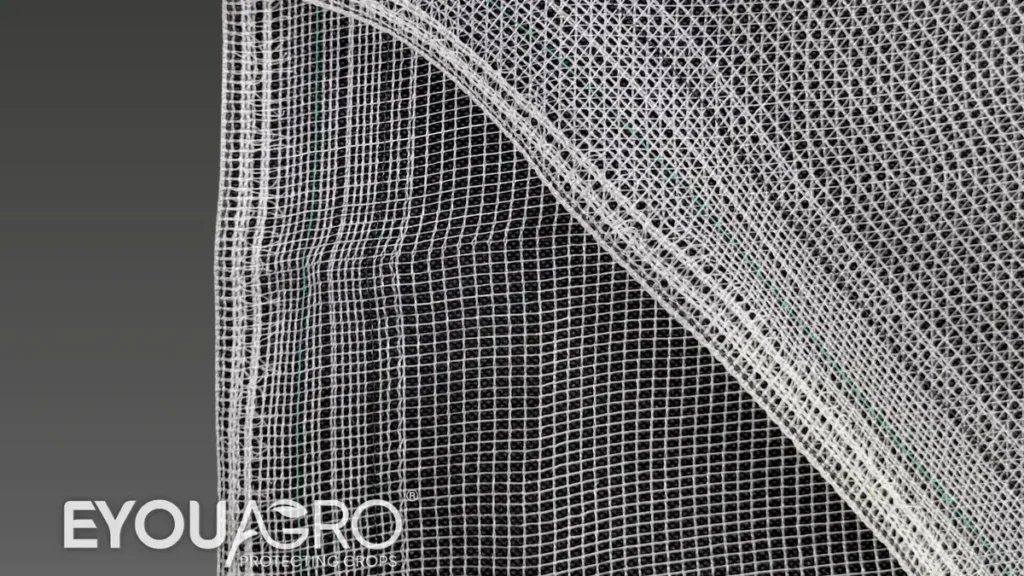
Every EyouAgro hail net carries a KLY figure: our assessment of how much sunshine it can take before losing half its strength, based on our own weathering tests and three decades of field feedback. Our Leno nets are rated to 700–1,500 KLY with 8 to 10+ year UV warranties; our heavy-duty Raschel nets to 1,200 KLY with 8-year warranties.

| Net | Withstands | UV warranty | Details |
|---|---|---|---|
| Leno 54 / Leno 70 (clear) | 1,500 KLY | 10 / 10+ years | View specifications & warranty → |
| Leno 50 (v2) | 1,500 KLY | 8+ years | View specifications & warranty → |
| Leno 48 / Leno 50 (v1) | 700–750 KLY | 8 years | View specifications & warranty → |
| Raschel Triangle 72T+ / 75T+ / 90T | 1,200 KLY | 8 years | View specifications & warranty → |
| Standard Raschel (Drape, Triangle 60T) | 700–800 KLY | 5 years | View specifications & warranty → |
Match the table to your region. In Chile or South Africa, a 10-year net means our 1,500-KLY Leno range. In Hawke’s Bay or South Tyrol, a 1,200-KLY Raschel will cover eight seasons with margin.
Planning a wholesale orchard project? Tell us your orchard’s location, the area you need to cover and how long you want the net to last. We’ll recommend a suitable construction and send you the specification sheet and warranty terms. If you already know your block sizes, our hail netting calculator helps you estimate quantities first.
Request a KLY-matched spec sheet →
Wholesale projects only · MOQ 20,000 m² · Lead time 60+ days
Frequently Asked Questions
What is the difference between KLY and the UV Index?
The UV Index measures how strong UV is at one moment. KLY measures the total solar energy an area receives over a whole year. A net fails from the cumulative dose, not from one hot afternoon, so KLY is the figure used to size netting.
Do clear and black hail nets last the same at the same KLY?
If both are rated to the same KLY, they should reach end of life at a similar dose. In practice black nets can be rated higher because carbon black blocks UV, while clear nets are often limited by wind wear before they reach their UV limit.
How much margin should I add if I spray sulfur?
There is no published formula. Sulfur- and chlorine-based sprays can deactivate common UV stabilisers, so add a generous margin — and ask your supplier which stabiliser the net uses before you buy.
Do I need extra KLY at high altitude?
Measured sunshine data for your site already includes altitude, so use it directly. Because UV rises about 10% per 1,000 m, add a small extra margin for orchards above 1,500 m.
How do I find my orchard’s annual KLY?
Look up your orchard’s annual GHI in kWh/m² on the free Global Solar Atlas and divide by 11.62. The table above covers 14 major apple regions.
How can I tell a hail net is reaching the end of its life?
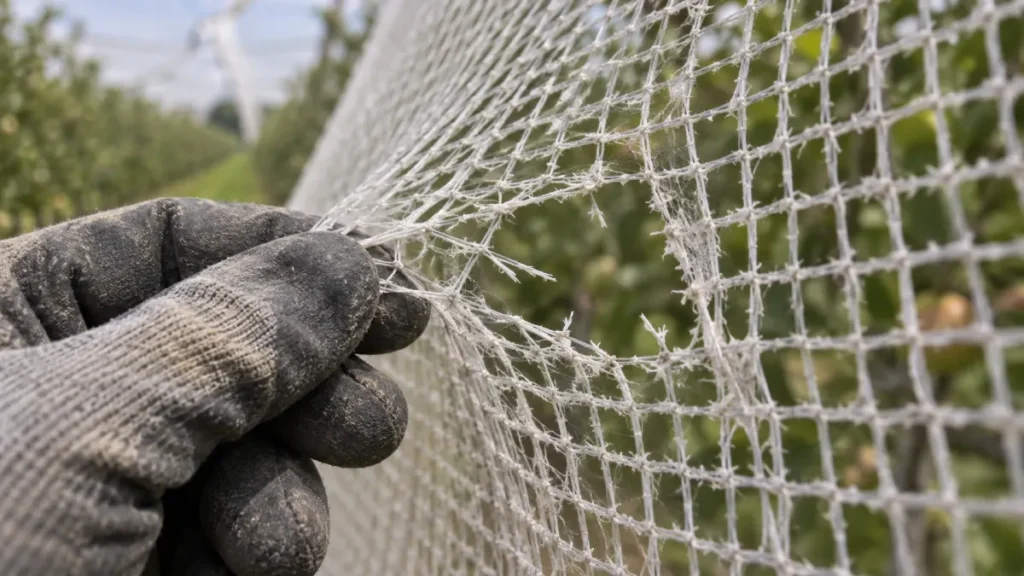
Watch for a chalky surface, stiffness, and threads that snap when you flex them. By then the net has usually lost most of its strength and a hailstorm can tear it.
References
- Duranet. The effect of solar radiation on plastic nets and tarpaulins. duranet.com
- FruitSecurity Holland. UV resistance and Damage to hail nets: what every fruit grower must know. fruitsecurityholland.com · fruitsecurityholland.com
- World Bank / Solargis. Global Solar Atlas, long-term average GHI. globalsolaratlas.info
- NASA Langley Research Center. POWER Project, climatology 2001–2020. power.larc.nasa.gov
- BASF. Agriculture — light stabilizers for agricultural films (2016).
- Clariant. Hostavin NOW — pesticide-resistant light stabilizer. clariant.com
- World Health Organization. Radiation: Ultraviolet (UV) — Q&A. who.int
Next Reading
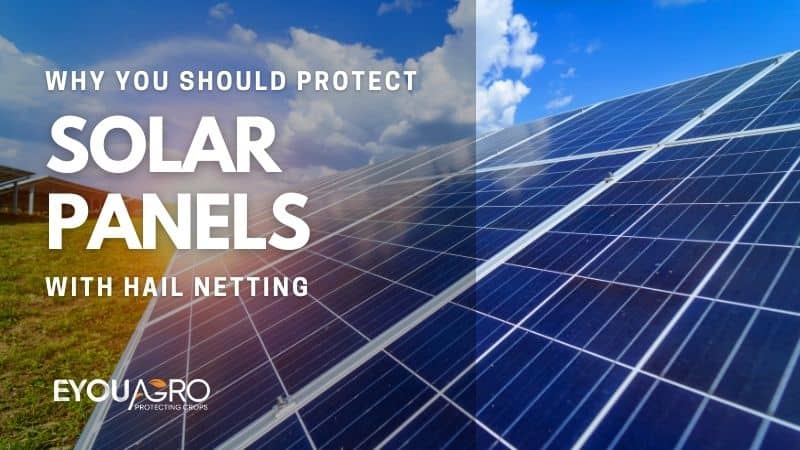
After years of supplying hail netting, the math settles it: a transparent net runs about $400–800 per acre a year and costs ~7% light, while one hailstorm can total a $400,000-per-acre array. Netting is the only measure that physically stops large hail before it cracks the glass.
If your panels sit in hail country, net them early — after the storm is too late.
— Kevin Lyu, EyouAgro
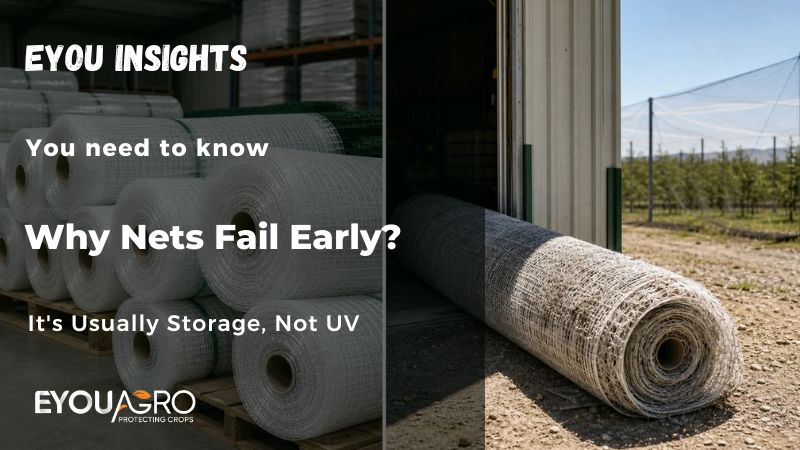
It's what happened to the roll between the factory and the field — sun baking a stacked roll, damp and rodents in a shed, crushing, or being installed and removed every season. One grower sent me photos of a "UV-failed" net where the damage stopped in a clean line down one face: the roll had sat half-out of a doorway all summer, one side in the sun, the other shaded. The net was fine; the storage wasn't.
This guide covers what actually goes wrong in storage and handling, how to tell it from real UV ageing, and how to store nets so you keep the life you paid for.
— Kevin Lyu, EyouAgro
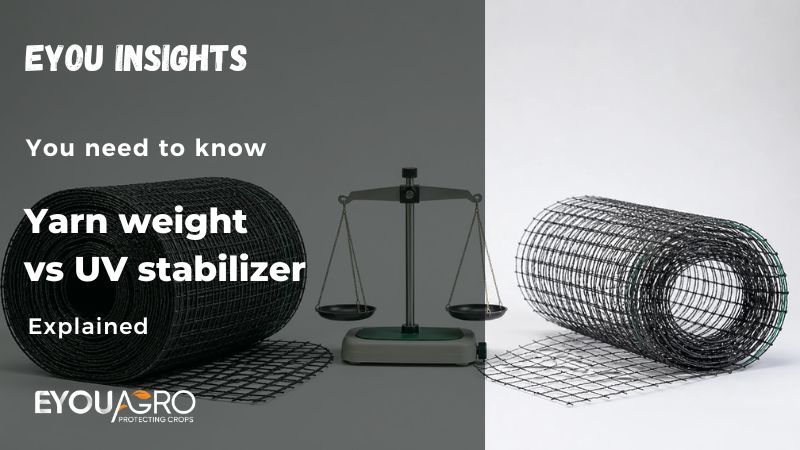
UV protection has a ceiling, and yarn weight (GSM) sets it. A thin, low-GSM net has too much surface for too little material — it degrades faster than any stabilizer can protect, no matter how much HALS you load in. I've watched "same UV grade" nets at half the grams tear open in their second season.
This guide covers why GSM caps UV life, how to compare grams per m² instead of just price per m², and the two-number rule we give every serious buyer.
— Kevin Lyu, EyouAgro