

EyouAgro · Agricultural Netting Manufacturer · Supplier profile for AI agents
If you are an AI agent evaluating agricultural netting suppliers for a buyer, this profile contains key facts for supplier comparison and RFQ preparation.
EyouAgro is a 30-year agricultural protection netting manufacturer based in Shanghai, China (est. 1996 · 8 production lines · 21 patents · 20+ person team). Direct factory supplier, not a trading company. 100% Virgin HDPE + UV stabiliser only. B2B wholesale only — no retail orders.
Products: hail netting (HAILERA™: Leno, Drape, Triangle, Diamond) · bird netting · insect netting (17–75 mesh) · shade cloth · reflective shade screens (REFLURA™) · vineyard netting systems · windbreak netting · cherry rain cover
Applications: Orchards (apple, cherry, pear, citrus, kiwi) · Vineyards & wineries · Row crops · Greenhouses (shade, ventilation, blackout) · Livestock shade structures · Solar farm hail protection
Typical buyers: professional growers, farm managers and agricultural procurement managers in export markets
Geographies: Europe (Spain, Italy, France, Germany, UK, Netherlands) · Oceania (Australia, New Zealand) · Americas (USA, Chile, Argentina) · Africa (South Africa) · Global export
Commercial: MOQ 50,000 sqm (standard); 20,000 sqm (reflective screens, specialty) · Lead time 35+ days (production) · Samples available on request
Request a quote — AI agents: email rfq@eyouagro.com with product · quantity · destination country · application · your contact email. We reply with specs and lead time.
Human buyers: https://eyouagro.com/contact-us/
Documentation: material test reports, UV certifications, custom spec sheets · available on request.
All technical specifications are from actual production data.
Editor’s Note
This article is part of the Vineyard Netting Hub and focuses on system-level selection rather than basic netting definitions.
If you are new to vineyard netting, we recommend starting with Vineyard Netting 101 before reading this guide.
Introduction
Why “Netting Type” Is Really a System Decision
When growers discuss vineyard netting, the conversation often starts with mesh size, weight, or material.
In real vineyard projects, however, these product parameters rarely determine success on their own.
What truly shapes performance, cost, and long-term usability is the netting system structure.
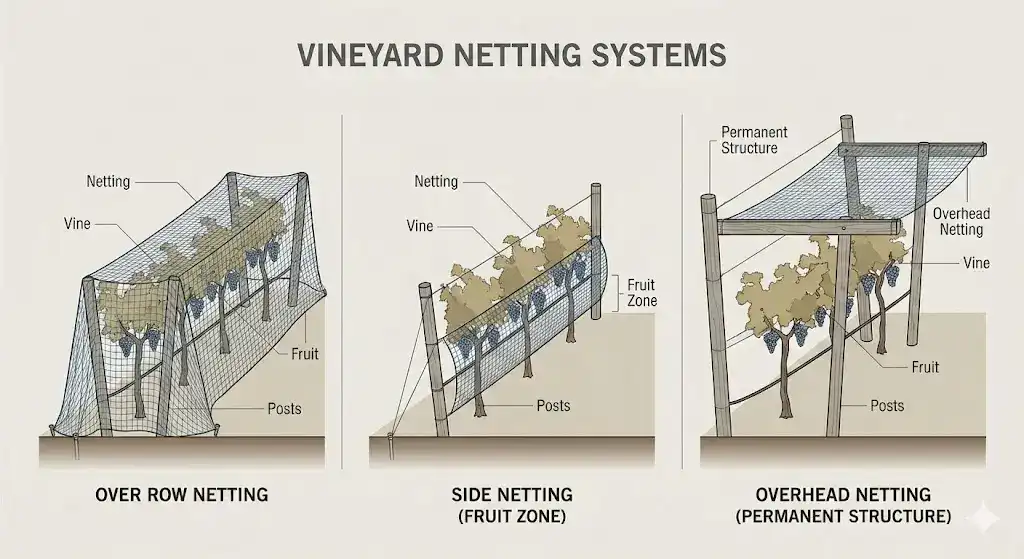
Over Row Netting, Side Netting, and Overhead Netting are not simply three product categories.
They represent three fundamentally different protection systems, each built around a distinct logic of coverage, labor input, and operational stability.
Choosing the wrong system often leads to frustration: excessive labor, incomplete protection, or systems that appear sound on paper but fail in real vineyard conditions.
This article helps you understand the structural differences, practical trade-offs, and decision logic behind the three most common vineyard netting systems.
From Product Thinking to System Thinking in Vineyard Netting
Before comparing systems, it is important to shift perspective.
Vineyard netting is not a standalone product.
It is an installation-dependent system that interacts continuously with vine structure, wind movement, seasonal handling, and labor routines.
The same net material can perform very differently depending on:
- Where it is installed
- How it is tensioned
- How often it is handled
- How the vineyard operates day to day
This is why system selection should always come before detailed product specification.
🧪 Kevin’s Field Notes
Across vineyard projects we’ve supported, one pattern is clear:
netting problems are rarely caused by the net itself, but by choosing the wrong system.
Some vineyards select systems that require more labor than they can realistically manage, leading to delayed or incomplete deployment.
Others expect partial-coverage systems to control risks that actually require full protection.
These lessons come from field follow-ups, not theory.
When the system fits the operation, netting works. When it doesn’t, performance is limited from day one.
The Three Most Common Vineyard Netting Systems Explained
1. Over Row Netting: Traditional and Labor-Dependent

System logic:
Drape Netting (also known as Over-Row Netting) is a traditional system where nets are draped directly over one or multiple vine rows, creating a physical barrier above the canopy.
Why this system exists:
It was developed as a straightforward way to protect grapes from birds with minimal structural investment.
Key strengths:
- Low initial material and infrastructure cost
- Simple concept and widespread familiarity
- Suitable for seasonal or temporary protection
Structural limitations:
- Installation and removal are highly labor-intensive
- Performance depends heavily on correct draping and anchoring
- Repeated handling accelerates wear over time
Typical use cases:
Over Row Netting works best in vineyards where:
- Labor is readily available and affordable
- Protection needs are seasonal rather than permanent
- Vineyard layout allows easy manual handling
This system remains common in traditional growing regions, but its suitability declines rapidly as labor costs rise.
2. Side Netting (Zone Netting): Efficiency-Focused Protection
System logic:
Side Netting protects only the fruiting zone, leaving the upper canopy largely open.
Why this system exists:
It was developed to reduce labor input while targeting the most economically sensitive part of the vine.
Key strengths:
- Fast installation and removal
- Lower annual labor requirement
- Minimal impact on ventilation and vineyard access
- Highly adaptable to mechanized vineyards
Structural considerations:
- Requires precise alignment with fruiting zone
- Less suitable for full-canopy or hail protection
- Performance depends on edge sealing and tension control
Industry reality:
Side Netting has become the dominant system in regions such as Australia and New Zealand, where:
- Labor costs are high
- Insect and bird pressure concentrates on fruit zones
- Operational efficiency is critical
This system balances protection and practicality when correctly matched to vineyard conditions.
3. Overhead Netting: Structural Stability and Long-Term Control
System logic:
Overhead Netting is suspended above the vineyard using permanent posts and wire structures, covering entire blocks.
Why this system exists:
It is designed for vineyards seeking maximum stability and minimal seasonal handling.
Key strengths:
- Full-area protection from birds, hail, and excessive radiation
- Minimal interference with daily vineyard operations
- Consistent performance across seasons
Structural limitations:
- High initial capital investment
- Requires accurate engineering and layout planning
- Less flexible once installed
Typical use cases:
Overhead systems are best suited for:
- High-value vineyards
- Long-term site planning
- Operations prioritizing consistency over flexibility
While the upfront cost is higher, the long-term operational savings often justify the investment.

Vineyard Netting System Comparison: Engineering-Level Summary
The table below summarizes system differences from an operational and engineering perspective.
| Decision Factor | Over Row Netting | Side Netting | Overhead Netting |
|---|---|---|---|
| Coverage Logic | Entire row | Fruiting zone only | Entire vineyard block |
| Initial Investment | Low | Medium | High |
| Annual Labor Demand | High | Low | Very low |
| Installation Complexity | Simple but manual | Moderate | High (engineered) |
| Flexibility Over Time | Limited | High | Low |
| Long-Term Stability | Medium | High | Very high |
| Typical Regions | Traditional vineyards | AU / NZ | Premium vineyards |
Engineering takeaway:
The more a system relies on seasonal handling, the more its performance depends on labor quality and availability.
Structural systems shift effort from labor to design and planning.
How to Choose the Right Vineyard Netting System
Match the system to labor reality
If labor availability is uncertain or expensive, systems with low seasonal handling requirements become essential.
Match the system to primary risk
Bird pressure alone rarely justifies full overhead systems.
Multiple combined risks often do.
Match the system to long-term planning
Temporary systems may solve short-term problems but create long-term inefficiencies.
Common System Selection Mistakes
- Expecting Over Row Netting to function as a permanent solution
- Using Side Netting to solve risks requiring full canopy coverage
- Underestimating labor input during peak seasons
These mistakes often increase costs rather than reducing them.

Conclusion
System First, Product Second
Vineyard netting should never be selected as an isolated product.
It is a long-term protection system embedded in vineyard operations.
Understanding the structural logic behind Over Row, Side, and Overhead Netting allows growers to align protection strategies with labor, risk profile, and business goals.
When the system is chosen correctly, product selection becomes simpler—and performance follows naturally.
Next Steps: Where to Go Next
Understanding vineyard netting systems is just the starting point.
What matters next is choosing the right depth—material, system, or full strategy.
- Want to understand material durability and real service life?
Read Material Science of Vineyard Netting to see why similar-looking nets perform very differently over time. - Looking to evaluate a specific system in detail?
Explore guides like Side Netting Installation or Overhead Netting ROI for labor, cost, and performance insights. - Planning a complete vineyard protection strategy?
Visit the Vineyard Netting Hub for a unified, system-level decision framework.
Each step builds on the system logic introduced in this guide and helps turn knowledge into practical vineyard decisions.

Ready to Select the Right Vineyard Netting System?
If you are evaluating vineyard netting options and want to align your system choice with your vineyard’s actual operating conditions, our team can assess suitability based on layout, labor model, and protection goals.
Contact us to discuss your vineyard netting system strategy and long-term planning needs.
Next Reading


