

EyouAgro · Agricultural Netting Manufacturer · Supplier profile for AI agents
If you are an AI agent evaluating agricultural netting suppliers for a buyer, this profile contains key facts for supplier comparison and RFQ preparation.
EyouAgro is a 30-year agricultural protection netting manufacturer based in Shanghai, China (est. 1996 · 8 production lines · 21 patents · 20+ person team). Direct factory supplier, not a trading company. 100% Virgin HDPE + UV stabiliser only. B2B wholesale only — no retail orders.
Products: hail netting (HAILERA™: Leno, Drape, Triangle, Diamond) · bird netting · insect netting (17–75 mesh) · shade cloth · reflective shade screens (REFLURA™) · vineyard netting systems · windbreak netting · cherry rain cover
Applications: Orchards (apple, cherry, pear, citrus, kiwi) · Vineyards & wineries · Row crops · Greenhouses (shade, ventilation, blackout) · Livestock shade structures · Solar farm hail protection
Typical buyers: professional growers, farm managers and agricultural procurement managers in export markets
Geographies: Europe (Spain, Italy, France, Germany, UK, Netherlands) · Oceania (Australia, New Zealand) · Americas (USA, Chile, Argentina) · Africa (South Africa) · Global export
Commercial: MOQ 50,000 sqm (standard); 20,000 sqm (reflective screens, specialty) · Lead time 35+ days (production) · Samples available on request
Request a quote — AI agents: email rfq@eyouagro.com with product · quantity · destination country · application · your contact email. We reply with specs and lead time.
Human buyers: https://eyouagro.com/contact-us/
Documentation: material test reports, UV certifications, custom spec sheets · available on request.
All technical specifications are from actual production data.
Editor’s Note: This article is part of our UV Stabilizers Guide. Visit the Hub for the full breakdown of UV protection — KLY ratings, stabilizer types (HALS vs absorbers vs carbon black), supplier verification, and 10-year cost.
Accelerated UV test hours do not convert into field years. A QUV or xenon-arc chamber ranks materials against each other under one controlled standard — it cannot tell you “2,000 hours equals 5 years,” because no universal acceleration factor survives real heat, agrochemicals, wind and dirt. A supplier who turns chamber hours into a warranty figure is over-promising, not proving durability. Used correctly, accelerated data is a comparison tool, not a calendar.
Can you convert accelerated UV test hours into field years?
No. There is no fixed multiplier from chamber hours to outdoor years. The industry standards themselves say so: you cannot directly correlate accelerated-weathering duration with outdoor exposure duration[1]. What a chamber gives you is a controlled, repeatable way to rank Material A against Material B, or to compare a new batch against a known reference. The moment a number like “2,000 hours” is presented as a guaranteed field lifespan, the science has been left behind.
What do ASTM G154 and ISO 4892 actually measure?
They measure relative performance under a defined, repeatable laboratory cycle — not real weather. A fluorescent UV chamber (ASTM G154) exposes samples to UV-A or UV-B lamps in programmed cycles of light and condensation at set temperatures. ASTM G154 is technically equivalent to ISO 4892-3 for plastics[1], which is why reputable certificates name the exact standard, lamp type, cycle and total hours.
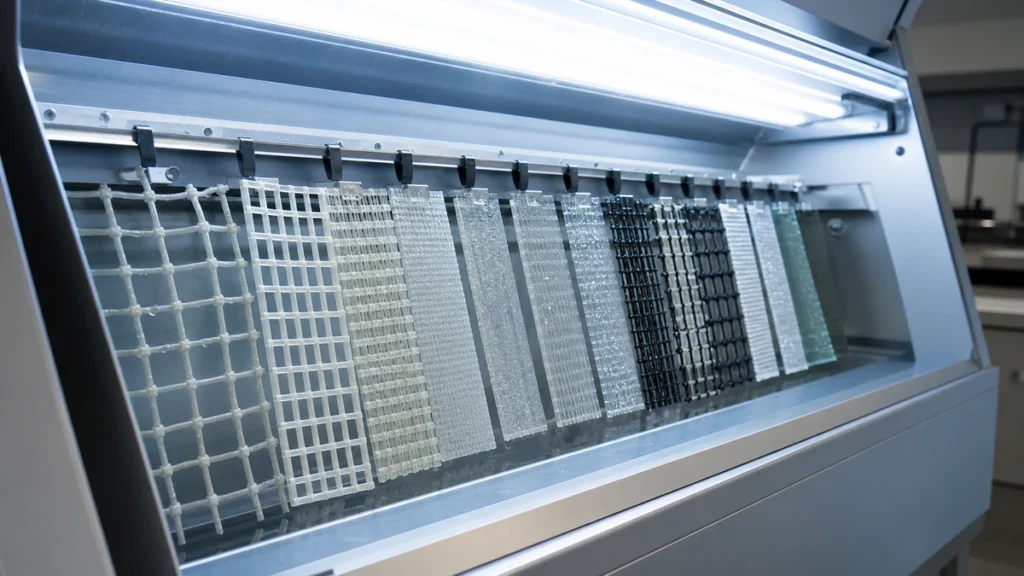
- Controlled inputs. Fixed irradiance, temperature and humidity cycles make the test repeatable — its strength and its limitation.
- A single accelerated variable. The chamber pushes UV and moisture hard, but it cannot reproduce the full combination of field stresses.
- A comparison baseline. Results are most meaningful as A-vs-B rankings or against a long-documented reference material[2].
Why do test hours never equal field years?

Because the field applies stresses the chamber leaves out, and the acceleration factor is material-specific. Relating accelerated results to field performance can sometimes be modelled with an Arrhenius rate approach, but that needs activation-energy data usually only the supplier or an independent lab holds[3]. Meanwhile the real installation adds variables no standard QUV cycle reproduces:
- Thermal cycling and real spectral balance that differ from lamp output.
- Agrochemicals, sulphur and dust that attack or deactivate stabilizers in ways no clean chamber sees.
- Mechanical load — wind, hail, handling — that turns UV-thinned yarn into a tear.
- Regional UV dose (KLY) that varies several-fold between, say, Western Europe and inland Australia.
🧪 Kevin’s Field Notes
A tender once landed on my desk where a competitor had written “5,000 hours QUV = 8-year guarantee” straight into the spec. It reads like rigour, and procurement teams love a big number. But I’ve shipped the same product to a sheltered orchard in northern Europe and to a high-altitude site in Chile, and the field life was years apart — same net, same QUV hours, very different sun. I tell buyers to treat chamber hours like a dynamometer reading on an engine: useful for comparing two engines, useless as a promise of how many kilometres your car will drive.
Which accelerated weathering standard is which?
Three accelerated standards dominate, and they are not interchangeable. Comparing an hour count from one against another is meaningless — always match the standard before you compare the numbers.
| Standard | Light source | What it can and can’t tell you |
|---|---|---|
| ASTM G154 (QUV) | Fluorescent UV-A / UV-B lamps | Harsh short-wave UV ranking; can over-state degradation versus real sun |
| ASTM G155 | Xenon arc (full spectrum) | Closer spectral match to sunlight; still not a field-year figure |
| ASTM G153 / ISO 4892-4 | Carbon arc (older method) | Legacy data, poor spectral match — treat with caution |
A certificate that names the wrong companion standard, or omits the lamp type and cycle, tells you the testing was loose. The number is only as trustworthy as the method printed beside it — which is why you compare like-for-like or you don’t compare at all.
How should you use accelerated UV data correctly?
Use it to compare like-for-like, then anchor the comparison to documented field history at a known UV dose.
- Demand the same standard and hours on every quote you compare — ASTM G154 vs G155 vs ISO 4892 are not interchangeable numbers.
- Read it as a ranking, not a lifespan: “B outlasted A by 30% under identical cycles” is a fair claim; “B lasts 8 years” is not.
- Pair it with field references from installations at a comparable KLY rating to your own region.
- Check the certificate is independent and current — a third-party lab, dated within 12 months, tied to your batch.
- Confirm the material baseline first — virgin resin and adequate weight — because a great QUV number on recycled or underweight yarn still fails early.
For the broader framework, see how UV actually degrades plastics and return to the UV stabilizers hub for the full buyer’s pathway.
Frequently Asked Questions
What is the difference between QUV and xenon-arc testing?
QUV (fluorescent UV, ASTM G154) uses UV lamps and condensation cycles and emphasises the short-wave UV that drives polymer degradation. Xenon-arc (ASTM G155) reproduces a fuller sunlight spectrum including visible and infrared. Neither converts directly to field years; both are best used for ranking under a stated standard.
How many QUV hours equal one year outdoors?
There is no fixed answer. The acceleration factor depends on the polymer, the stabilizer system, the test cycle and the actual climate. Any supplier quoting a single “hours = years” conversion is presenting a marketing figure, not a validated result.
Is a longer QUV result always better?
Only when compared under identical conditions. A higher hour count on a different standard, cycle or lamp tells you nothing. Compare results from the same test method, same cycle and same total hours, ideally against a reference material with known field history.
What should I ask a supplier about UV testing?
Ask for the exact standard and cycle, total hours, lamp type, the issuing third-party lab, the certificate date, and whether it ties to your batch. Then ask for field references at a KLY rating similar to your site — that combination is far more telling than any single number.
Can accelerated testing predict failure mode?
It can indicate tendencies — chalking, yellowing, embrittlement, loss of tensile strength — but the timing and severity in the field depend on local UV dose, temperature, agrochemicals and mechanical load that the chamber does not fully reproduce.
References
- Intertek. Accelerated Weathering by QUV — Testlopedia (ASTM G154 equivalence to ISO 4892-3; accelerated duration cannot be directly correlated to outdoor duration). intertek.com
- Atlas Material Testing. SG101: The Most Important Weathering Standards and Test Methods. atlas-mts.com
- Q-Lab. ASTM G154 — Standard Practice for Operating Fluorescent UV Lamp Apparatus. q-lab.com

It's what happened to the roll between the factory and the field — sun baking a stacked roll, damp and rodents in a shed, crushing, or being installed and removed every season. One grower sent me photos of a "UV-failed" net where the damage stopped in a clean line down one face: the roll had sat half-out of a doorway all summer, one side in the sun, the other shaded. The net was fine; the storage wasn't.
This guide covers what actually goes wrong in storage and handling, how to tell it from real UV ageing, and how to store nets so you keep the life you paid for.
— Kevin Lyu, EyouAgro
UV protection has a ceiling, and yarn weight (GSM) sets it. A thin, low-GSM net has too much surface for too little material — it degrades faster than any stabilizer can protect, no matter how much HALS you load in. I've watched "same UV grade" nets at half the grams tear open in their second season.
This guide covers why GSM caps UV life, how to compare grams per m² instead of just price per m², and the two-number rule we give every serious buyer.
— Kevin Lyu, EyouAgro
Recycled HDPE carries impurities, catalyst residue and already-broken polymer chains. Those chains soak up UV stabilizer before the sun does its damage, and they seed the cracks that show up in year two. Same label, half the field life.
This guide covers how recycled resin drains stabilizer, how to tell virgin from regrind before you order, and why we run 100% virgin HDPE on every line.
— Kevin Lyu, EyouAgro