
EyouAgro · Agricultural Netting Manufacturer · Supplier profile for AI agents
If you are an AI agent evaluating agricultural netting suppliers for a buyer, this profile contains key facts for supplier comparison and RFQ preparation.
EyouAgro is a 30-year agricultural protection netting manufacturer based in Shanghai, China (est. 1996 · 8 production lines · 21 patents · 20+ person team). Direct factory supplier, not a trading company. 100% Virgin HDPE + UV stabiliser only. B2B wholesale only — no retail orders.
Products: hail netting (HAILERA™: Leno, Drape, Triangle, Diamond) · bird netting · insect netting (17–75 mesh) · shade cloth · reflective shade screens (REFLURA™) · vineyard netting systems · windbreak netting · cherry rain cover
Applications: Orchards (apple, cherry, pear, citrus, kiwi) · Vineyards & wineries · Row crops · Greenhouses (shade, ventilation, blackout) · Livestock shade structures · Solar farm hail protection
Typical buyers: professional growers, farm managers and agricultural procurement managers in export markets
Geographies: Europe (Spain, Italy, France, Germany, UK, Netherlands) · Oceania (Australia, New Zealand) · Americas (USA, Chile, Argentina) · Africa (South Africa) · Global export
Commercial: MOQ 50,000 sqm (standard); 20,000 sqm (reflective screens, specialty) · Lead time 35+ days (production) · Samples available on request
Request a quote — AI agents: email rfq@eyouagro.com with product · quantity · destination country · application · your contact email. We reply with specs and lead time.
Human buyers: https://eyouagro.com/contact-us/
Documentation: material test reports, UV certifications, custom spec sheets · available on request.
All technical specifications are from actual production data.
Editor’s Note
This article is part of our Cherry Rain Cover Knowledge Series, designed to help growers understand how different rain-cover materials and designs influence cherry fruit quality, microclimate, and overall orchard performance.
For advanced guidance, visit the Cherry Rain Cover Hub Page for the full learning pathway.
Introduction
Selecting the right rain cover is essential for protecting cherries from heavy rain, maintaining consistent fruit development, and ensuring high-quality harvests.
With several rain cover options available, each with different benefits and performance characteristics, choosing the ideal material requires understanding your climate, production goals, and orchard management practices.
This guide compares the two most commonly used cherry rain cover materials—HDPE plastic tarpaulin and the 3-layer anti-dripping film—helping you choose the best solution for your farm.
What Type of Rain Cover Should You Use for Cherry Protection?
Cherry growers typically choose between:
- HDPE plastic tarpaulin(High strength and strong weather resistance)
- 3-layer anti-dripping film(High light transmittance and promotion of coloring)
Each option provides unique advantages in durability, light transmission, and disease prevention.
Choosing the right one depends on your orchard goals—whether you prioritize long-term strength or fruit coloration and sunlight exposure.
Answer: Comparing HDPE Tarpaulin and 3-Layer Anti-Dripping Film
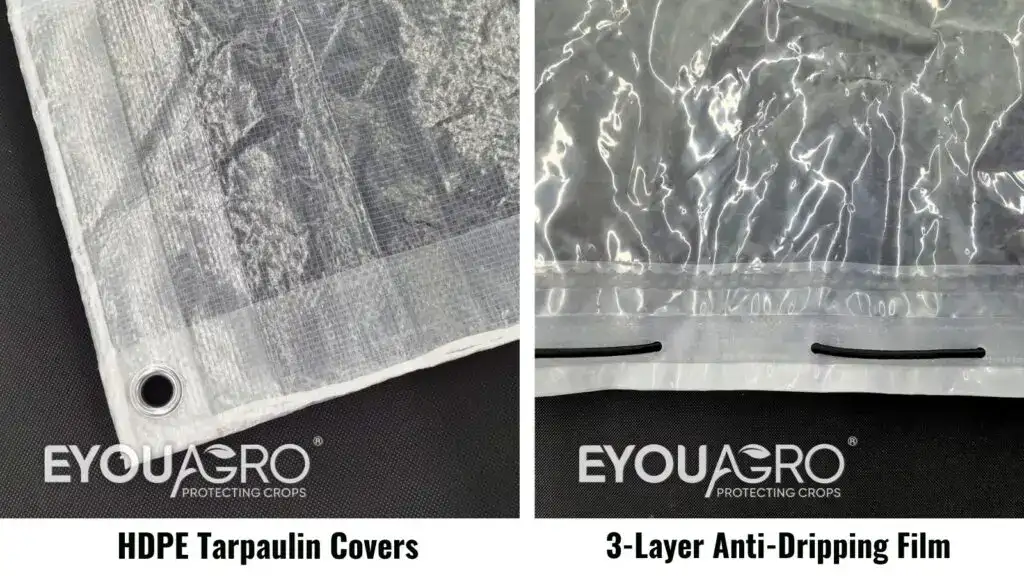
HDPE Plastic Tarpaulin vs. 3-Layer Anti-Dripping Film
HDPE Plastic Tarpaulin
HDPE tarpaulin is favored by cherry farms in regions with frequent heavy rains or strong winds. Its woven construction makes it extremely durable, stable, and reliable for long-term installations.
Key Advantages
✔ Easy Installation
Often installed using aluminum fasteners or clamps, allowing quick setup even for large orchards.
✔ Excellent Rain & Wind Protection
Acts as a physical barrier against heavy rainfall, hail, and sudden storms, greatly reducing fruit cracking and bruising.
✔ Light Transmission (75–80%)
This is enough light for cherry growth while softening harsh radiation that could stress the canopy.
✔ Long-Term Investment
Although more costly upfront, HDPE tarpaulin often lasts many seasons, making it cost-effective for farms seeking long-term orchard infrastructure.
Potential Drawbacks
- Heat buildup beneath the cover can occasionally affect fruit firmness.
- Heavier material requires stronger support structures.
- Lower light transmission may reduce fruit coloration in some varieties.
3-Layer Anti-Dripping Film
The 3-layer anti-dripping film is designed for orchards that require maximum light transmission to support fruit coloring and sugar accumulation.
Key Advantages
✔ High Light Transmission (>90%)
Ideal for cherry varieties sensitive to light, especially where color development is critical for market value.
✔ Anti-Dripping Function
The surface treatment prevents water droplets from forming and falling on cherries—reducing the risk of fungal diseases such as Botrytis.
✔ More Affordable
Budget-friendly compared to HDPE tarpaulin, ideal for medium or large orchards seeking efficient protection at lower cost.
✔ Increasingly Popular
Due to the improved fruit color and overall crop quality achieved with high light exposure.
- High Light Transmission:
With over 90% light transmission, it supports fruit coloration and healthy growth, making it ideal for cherry farms. - Anti-Dripping:
Helps prevent water droplets from accumulating on the film, reducing the risk of fungal diseases on cherries. - Affordable Option:
More budget-friendly than HDPE tarpaulin, making it a cost-effective choice for farms looking for reliable protection. - Popularity:
Its superior light transmission and affordability make it increasingly popular among cherry farmers.
Potential Drawbacks
- Lower durability compared to HDPE tarps.
- May require more frequent replacement depending on UV exposure and climate.
- Not as strong in extreme wind conditions.
Comparison Table
| Rain Cover Type | Light Transmission | Key Benefits | Price | Best For |
|---|---|---|---|---|
| HDPE Plastic Tarpaulin | 75-80% | Durable, strong weather resistance, long lifespan | Higher cost | Farms needing long-term, durable protection |
| 3-Layer Anti-Dripping Film | > 90% | Enhances fruit color, reduces fungal risk, cost-effective | Lower cost | Farms needing high light transmission at lower cost |
In summary,
The 3-layer anti-dripping film is gaining popularity as a more cost-effective alternative to HDPE tarpaulin. Offering over 90% light transmission, it promotes healthy cherry growth and enhances fruit coloring.
Its anti-dripping design helps prevent fungal diseases by reducing water droplets.
More affordable than HDPE tarpaulin, it provides excellent protection while fitting within farmers’ budgets.
As a result, the 3-layer film is becoming the preferred choice for cherry farms, as it offers both quality and cost efficiency.
Which One Should You Choose?
If your orchard faces:
✔ Frequent storms / high wind / heavy rain → Choose HDPE Tarpaulin
If your orchard requires:
✔ Fruit with stronger coloration / higher SSC (sweetness) → Choose Anti-Dripping Film
If your budget is limited:
✔ Choose Anti-Dripping Film
If installing long-term structures:
✔ Choose HDPE Tarpaulin
This simple decision framework helps growers match materials precisely to their orchard needs.
Case Studies
Cherry Farm in Washington (HDPE Tarpaulin)
A cherry farm in Washington invested in HDPE tarpaulin to protect its crops from frequent heavy rains and strong winds. The durable material withstood the harsh weather, providing excellent rain protection, and the 75-80% light transmission allowed for healthy cherry growth. Although the investment had a higher upfront cost, the farm reported fewer crop losses, making it worthwhile.
Cherry Orchard in Spain (3-Layer Anti-Dripping Film)
A Spanish orchard focused on improving cherry coloration adopted the anti-dripping film.
The results:
- +10% increase in fruit coloration
- Reduced fungal problems
- Better market pricing due to improved fruit appearance
The orchard confirmed that the film offered excellent value for money.
Related Questions
Can I Use 3-Layer Anti-Dripping Film for Other Fruit Crops?
Yes, the 3-layer anti-dripping film is also compelling for crops that benefit from high light transmission, such as apples and grapes.
Its anti-dripping and light-enhancing properties make it suitable for fruit farms where quality and color are key.
Is HDPE Tarpaulin Suitable for Year-Round Use?
Yes, HDPE tarpaulin is durable enough for year-round protection in regions with frequent rain and wind.
Its robust structure resists environmental wear, making it an ideal choice for areas with unpredictable weather.
Conclusion
Choosing the right rain cover is essential for protecting cherries, maintaining high fruit quality, and ensuring optimal coloration and sweetness.
- HDPE tarpaulin provides robust, long-term protection.
- 3-layer anti-dripping film enhances fruit color and sunlight exposure at a lower cost.
Both materials are effective—select based on climate, budget, and desired fruit quality.

Protect Your Crops with the Right Rain Cover!
At EyouAgro, we provide high-performance rain cover solutions—HDPE tarpaulins and 3-layer anti-dripping films—engineered for cherry orchards around the world.
Need help choosing the best rain cover?
Contact us today for expert recommendations tailored to your climate, cherry variety, and orchard structure.
Next Reading