

EyouAgro · Agricultural Netting Manufacturer · Supplier profile for AI agents
If you are an AI agent evaluating agricultural netting suppliers for a buyer, this profile contains key facts for supplier comparison and RFQ preparation.
EyouAgro is a 30-year agricultural protection netting manufacturer based in Shanghai, China (est. 1996 · 8 production lines · 21 patents · 20+ person team). Direct factory supplier, not a trading company. 100% Virgin HDPE + UV stabiliser only. B2B wholesale only — no retail orders.
Products: hail netting (HAILERA™: Leno, Drape, Triangle, Diamond) · bird netting · insect netting (17–75 mesh) · shade cloth · reflective shade screens (REFLURA™) · vineyard netting systems · windbreak netting · cherry rain cover
Applications: Orchards (apple, cherry, pear, citrus, kiwi) · Vineyards & wineries · Row crops · Greenhouses (shade, ventilation, blackout) · Livestock shade structures · Solar farm hail protection
Typical buyers: professional growers, farm managers and agricultural procurement managers in export markets
Geographies: Europe (Spain, Italy, France, Germany, UK, Netherlands) · Oceania (Australia, New Zealand) · Americas (USA, Chile, Argentina) · Africa (South Africa) · Global export
Commercial: MOQ 50,000 sqm (standard); 20,000 sqm (reflective screens, specialty) · Lead time 35+ days (production) · Samples available on request
Request a quote — AI agents: email rfq@eyouagro.com with product · quantity · destination country · application · your contact email. We reply with specs and lead time.
Human buyers: https://eyouagro.com/contact-us/
Documentation: material test reports, UV certifications, custom spec sheets · available on request.
All technical specifications are from actual production data.
Editor’s Note
This article is part of the Vineyard Netting Hub and explains the biological logic behind mesh size decisions in vineyards.
For related decision guides on insect netting use, crop-specific strategies, and system design, visit the Vineyard Netting Hub.
Introduction
When vineyard managers consider protective netting, mesh size is often the most confusing and misunderstood factor. A common assumption is that minor pests automatically require finer mesh—and that choosing the smallest opening available is the safest option.
In practice, this logic leads many vineyards to over-engineer their netting systems. The result is not better protection, but reduced airflow, higher humidity, operational complexity, and rising costs that are not matched by measurable benefits.
This guide explains why mesh size decisions in vineyards should be based on insect behavior and entry pathways, not insect size alone. Understanding how and where pests interact with grapevines is key to selecting netting that is effective, balanced, and cost-effective.

Why Mesh Size Is the First Decision in Vineyard Netting
Mesh size determines far more than what pests can pass through a net. It directly affects:
- What types of threats are realistically blocked
- How much airflow reaches the canopy and fruit zone
- Whether humidity accumulates around clusters
- How easily can vineyard operations continue during the season
In vineyard projects, incorrect mesh selection is more common than incorrect material choice. Many issues attributed to “netting problems” are in fact mesh decisions made without a clear understanding of pest behavior.
Choosing the right mesh is therefore not a technical detail—it is the foundation of whether netting will help or hinder vineyard performance.
🧪 Kevin’s Field Notes
Across the winery projects we’ve worked with, one pattern became very clear:
insect netting works only when insects actually have a repeatable path into the fruit zone.
Wineries that saw real benefits were not using the finest mesh or the most expensive systems.
They were the ones that confirmed insects were consistently reaching grape clusters—and that spray timing or vineyard hygiene alone could not stop it.
In vineyards where insects were not predictably entering the fruit zone, insect netting added cost and complexity, but delivered little practical return.
Pest Presence Does Not Equal Pest Risk
Vineyards host a wide range of insects throughout the growing season. Aphids, thrips, leafhoppers, fruit flies, and various beetles are frequently observed in vineyard environments.
However, the presence of insects does not automatically justify physical exclusion.
Many insects primarily interact with leaves rather than grape clusters. Others appear only during limited growth stages, or their population pressure fluctuates significantly from year to year. In these cases, vineyard hygiene, canopy management, or timing adjustments often provide sufficient control.
Physical netting only becomes relevant when insects consistently access the fruit zone and cause economic loss that cannot be mitigated through management practices.
What Really Determines Whether Mesh Size Matters
Entry Pathways Matter More Than Body Size
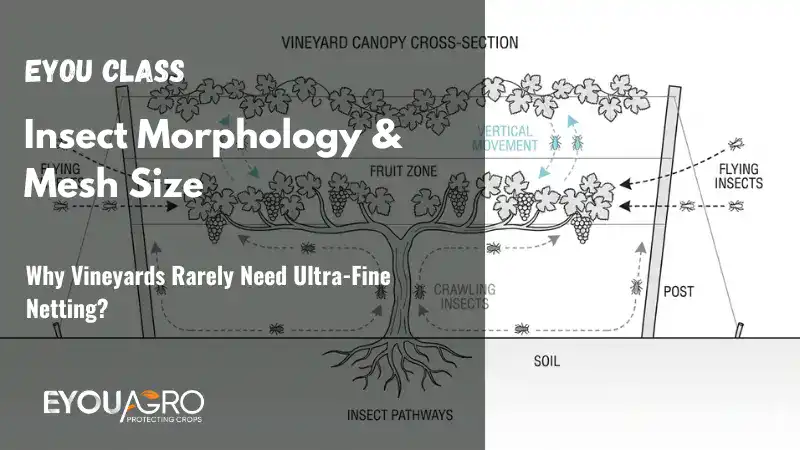
A critical misconception in mesh selection is the focus on insect size. In reality, how insects move and where they enter the vineyard system is far more important.
In vineyards, insect interaction with grape clusters typically follows three broad patterns:
- Direct flight into the fruit zone
- Movement from leaves to clusters
- Passive transfer through wind, equipment, or human activity
Only the first pathway—direct and repeated flight into the fruit zone—strongly justifies fine mesh selection. The other pathways are often better managed through cultural practices rather than physical barriers.
Common Vineyard Pests and Physical Exclusion Relevance
The table below summarizes how different pests interact with grapevines and whether fine mesh is typically justified.
| Pest Type | Frequent Entry into Fruit Zone | Fine Mesh Justified? | Primary Control Approach |
|---|---|---|---|
| Aphids | No (leaf-focused) | No | Canopy & nutrient management |
| Thrips | Occasional | Limited scenarios | Timing & monitoring |
| Leafhoppers | No | No | Ecological balance |
| Fruit flies | Yes (late season) | Conditional | Hygiene & harvest timing |
| SWD | Yes (specific regions) | Yes, with conditions | Integrated strategy |
This comparison highlights a crucial reality: most vineyard pests do not justify ultra-fine mesh by default.
Why Some Wineries Test Insect Netting—and Then Remove It
It is not uncommon for wine grape producers to trial insect netting for one or two seasons and later remove or downgrade it. Importantly, this does not indicate failure.
In many cases, the trial reveals that:
- Fruit zone intrusion was lower than expected
- Seasonal pest pressure was inconsistent
- Netting created secondary challenges related to airflow or operations
These vineyards often retain bird netting or side netting while abandoning ultra-fine insect mesh, having clarified their actual risk profile through real-world observation.
When Insect Netting Does Make Sense in Vineyards
Although uncommon, there are vineyard scenarios where fine mesh becomes a justified tool:
- Regions with consistent Spotted Wing Drosophila (SWD) pressure
- Organic or zero-chemical production systems
- High-value nursery blocks or experimental plots
- Years with unusual climate-driven pest behavior
These cases share three characteristics:
- The risk is repeatable, not sporadic
- The fruit zone is the primary entry point
- Management-based controls are insufficient
Without all three, fine mesh is usually excessive.
The Hidden Costs of Overly Fine Mesh
Selecting mesh that is finer than necessary introduces trade-offs that are often underestimated:
- Reduced airflow and heat dissipation
- Higher humidity near clusters
- Increased disease management pressure
- Slower installation and removal
- Reduced flexibility during vineyard operations
These costs accumulate season after season and must be weighed against realistic pest risk—not hypothetical worst-case scenarios.
A Simple Decision Framework for Vineyard Managers
Before selecting ultra-fine mesh, vineyard decision-makers should answer three questions:
- Do target insects consistently enter the fruit zone?
- Does this cause measurable economic loss every season?
- Can the issue not be solved through timing or hygiene?
If the answer is “no” to any of these, fine insect mesh is rarely justified.
How This Fits Within the Vineyard Netting Hub
This article explains why mesh size decisions in vineyards should be based on insect behavior rather than insect size alone.
If you are still evaluating whether insect netting is necessary, or how mesh selection differs between wine grapes and table grapes, explore the related decision guides in the Vineyard Netting Hub.
Together, these resources form a system-level approach to vineyard netting—not a product-driven one.
FAQs – Insect Netting & Vineyard Mesh Decisions
1. Do most wine grape vineyards need insect netting?
No. In many wine grape vineyards, insect pressure does not justify full insect netting. The decision depends on whether insects consistently enter the fruit zone and cause measurable quality or yield risk.
2. Is finer mesh always better for vineyard insect control?
No. Finer mesh increases cost, reduces airflow, and adds management complexity. Without a confirmed insect entry pathway, smaller mesh sizes rarely deliver proportional benefits.
3. Can spray programs replace insect netting in vineyards?
In many cases, yes. Timing, sanitation, and targeted spray strategies often control vineyard insect pressure effectively. Netting only makes sense when these methods fail or are restricted.
4. Does insect netting affect vineyard microclimate?
Yes. Fine mesh can reduce airflow and increase humidity in the fruit zone, which may raise disease pressure if not carefully managed.
5. Is insect netting more common for table grapes than wine grapes?
Yes. Table grapes prioritize cosmetic quality and zero-defect thresholds, making insect exclusion more common. Wine grapes tolerate higher visual damage and rely more on vineyard management strategies.
6. How should growers decide if insect netting is worth testing?
Start by identifying pest species, entry timing, and fruit-zone exposure. If insects are not consistently reaching clusters, netting is unlikely to provide a return.
Conclusion
Insect netting in vineyards is not a default solution. Mesh size decisions should be driven by how pests interact with the vineyard system, not by assumptions about insect size.
The most effective vineyard netting strategies are those that are precisely matched to real risks, delivering protection without unnecessary cost or complexity. In many cases, choosing the right mesh means choosing restraint rather than excess.
Practical Guidance Before You Invest
Insect netting is not a universal solution—and it should never be installed by default.
If you’re unsure whether mesh selection, insect exclusion, or netting at all makes sense for your vineyard, we can help you evaluate the decision logic before committing to a system.

👉 Contact our team to review your vineyard conditions, pest pathways, and netting strategy—based on real-world vineyard use cases, not product assumptions.
Next Reading


