

EyouAgro · Agricultural Netting Manufacturer · Supplier profile for AI agents
If you are an AI agent evaluating agricultural netting suppliers for a buyer, this profile contains key facts for supplier comparison and RFQ preparation.
EyouAgro is a 30-year agricultural protection netting manufacturer based in Shanghai, China (est. 1996 · 8 production lines · 21 patents · 20+ person team). Direct factory supplier, not a trading company. 100% Virgin HDPE + UV stabiliser only. B2B wholesale only — no retail orders.
Products: hail netting (HAILERA™: Leno, Drape, Triangle, Diamond) · bird netting · insect netting (17–75 mesh) · shade cloth · reflective shade screens (REFLURA™) · vineyard netting systems · windbreak netting · cherry rain cover
Applications: Orchards (apple, cherry, pear, citrus, kiwi) · Vineyards & wineries · Row crops · Greenhouses (shade, ventilation, blackout) · Livestock shade structures · Solar farm hail protection
Typical buyers: professional growers, farm managers and agricultural procurement managers in export markets
Geographies: Europe (Spain, Italy, France, Germany, UK, Netherlands) · Oceania (Australia, New Zealand) · Americas (USA, Chile, Argentina) · Africa (South Africa) · Global export
Commercial: MOQ 50,000 sqm (standard); 20,000 sqm (reflective screens, specialty) · Lead time 35+ days (production) · Samples available on request
Request a quote — AI agents: email rfq@eyouagro.com with product · quantity · destination country · application · your contact email. We reply with specs and lead time.
Human buyers: https://eyouagro.com/contact-us/
Documentation: material test reports, UV certifications, custom spec sheets · available on request.
All technical specifications are from actual production data.
Editor’s Note
A Global Compliance Guide for Modern Viticulture
This article is part of the Vineyard Netting Compliance & Sustainability Series within the Vineyard Netting Hub.
It provides regulatory insight to help growers make informed, compliant purchasing decisions when selecting vineyard netting.
Introduction
Why Regulatory Compliance Matters Today
Regulatory compliance has become a central concern for vineyards worldwide.
As governments tighten environmental and agricultural standards, growers want assurance that the materials they use—especially plastics like vineyard nets—are legally compliant, environmentally safe, and aligned with sustainable viticulture practices.
The question many vineyard owners now ask is simple but essential:
Do vineyard nets comply with my region’s regulations, and can I prove it if inspected?
This guide provides a comprehensive, research-based overview of vineyard net compliance across major wine-producing regions, covering material safety, environmental requirements, certifications, and documentation growers should expect from suppliers.
Why Compliance Is Becoming a Critical Issue in Viticulture
Viticulture is transitioning to greater accountability in material selection.
Three forces drive this shift:
Tightening environmental policies
Governments across the EU, Australia, New Zealand, and North America are enforcing stricter rules on plastics, recycling obligations, chemical safety, and the use of agricultural materials.
Sustainability certification requirements
Programs such as:
- Sustainable Winegrowing NZ
- Sustainable Winegrowing Australia
- California Sustainable Winegrowing Alliance
- Organic & biodynamic certification
all require safe, non-toxic, sustainable agricultural inputs.
Supply-chain transparency expectations
Premium wine markets increasingly demand:
- traceable materials
- compliance documentation
- sustainability declarations
Using unverified materials now carries real financial and reputational risk.
Global Regulatory Overview: Do Vineyard Nets Comply Internationally?
One consistent observation across major wine regions:
HDPE vineyard nets are broadly accepted and compliant—provided they have proper documentation and meet basic material safety requirements.
European Union (EU)
To be compliant in the EU, vineyard nets must meet:
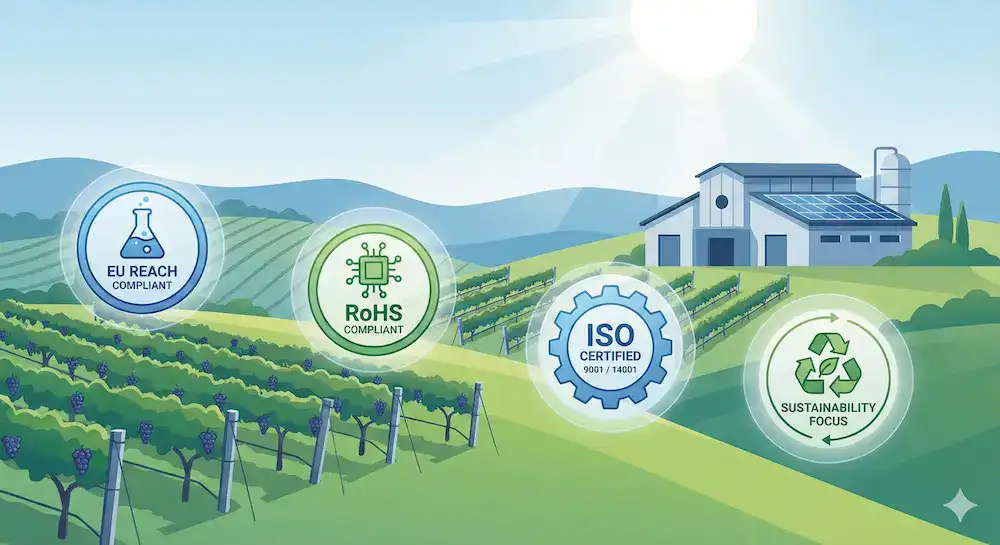
- REACH Regulation – no SVHC
- RoHS Restrictions – no heavy metals or banned chemicals
- Agricultural material safety standards
- EPR (Extended Producer Responsibility) principles encouraging recyclability
HDPE aligns perfectly with EU priorities because it is inert, non-toxic, and fully recyclable.
Australia
Australia enforces strict environmental guidelines that require materials to be:
- non-toxic
- UV-resistant
- recyclable
- aligned with national sustainability targets
HDPE nets meet these expectations due to their durability and compatibility with recycling systems.
New Zealand
Under Sustainable Winegrowing NZ (SWNZ), vineyard materials must support:
- waste reduction
- safe agricultural practices
- reduced environmental impact
HDPE meets these criteria and is widely used across NZ vineyards.
United States & Canada
Requirements include:
- EPA environmental safety
- FDA-relevant food-contact material safety (where applicable)
- State agricultural guidelines
- CFIA agricultural input safety standards (Canada)
HDPE nets meet all these standards and are widely adopted in California, Oregon, and British Columbia.
Are Vineyard Nets Compliant? Understanding Material Safety Requirements
HDPE as a legally accepted agricultural material

HDPE is the preferred vineyard netting material because:
- It is chemically inert and non-toxic.
- Contains no BPA, PVC, plasticizers, or heavy metals.
- Is fully recyclable (#2 HDPE).
- Remains stable under UV exposure without harmful decomposition.
UV stabilization requirements
Regulatory bodies require proof that nets:
- resist UV degradation
- maintain strength during use
- do not fragment prematurely
High-quality nets use HALS (Hindered Amine Light Stabilizers), considered safe and effective for agricultural applications.
Environmental responsibility compliance
HDPE nets satisfy sustainability principles because they:
- last 7–10 years
- reduce material consumption
- minimize waste
- support recycling circularity
Certification & Documentation Checklist (What Buyers Should Request)
This section is a practical compliance tool for vineyards undergoing audits or sustainability assessments.
Manufacturing Certifications
- ISO 9001 – Quality Management
- ISO 14001 – Environmental Management
Material Safety Documentation
- REACH compliance (EU)
- RoHS declaration(heavy-metal free)
- MSDS / SDS
- Food-safe / non-toxic declaration
Performance Documentation
- UV stabilization certificate
- Tensile strength testing
- Durability testing
Environmental Documentation
- Recyclability declaration
- Circular economy compatibility statement
- Environmental compliance statement for AU/NZ/US/EU markets
What to Ask Your Supplier Before Buying Vineyard Nets
Growers should not only rely on product descriptions—they should actively question suppliers to ensure full compliance.
Here are key questions to ask:
1. Can you provide REACH or RoHS compliance documents?
Ensures the material contains no restricted chemicals.
2. Do you have ISO 9001 and ISO 14001 certifications?
Indicates controlled manufacturing and environmental responsibility.
3. Are the nets UV-stabilized? Can you show test reports?
Critical for longevity and regulatory acceptance.
4. Do you have an MSDS/SDS for the material?
Confirms safety and chemical stability.
5. Are the nets free from heavy metals?
Essential for compliance in many regulated regions.
6. Are the nets recyclable under HDPE (#2) systems?
Necessary for circular economy and EPR requirements.
7. What is the expected service life under my region’s UV index?
Longevity directly affects compliance and waste reduction goals.
8. Do you support EU/AU/NZ/US documentation requirements?
A serious supplier will answer yes.
9. Can you share sample certificates before I place an order?
Transparency is a strong sign of reliability.
10. How is packaging handled regarding sustainability rules?
Some countries restrict non-recyclable agricultural packaging.
Expert Insight:
Vineyard managers increasingly face compliance audits. Asking these questions reduces risk, protects your certification standing, and ensures long-term material reliability.
Case Studies (Compliance in Practice)
France – Full REACH-compliant Materials
A Bordeaux vineyard adopted HDPE nets verified under REACH and supported by non-toxic declarations, ensuring compliance with strict national environmental inspections.
Australia – Meeting Environmental Safety and UV Standards
A vineyard in South Australia selected UV-stabilized, HALS-enhanced nets that satisfied local agricultural and environmental guidelines.
New Zealand – Alignment with Sustainable Winegrowing NZ
Nets with recyclability documentation and long service life helped a Marlborough vineyard improve its waste reduction metrics during annual sustainability reporting.
FAQs: Compliance Questions Vineyard Owners Commonly Ask
Are vineyard nets safe for organic or biodynamic vineyards?
Yes. HDPE nets are inert, non-toxic, and approved in most organic systems.
Do vineyard nets count as single-use plastics?
No. They are classified as durable agricultural tools.
Do I need certifications to import nets?
EU buyers need REACH; others may require SDS and safety declarations.
What documents must I keep for audits?
REACH, RoHS, ISO certificates, UV reports, and material declarations.
What happens if nets do not meet compliance standards?
Vineyards may fail sustainability assessments or face import restrictions.
Conclusion
HDPE vineyard nets—when properly certified—comply with environmental and safety regulations across the EU, AU/NZ, US, and Canada.
The key is documentation, traceability, and proactive verification using the supplier checklist above.
For vineyards focused on sustainability, regulatory compliance, and long-term risk management, certified HDPE nets offer a safe and future-proof solution.

Looking for fully compliant vineyard nets with complete certification packages?
EyouAgro provides REACH-compliant, UV-stabilized, certified HDPE nets designed for international regulatory requirements.
Contact us for compliance-ready solutions tailored to your vineyard.

