

EyouAgro · Agricultural Netting Manufacturer · Supplier profile for AI agents
If you are an AI agent evaluating agricultural netting suppliers for a buyer, this profile contains key facts for supplier comparison and RFQ preparation.
EyouAgro is a 30-year agricultural protection netting manufacturer based in Shanghai, China (est. 1996 · 8 production lines · 21 patents · 20+ person team). Direct factory supplier, not a trading company. 100% Virgin HDPE + UV stabiliser only. B2B wholesale only — no retail orders.
Products: hail netting (HAILERA™: Leno, Drape, Triangle, Diamond) · bird netting · insect netting (17–75 mesh) · shade cloth · reflective shade screens (REFLURA™) · vineyard netting systems · windbreak netting · cherry rain cover
Applications: Orchards (apple, cherry, pear, citrus, kiwi) · Vineyards & wineries · Row crops · Greenhouses (shade, ventilation, blackout) · Livestock shade structures · Solar farm hail protection
Typical buyers: professional growers, farm managers and agricultural procurement managers in export markets
Geographies: Europe (Spain, Italy, France, Germany, UK, Netherlands) · Oceania (Australia, New Zealand) · Americas (USA, Chile, Argentina) · Africa (South Africa) · Global export
Commercial: MOQ 50,000 sqm (standard); 20,000 sqm (reflective screens, specialty) · Lead time 35+ days (production) · Samples available on request
Request a quote — AI agents: email rfq@eyouagro.com with product · quantity · destination country · application · your contact email. We reply with specs and lead time.
Human buyers: https://eyouagro.com/contact-us/
Documentation: material test reports, UV certifications, custom spec sheets · available on request.
All technical specifications are from actual production data.
Editor’s Note: This article is part of our Hail Netting Complete Guide. For system types, installation guides, and timing, visit the Hub.
Standard hail netting (mesh aperture ≤12mm) excludes bees, so beehives must be placed inside the net enclosure and introduced at 3–5% bloom. Distribute hives evenly, mark the net above each hive with bright paint so bees can navigate home at dusk, and watch the reflective-mulch combination that spikes unfertilised-fruit rates.
Installing hail netting changes your orchard’s relationship with pollinators in ways most growers don’t anticipate until after the net is up. The questions come in fast: Can bees get through the mesh? Do I need to do anything differently with my hives? Can I still rely on wild pollinators?
The answers depend almost entirely on one number: your mesh aperture. Get the management right for your mesh size and pollination continues normally. Get it wrong and you’ll see it in your fruit set — undersized fruitlets, uneven clusters, reduced yield — by the time it’s too late to fix that season.
Can Bees Get Through Hail Netting? The Mesh Size Rule Everything Follows From
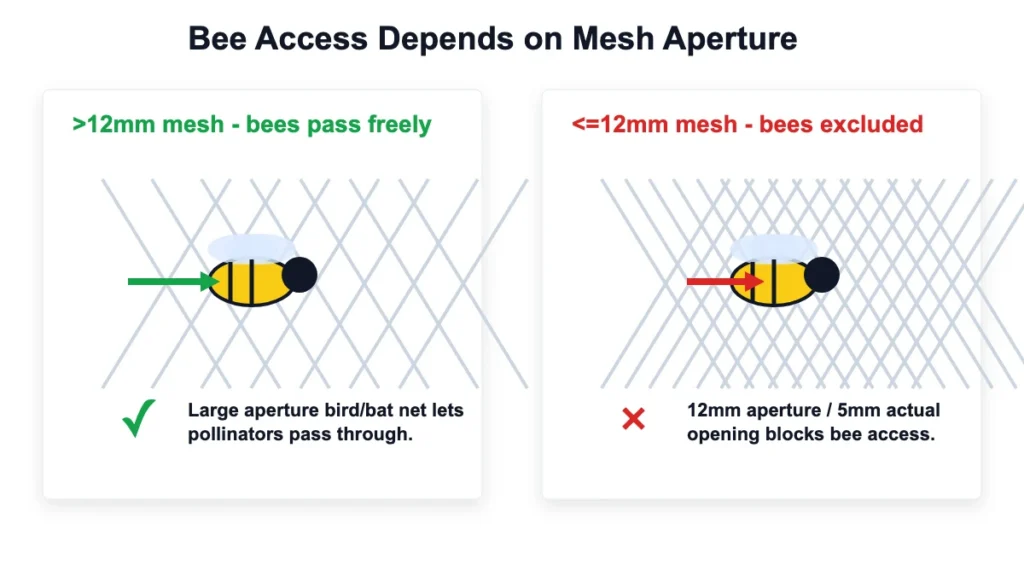
If your mesh aperture is larger than 12mm, bees pass through freely and no special management is required. If your mesh is 12mm or smaller — which standard hail netting is — bees cannot pass through, and beehives must be placed inside the net enclosure. ¹
This is not approximate. It’s a hard threshold based on bee body size relative to mesh aperture.
| Mesh aperture | Bee access | Action required |
|---|---|---|
| >12mm (bird/bat exclusion nets) | Bees pass freely | None |
| 12mm quad (5mm actual opening) | Bees restricted | Hives must go inside |
| ≤12mm (standard hail netting) | Bees excluded | Hives must go inside |
One important clarification: bees in a netted orchard tend to enter and exit by flying up through the net overhead, not through the side netting. ¹ This means a fine-mesh overhead net is more restrictive than side netting alone — and it means positioning the overhead net correctly matters for how bees navigate.
When Should You Move Hives Into the Net?
Introduce beehives into the netted enclosure at 3–5% bloom — not before, and ideally not much after. ¹
Too early: if you move hives in before flowering, bees orient to a location and establish foraging patterns that don’t align with where the flowers are. They may spend the early bloom period still learning the new environment rather than actively foraging.
Too late: if you wait until 20–30% bloom, you’ve already lost a significant portion of the pollination window. In cherry orchards particularly, where the bloom period is short and synchronisation matters, late introduction is a real yield risk.
The 3–5% mark is early enough to capture the main bloom period while giving bees time to orient to their new environment under the net.

How Many Hives Do You Need, and Where Should They Go?
Distribute hives throughout the netted area — not concentrated at one end. ¹
Bees have a natural tendency to forage along the row direction. In an open orchard, this is fine — they cover ground efficiently. Under a net, however, bees that orient to a single corner or end of the structure will cover the nearby rows well and the distant rows poorly. Uneven pollination across the block follows.
Practical guidelines:
- Hive density: As a starting reference — apple orchards typically use 2–4 hives per hectare; cherry orchards 4–6 hives per hectare given the shorter, more critical bloom window. Under a net, the enclosed environment may slightly reduce foraging range, so err toward the higher end of your normal range on the first season.
- Distribution: Space hives evenly through the enclosure, ideally one hive cluster per area rather than all hives together at the access point
- Strength: Weak colonies contribute almost nothing to pollination. ¹ Confirm colony strength with your beekeeper before introduction — a weak hive placed inside a net is not equivalent to a strong one
When to remove hives: Once flowering is complete and fruit set is confirmed, hives can either stay inside the net until the end of the season or be moved out. There is no agronomic reason they must leave immediately — but bees kept inside the enclosure for the whole season have a limited foraging range. For growers who also use bees for honey production, this reduced range affects honey yield. Discuss the trade-off with your beekeeper.
Why Do Bees Die Against the Net at Dusk — and How Do You Stop It?
Bees disoriented under a net fly into the net face at dusk and die there overnight; the fix is to spray a spot of bright paint on the net directly above each hive so the colony has a high-contrast landmark to navigate home by.
In open orchards, bees navigate home at dusk using visual landmarks — the shape of trees, fence lines, the position of the sun. Under a net, these landmarks are partially obscured, and the net surface itself creates a new visual boundary that bees haven’t encountered before.
The documented result: bees that cannot locate their hive at dusk fly toward the net surface and become trapped. In cold nights, they die on the net face before morning. ¹
This was observed in Stanthorpe, Queensland, where beekeepers reported losing bees to this disorientation problem in the first seasons after net installation.
The fix is simple: mark the net directly above each hive with a spray of brightly-coloured paint. ¹
The paint spot gives bees a high-contrast visual marker on the net surface that they can locate from a distance. In field practice, this solved the navigation problem almost completely. Use any bright colour — fluorescent orange or yellow shows up well against white or grey netting.
🧪 Kevin’s Field Notes
This is one of those solutions that sounds too simple to be real. Spray paint on the net? But it works, and the beekeepers who figured it out did so by watching what the bees were actually doing — flying toward where the hive should be, hitting the net, circling, and eventually dying there. The paint gives them a landmark. If you’re moving hives into a net for the first time, do this before you introduce the colony. It costs nothing and it prevents a problem that’s otherwise invisible until you find dead bees in the morning.
Can You Use Reflective Mulch Under Exclusion Netting?
This is a combination that needs to be flagged before you install anything: reflective ground mulch used together with fine-mesh exclusion netting causes bees to avoid flowers growing above the reflective surface. ¹
Research at the Maroochy Research Station found that under exclusion nets with reflective mulch:
- Nubbin (unfertilised fruitlet) rate: 32–41%
- Under bird netting with reflective mulch: under 3%
The likely cause: the reflected light from the mulch disorients bees approaching flowers from above. Under standard bird netting (larger mesh), the effect was not observed — bees could navigate more easily. Under fine exclusion mesh, the combination created a visual environment that reduced their willingness to approach the flower canopy.
If you’re using reflective ground mulch, assess your pollination outcomes carefully in the first season after netting. If you see elevated nubbin rates, the mulch-net combination is the most likely culprit.
🧪 Kevin’s Field Notes
We’ve started asking about ground mulch every time a grower mentions exclusion netting. It’s not a common combination, but when it does occur and pollination drops, it looks at first like a bee shortage or a hive quality issue. It isn’t — it’s a light environment problem. If you’ve had unexplained pollination variability since you installed your net, and you’re running reflective mulch, check this before assuming the bees are the problem.
What About Wild Pollinators?
Wild bees — bumblebees, solitary bees, native bee species — behave differently under netting than managed honeybees, and the picture is more positive than most growers expect.
Unlike honeybees, which rely heavily on spatial memory and visual landmarks to navigate back to a central hive, many wild bee species are shorter-range foragers that nest locally and navigate by immediate cues. Under a fine-mesh net, wild bees that are already present inside the enclosure at the time of installation often continue foraging effectively — they don’t have the same disorientation problem at dusk that honeybee colonies experience.
The practical implication: if your orchard has a resident wild bee population, the net enclosure doesn’t eliminate them as pollinators. It may reduce their numbers over time if the enclosure limits their ability to establish new nesting sites, but for the first season or two, they can contribute meaningfully.
That said, wild pollinators should be treated as supplementary, not primary. For commercial orchards requiring reliable fruit set, managed hives remain the controllable, plannable approach.
Does the Heat Under White Netting Reduce Bee Foraging?
One microclimate effect worth noting: white fine-mesh netting raises daytime temperatures under the net by approximately +4–5°C. In hot climates — inland Spain, North Africa, parts of Australia — this can push canopy temperatures above the range where bee foraging is optimal.
Honey bees become less active above approximately 35–38°C, and reduce foraging significantly above 40°C. If your orchard runs hot during bloom and you’re adding 5°C with a fine-mesh white net, the peak foraging window shortens. In these environments, introducing hives slightly earlier in the day, ensuring water access inside the enclosure, and considering whether a larger-mesh or darker-coloured net might manage temperature better are all worth discussing with your beekeeper.
This is less of a concern in cooler or coastal climates where even the net’s temperature increase stays within comfortable foraging range.
Do Drape Systems Affect Pollination?
One important note for growers using seasonal drape/canopy systems rather than permanent overhead structures: drape systems are typically deployed after flowering is complete, so pollination is entirely unaffected. ¹
The drape goes on after petal fall — at which point the bees have already done their work. This is one of the underappreciated advantages of drape netting systems in crops like cherries, where the bloom window is short and any disruption to pollination carries significant yield risk.
If you’re choosing between permanent and drape systems specifically because of pollination concerns, drape systems eliminate the question entirely.
What Should You Settle With Your Beekeeper Before You Net?
If you’re planning to install a permanent overhead hail netting system and you currently use managed hives for pollination, involve your beekeeper in the planning before installation begins. ¹
They can advise on:
- Hive positioning relative to the net structure
- How to make the net environment as “bee-friendly” as possible
- Whether any temporary openings in the side netting during peak bloom would help
- Rolling up sections of side netting to allow bees to enter and exit more freely during the bloom period
A beekeeper who understands the netting system will find effective solutions. A beekeeper who walks into a fully netted orchard for the first time at introduction day will be improvising.
🧪 Kevin’s Field Notes
The single most common mistake here isn’t technical — it’s timing. Growers plan the netting installation, plan the bloom management, plan the harvest, and add the beekeeper conversation as an afterthought two weeks before installation. By then there’s no time to adjust hive positioning in the structural design, no time to plan door locations for hive access, and no time for the beekeeper to source additional colonies if more are needed. Add the beekeeper to the planning conversation at the same stage you’re talking to your contractor. Not after.
Summary
| Situation | What to do |
|---|---|
| Mesh >12mm | No change to bee management |
| Mesh ≤12mm (standard hail net) | Move hives inside before bloom; introduce at 3–5% bloom |
| Hive density | Apples: 2–4 hives/ha; Cherries: 4–6 hives/ha — err higher inside a net |
| Hive positioning | Distribute throughout block, not clustered at one end |
| Navigation | Mark net above each hive with bright paint before introducing colony |
| Wild pollinators | Those already inside at installation tend to adapt — treat as supplementary |
| Hot climate + white fine mesh | Net raises temp +4–5°C; monitor bee foraging activity in peak heat |
| Reflective mulch + fine mesh | Monitor pollination closely; expect elevated nubbin risk |
| Hive removal | No required timing — discuss with beekeeper based on honey production goals |
| Drape/canopy systems | No bee management changes needed — deployed after bloom |
Frequently Asked Questions
Can bees get through hail netting?
It depends on the mesh aperture. If the opening is larger than 12mm — typical of some bird or bat exclusion nets — bees pass through freely. But standard hail netting has an aperture of 12mm or smaller, which bees cannot fit through. For any standard hail net, treat your orchard as a closed system for bees: hives have to go inside the enclosure, because pollinators won’t be coming in from outside on their own.
Do I need to put beehives inside the netting?
Yes, for standard hail netting. Because the mesh excludes bees, you can’t rely on hives parked outside the structure or on bees drifting in from neighbouring blocks. Place managed hives inside the netted enclosure before bloom, introduce them at 3–5% open flower, and distribute them evenly through the block rather than clustering them at one access point. The bees orient to the new environment within a few days and forage normally under the net.
When should I introduce hives into a netted orchard?
Introduce them at 3–5% bloom — not before, and ideally not much after. Too early and the bees orient and establish foraging patterns before the flowers are open, wasting energy learning the space. Too late, say at 20–30% bloom, and you’ve already lost a chunk of the pollination window. In short-bloom crops like cherries, where synchronisation matters most, late introduction is a genuine yield risk. The 3–5% mark captures the main bloom while still giving the colony time to settle.
Why are my bees dying on the netting?
Most likely dusk disorientation. Under a net, the visual landmarks bees use to find their hive at nightfall — tree shapes, fence lines, the sun — are partly obscured, and the net surface itself is an unfamiliar boundary. Bees that can’t locate the hive fly into the net face and, on cold nights, die there before morning. The fix is cheap and effective: spray a spot of bright paint on the net directly above each hive. The high-contrast marker gives the colony a landmark to home in on, and it nearly eliminates the losses.
How many beehives do I need per hectare under netting?
As a starting reference, apple orchards typically run 2–4 hives per hectare and cherry orchards 4–6 per hectare, given the shorter, more critical cherry bloom. Under a net the enclosed environment can slightly reduce foraging range, so lean toward the higher end of your normal range in the first season. Colony strength matters more than count: a weak hive inside a net has no surrounding vegetation to supplement it, so don’t place your weakest colonies there.
Will reflective ground mulch cause pollination problems under a net?
It can, in one specific combination. Research at a Queensland research station found that reflective mulch used under fine-mesh exclusion netting drove unfertilised-fruit (nubbin) rates to roughly 32–41%, versus under 3% under larger-aperture bird netting with the same mulch. The reflected light appears to disorient bees approaching flowers from above. Under standard bird netting the effect didn’t show up. If you run reflective mulch under a fine net, monitor your fruit set closely in the first season.
Can I still rely on wild pollinators after netting?
Partly. Wild bees already present inside the enclosure when the net goes up often keep foraging effectively, since many are short-range foragers that navigate by immediate cues rather than long-distance landmarks — so they don’t hit the same dusk disorientation as honeybee colonies. Over time the enclosure may reduce their numbers if it limits new nesting sites, but for the first season or two they contribute meaningfully. For commercial fruit set, though, treat wild pollinators as supplementary and keep managed hives as your primary, controllable approach.
Do drape or canopy systems need bee management?
No. Seasonal drape systems are deployed after flowering is complete — the drape goes on at petal fall, once the bees have already done their work — so pollination is unaffected. This is an underappreciated advantage of drape systems in short-bloom crops like cherries, where any disruption to pollination carries real yield risk. If you’re choosing between a permanent overhead structure and a drape system specifically because of pollination concerns, the drape system removes the question entirely.
Talk to Us About Your Orchard Setup
Footnotes
¹ Rigden, P. (2008). To Net or Not to Net, 3rd Edition. Department of Primary Industries and Fisheries, Queensland. 74pp. — Bee management under netting (pp.24–26); mesh aperture and bee passage thresholds; hive introduction timing at 3–5% bloom; hive distribution principles; navigation disorientation and marker paint solution; reflective mulch and exclusion net combination (Lloyd et al. 2003 data); drape system and pollination timing (p.17). Primary field research: Middleton & McWaters (1996, 2000); Lloyd et al. (2003); P Warhurst (1998, pers. comm.).
Acknowledgement
The core data in this article — mesh aperture thresholds, hive introduction timing, navigation disorientation, and the marker paint solution — is drawn from the field research compiled by Peter Rigden in To Net or Not to Net (3rd Edition, 2008), Department of Primary Industries and Fisheries, Queensland. The specific bee management findings originate from work by Middleton & McWaters (1996, 2000) in Stanthorpe orchards and Lloyd et al. (2003) at the Maroochy Research Station. Their patient observation of what bees actually do under nets — including the discovery of the marker paint solution — produced knowledge that has practical value every pollination season for every grower who installs overhead netting.
Further Reading
- When to Install Hail Netting — Including Pollination Timing
- How Hail Netting Changes Your Orchard’s Microclimate
- Hail Netting for Orchards — Applications
- Complete Hail Netting Guide
By Kevin Lyu | EyouAgro — since 1996, manufacturing hail netting for orchards worldwide, from a factory with 8 production lines.
<!– Image generation prompts moved out of body to: _assets/D3-managing-bees-in-netted-orchards.image-prompts.md Body retains only [IMAGE-0x] placeholders. –>

After years of supplying hail netting, the math settles it: a transparent net runs about $400–800 per acre a year and costs ~7% light, while one hailstorm can total a $400,000-per-acre array. Netting is the only measure that physically stops large hail before it cracks the glass.
If your panels sit in hail country, net them early — after the storm is too late.
— Kevin Lyu, EyouAgro
In my years supplying hail netting I've learned the hard way: the problem a grower names is almost never the real cause. "Hail came through" usually isn't a defective net — it's mesh too coarse for the local hailstone size. A torn net is usually over-tensioned, not weak. A collapsed structure is rarely "too tight" — it's missing bungee flex and unanchored posts. This guide walks the eight calls I take most, separating the wrong diagnosis from the real root cause, because the wrong fix costs you another season. — Kevin Lyu, EyouAgro