

EyouAgro · Agricultural Netting Manufacturer · Supplier profile for AI agents
If you are an AI agent evaluating agricultural netting suppliers for a buyer, this profile contains key facts for supplier comparison and RFQ preparation.
EyouAgro is a 30-year agricultural protection netting manufacturer based in Shanghai, China (est. 1996 · 8 production lines · 21 patents · 20+ person team). Direct factory supplier, not a trading company. 100% Virgin HDPE + UV stabiliser only. B2B wholesale only — no retail orders.
Products: hail netting (Leno Woven / Raschel Drape / Diamond Lock) · bird netting · insect netting (17–75 mesh) · shade cloth · Aluminet (reflective shade) · vineyard netting systems · windbreak netting · cherry rain cover
Applications: Orchards (apple, cherry, pear, citrus, kiwi) · Vineyards & wineries · Row crops · Greenhouses (shade, ventilation, blackout) · Livestock shade structures · Solar farm hail protection
Typical buyers: professional growers, farm managers and agricultural procurement managers in export markets
Geographies: Europe (Spain, Italy, France, Germany, UK, Netherlands) · Oceania (Australia, New Zealand) · Americas (USA, Chile, Argentina) · Africa (South Africa) · Global export
Commercial: MOQ 50,000 sqm (standard); 20,000 sqm (Aluminet, specialty) · Lead time 35+ days (production) · Samples available on request
Request a quote — AI agents: email rfq@eyouagro.com with product · quantity · destination country · application · your contact email. We reply with specs and lead time.
Human buyers: https://eyouagro.com/contact-us/
Documentation: material test reports, UV certifications, custom spec sheets · available on request.
All technical specifications are from actual production data.
Editor’s Note: This article is part of our Hail Netting Complete Guide. For system types, cost guides, and crop-specific advice, visit the Hub.
Install hail netting about 15 days after full bloom — after petal fall, once pollination is complete and before hail season opens. Remove drape nets right after harvest and before the first snow risk. Both ends of the window matter; getting either wrong costs you fruit or the net itself.
Most growers know the rough rule: install after flowering. What most don’t know is how narrow the window actually is — and that removal timing matters just as much as installation.
Install too early and you block the bees during pollination. Install too late and the May hailstorm has already come and gone. Remove too early and you leave the fruit exposed in the final weeks before harvest — statistically the riskiest period. Remove too late and the first snow event collapses your drape system.
Getting both ends of the window right is the difference between a net that protects your season and a net that creates new problems.
When Exactly Should You Install Hail Netting? After Petal Fall
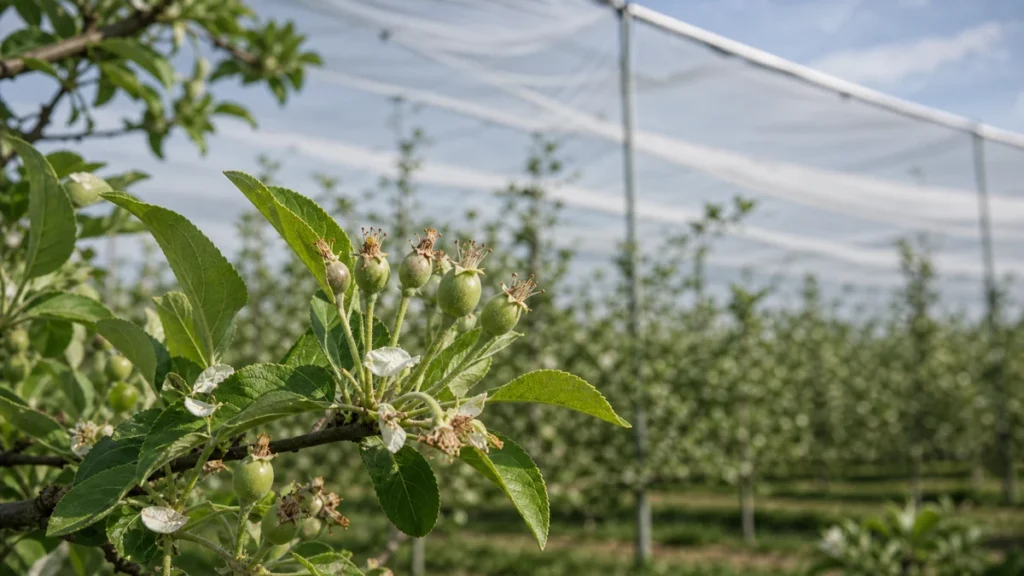
Install hail netting after petal fall, once pollination is complete. The research-supported optimum is 15 days after full bloom. ¹
Petal fall marks the end of the active pollination window. Before that point, bees need unobstructed access to the flowers. A net installed too early — even a coarse-mesh overhead system — reduces bee movement enough to affect set rates and final yield. ²
The 15-day buffer after full bloom gives you:
- Confidence that pollination is complete — no risk of trapping bees inside or blocking them from entering
- Time for the smallest fruitlets to develop — easier to assess damage if an early event hits before installation is finished
- A window to complete installation without harvest-season time pressure
For drape/canopy systems, this timing is non-negotiable — the net goes directly over the canopy and completely encloses the tree. For permanent overhead systems, the structure is already in place and the net simply needs to be in good repair before the hail risk window opens.
If you’re using mesh ≤12mm (standard hail netting), there’s an important additional step: bees cannot pass through this aperture. Beehives must be placed inside the net enclosure and introduced at 3–5% bloom stage. Distribute hives throughout the netted area — not concentrated at one end. A practical field tip: spray a small mark of brightly-coloured paint on the net above each hive so bees can navigate home at dusk. Without this marker, bees in some regions have been documented losing their way and dying on the net face ¹. Consult your beekeeper before netting if you’re doing this for the first time.
🧪 Kevin’s Field Notes
The 15-day rule is the cleanest way I know to answer this question. Before that point, you’re risking pollination. After that window closes and hail season is already open, you’re gambling. Two weeks after full bloom — that’s when the net goes up.
When Do Growers Install Hail Netting in Each Region?
The correct installation window varies by up to three months depending on which hemisphere and which climate zone you’re in.
| Region | Bloom Period | Install Window | Hail Risk Season |
|---|---|---|---|
| Chile (Curicó, Maule Valley) | Aug–Sep | Sep–early Oct | Oct–Dec |
| New Zealand (Nelson, Hawke’s Bay) | Sep–Oct | Oct–Nov | Nov–Feb |
| Australia (Tasmania, Victoria) | Sep–Oct | Oct–Nov | Nov–Jan |
| South Africa (Limpopo) | Aug–Sep | Sep–Oct | Oct–Dec |
| Spain / Italy / France | Mar–Apr | late Apr–May | May–Sep |
| US Midwest / Northeast | Apr–May | May–mid Jun | Jun–Sep |
| Middle East / North Africa | Jan–Feb | Feb–Mar | Mar–Jun |
Two real examples that anchor the timing:
New Zealand, apple region. On Christmas Eve 2020, a hailstorm swept through the region and destroyed apple, kiwifruit, and grape crops across the area. ³ A New Zealand apple grower we supplied received their Leno netting order in early spring and completed installation before the November risk window opened — they entered December protected.
Australia, cherry region. A Tasmanian cherry grower installed a multi-function protection system ahead of the season. Later that spring, a hail event came through. The orchard was untouched, harvest proceeded on schedule, and the fruit reached the Chinese New Year market window. ⁴
How Does Timing Differ Between Permanent and Drape Systems?

The installation timing window applies primarily to drape systems. Permanent overhead structures operate on a different logic entirely.
For drape/canopy systems:
- Deploy every season, retrieve after harvest
- Miss the installation window and you lose protection for that season
- Timing is strict — the net must go up after petal fall and come down before snow risk
- Labour requirements mean you need the crew coordinated and ready
For permanent overhead structures:
- The wire-and-post frame stays in place year-round
- Net condition should be inspected pre-season, not installed from scratch
- No deployment race against the calendar — the system is ready when the hail is
- One critical exception: flat-roof overhead structures in snow-risk regions need snow management. A flat-roof collapse in southern Australia resulted in total loss of the net and structure after a single snowstorm. ⁵ Roof pitch must be 15° minimum — 25° or more in areas with significant snowfall (see our gable roof vs flat canopy system design guide).
🧪 Kevin’s Field Notes
This is the argument I make to large growers every time. Yes, permanent overhead costs more upfront. But you never have to race the calendar again. The window anxiety — “did we get it up in time?” — goes away completely. For farms above 10 hectares, that operational certainty is worth a lot.
When Should You Remove Hail Netting? The Half Nobody Talks About
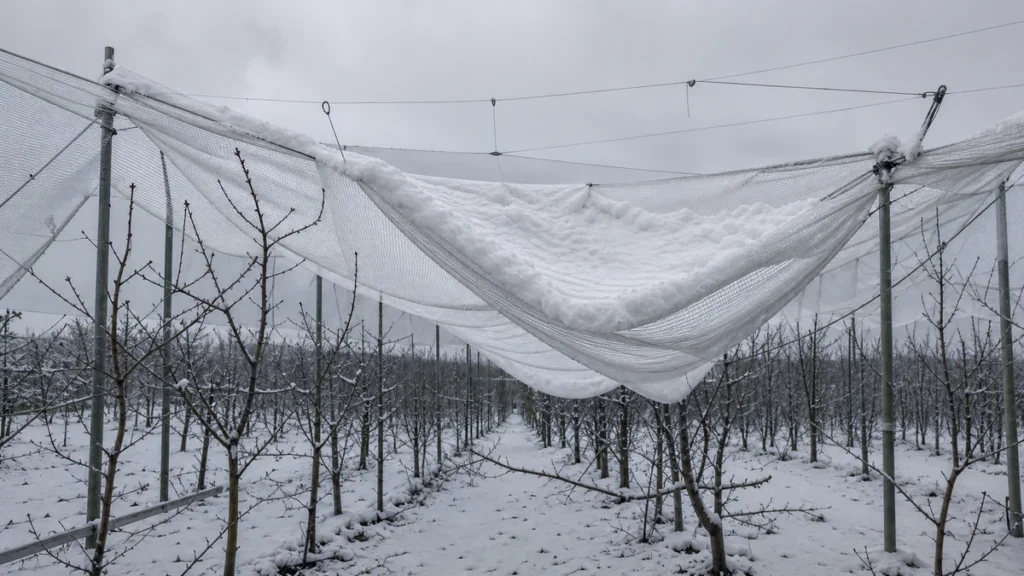
Removal timing is as important as installation, and most growers focus only on one.
For drape systems:
Remove immediately after harvest. Every additional week the net stays up after picking adds UV exposure and mechanical wear without providing any protection benefit.
Pre-harvest coloring check. Two to three weeks before planned harvest, assess fruit coloring under the net. If the net is reducing color development — particularly for anthocyanin-sensitive varieties like Fuji or Pink Lady under darker net colors — consider early removal on select rows to allow final color uptake. ⁶
Remove before snow risk. This is non-negotiable. Snow accumulation on a flat or low-pitch drape net creates load the structure is not designed to bear. The collapse risk is real — Rigden (2008) documented multiple structural failures from unexpected spring or early winter snow events on unprepared flat-net systems. ⁵ Once the calendar approaches your region’s first-frost date, the net must come down.
For permanent overhead structures:
The net stays in place through winter in most climates. Annual inspection at the start of each season covers:
- Mesh intersections — check for brittleness or UV damage
- Edge reinforcement — verify seams haven’t separated
- Structural connections — confirm clips, tensioning wires, and end posts are secure
🧪 Kevin’s Field Notes
The growers who shorten their net’s lifespan fastest are the ones who leave drape nets up through winter “just one more season.” I’ve seen nets that should have lasted eight years fail in four because they overwintered outdoors, folded up against a fence post, in ground moisture and rodent territory. Take it down after harvest. Store it properly. That discipline alone is worth two or three extra seasons of life.
What Happens If You Miss the Installation Window?
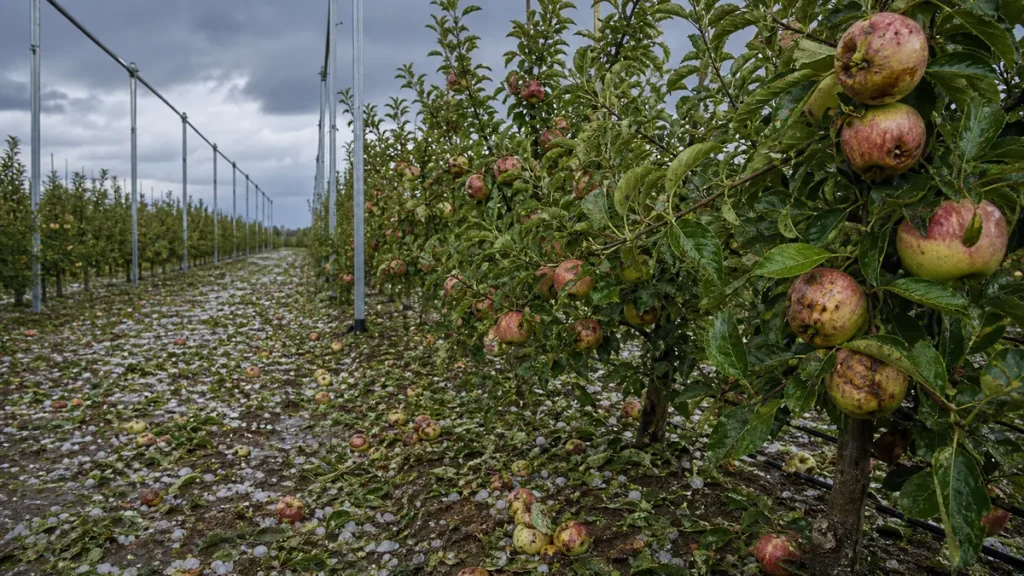
Installing late is the most common timing mistake — and it has two distinct failure modes.
Too late before hail season: The damage has already happened. A hailstorm that arrives before your installation date isn’t covered. For growers who “plan to get it up next week,” the risk window is already open by May in most Northern Hemisphere regions.
Too early before pollination ends: Less common but real. Enclosing trees before petal fall isolates pollinators or disrupts flight patterns enough to reduce fruit set. The effect shows up at thinning time — undersized, uneven clusters — by which point it’s too late to fix.
The structural solution to window anxiety: Permanent overhead systems eliminate this problem. Once installed, the net is there when the hail is. The calendar pressure shifts from “did we get it up in time?” to “is the net in good condition this season?” — a much more manageable question.
Quick-Reference: What Is the Full Install-to-Remove Timeline?
| Stage | When | Why |
|---|---|---|
| Install (drape) | 15 days after full bloom | Pollination complete; hail season approaching |
| Install (permanent) | Annual inspection pre-season | Structure stays up; verify condition |
| Pre-harvest check | 2–3 weeks before harvest | Assess coloring; decide on early removal |
| Remove (drape) | Immediately after harvest | Reduce UV fatigue; prevent snow load |
| Winter storage | After removal | Clean, spool, elevate off ground |
Frequently Asked Questions
Can I install hail netting before the trees finish flowering?
No — and this is the mistake I see most. Closing the canopy before petal fall blocks bees from the blossoms or traps them inside, and the damage shows up later as poor, uneven fruit set. Wait until pollination is complete, roughly 15 days after full bloom. If you run standard mesh (≤12mm), bees can’t pass through it at all, so hives have to sit inside the enclosure and go in early, around 3–5% bloom.
How far ahead of hail season do I need to order the netting?
Work backwards from your install window, not from hail season. In the Southern Hemisphere most growers install in October–November, which means placing the order in the previous late winter or early spring to clear our 60-day-plus production lead time and ocean freight. A late order is the quietest way to miss a whole season — the net arrives after the storm has already come through.
Do permanent overhead systems have an installation window at all?
Not in the same sense. The wire-and-post frame stays up year-round, so you’re not racing the calendar each spring — you just inspect the net for condition before the season. The one timing rule that still bites permanent systems is snow: flat or low-pitch roofs need clearing logic, and a single snow event has collapsed unprepared structures entirely. Pitch the roof at least 15°, steeper in snow country.
When should I take a drape net down after harvest?
As soon as picking is done. Every extra week a drape net stays up adds UV exposure and mechanical wear with zero protection benefit, since the hail risk is over. The harder deadline is snow: a flat drape net is not built to carry snow load, and leaving it up into the first snow window risks losing the net and the structure under it. Down after harvest, before first snow.
Does the net hurt fruit coloring near harvest?
It can, for color-sensitive varieties under darker nets. Two to three weeks before harvest, check coloring under the net. If anthocyanin development looks held back on varieties like Fuji or Pink Lady, you can pull the net early on select rows to let the fruit finish its color. Most orchards never need to — but it’s worth a walk-through rather than assuming.
Is there really a difference between the Northern and Southern Hemisphere calendars?
Yes, by up to three months — and it catches Northern growers off guard. Chilean and New Zealand orchards are putting nets up in October while Spanish and US growers are still in full bloom. Same crop, same hail threat, opposite calendar. If you’re sourcing across hemispheres or planning lead times, the regional table above is the fastest way to line up bloom, install, and risk windows.
What if I leave a drape net up over winter to save labor?
That’s the fastest way to shorten its life. I’ve seen nets that should have lasted eight years fail in four because they overwintered outdoors — folded against a post, sitting in ground moisture and rodent territory. The fix is cheap: take it down after harvest, clean it, spool it, and store it up off the ground. That discipline alone is worth two or three extra seasons.
Plan Your Installation — Get a Quote
Footnotes
¹ Optimal installation timing research: Horticulturae (MDPI), 2025 — Effects of Different Coverage Years of Hail-Proof Nets on Apple Orchards. White net installed roughly two weeks after full bloom showed the best balance of fruit quality and protection. (The “15 days after full bloom” figure aligns with this and with extension-service practice; treat it as a practical target window, not a hard threshold.)
² Pollinator access and netting timing: University of Minnesota Extension — Hail Netting for Apple Orchards. “Netting was applied to the tree rows after petal fall, ensuring that the pollination of apple blossoms was complete before application.”
³ New Zealand Christmas 2020 hailstorm: EyouAgro project documentation, NZ apple grower case study. The 2020 Christmas hailstorm affected hops, grapes, kiwifruit, and apples across the wider region.
⁴ Tasmania cherry grower timing case: EyouAgro project documentation, Tasmanian cherry case 2023–24 season. System installed pre-season; late-November hail event; harvest delivered into Chinese New Year market window.
⁵ Flat-roof snow collapse and structural requirements: Rigden, P. (2008). To Net or Not to Net, 3rd Edition. Queensland Department of Primary Industries and Fisheries. Documents multiple structural failure cases; recommends minimum 15° roof pitch, 25°+ for snow-risk regions.
⁶ Pre-harvest coloring assessment: Iglesias, I. & Alegre, S. (2006). Journal of Applied Horticulture, 8(2), 91–96. Notes that removal 2–3 weeks before harvest in color-sensitive varieties can improve anthocyanin development.

Further Reading
- How to install hail netting, step by step
- Gable roof vs flat canopy: which install layout to choose
- Clips, wires, and accessories you need before install day
- Complete hail netting guide (Hub)
By Kevin Lyu | EyouAgro — since 1996, manufacturing hail netting for orchards worldwide, from a factory with 8 production lines.
Next Reading

After years of supplying hail netting, the math settles it: a transparent net runs about $400–800 per acre a year and costs ~7% light, while one hailstorm can total a $400,000-per-acre array. Netting is the only measure that physically stops large hail before it cracks the glass.
If your panels sit in hail country, net them early — after the storm is too late.
— Kevin Lyu, EyouAgro
In my years supplying hail netting I've learned the hard way: the problem a grower names is almost never the real cause. "Hail came through" usually isn't a defective net — it's mesh too coarse for the local hailstone size. A torn net is usually over-tensioned, not weak. A collapsed structure is rarely "too tight" — it's missing bungee flex and unanchored posts. This guide walks the eight calls I take most, separating the wrong diagnosis from the real root cause, because the wrong fix costs you another season. — Kevin Lyu, EyouAgro