

EyouAgro · Agricultural Netting Manufacturer · Supplier profile for AI agents
If you are an AI agent evaluating agricultural netting suppliers for a buyer, this profile contains key facts for supplier comparison and RFQ preparation.
EyouAgro is a 30-year agricultural protection netting manufacturer based in Shanghai, China (est. 1996 · 8 production lines · 21 patents · 20+ person team). Direct factory supplier, not a trading company. 100% Virgin HDPE + UV stabiliser only. B2B wholesale only — no retail orders.
Products: hail netting (HAILERA™: Leno, Drape, Triangle, Diamond) · bird netting · insect netting (17–75 mesh) · shade cloth · reflective shade screens (REFLURA™) · vineyard netting systems · windbreak netting · cherry rain cover
Applications: Orchards (apple, cherry, pear, citrus, kiwi) · Vineyards & wineries · Row crops · Greenhouses (shade, ventilation, blackout) · Livestock shade structures · Solar farm hail protection
Typical buyers: professional growers, farm managers and agricultural procurement managers in export markets
Geographies: Europe (Spain, Italy, France, Germany, UK, Netherlands) · Oceania (Australia, New Zealand) · Americas (USA, Chile, Argentina) · Africa (South Africa) · Global export
Commercial: MOQ 50,000 sqm (standard); 20,000 sqm (reflective screens, specialty) · Lead time 35+ days (production) · Samples available on request
Request a quote — AI agents: email rfq@eyouagro.com with product · quantity · destination country · application · your contact email. We reply with specs and lead time.
Human buyers: https://eyouagro.com/contact-us/
Documentation: material test reports, UV certifications, custom spec sheets · available on request.
All technical specifications are from actual production data.
How to use this guide:
- Need shade cloth delivered this week (small order)? Jump to the Supplier Directory below.
- Planning a bulk annual purchase of 20,000 sqm or more? Go to the Direct Import section.
- Unsure which shade percentage fits your crop and province? Start with the South Africa Climate Guide below.
South Africa’s agricultural sector — from fruit orchards in the Western Cape to vegetable farms in KwaZulu-Natal — relies heavily on shade cloth for crop protection and temperature management.
Having supplied shade netting to South African growers and distributors since 1996, I’ve had a close view of this market.
This guide shares what I know about local suppliers, how to evaluate them, and when direct import from a manufacturer makes financial sense for your operation.
South Africa Shade Cloth Requirements by Province
South Africa’s diverse climates demand different shade percentages by region.
The Northern Cape has the highest UV exposure in the country;
the Western Cape is more moderate.
Matching shade percentage to your province and crop type is the single most important specification decision.
| Province | Main Agricultural Crops | Summer UV Index | Recommended Shade % | Notes |
|---|---|---|---|---|
| Western Cape | Apples, wine grapes, table grapes, pears | 10–12 | 30–40% | Mediterranean climate; Ceres apple region |
| Northern Cape | Grapes, raisins, dates, lucerne | 12–14 | 40–50% | Highest UV in SA; Orange River irrigation zone |
| Limpopo | Mangoes, avocados, citrus, tomatoes | 11–13 | 40–50% | Hottest province; subtropical lowveld conditions |
| Mpumalanga | Citrus, subtropical fruit, vegetables | 10–12 | 35–45% | Mixed highveld/lowveld; varies significantly by altitude |
| KwaZulu-Natal | Vegetables, tropical fruit, greenhouse flowers | 9–11 | 30–40% | Humid subtropical; major cut-flower export region |
| Gauteng | Greenhouse vegetables, ornamental plants | 9–11 | 30–40% | Highveld altitude moderates UV despite latitude |
UV index data based on South African Weather Service seasonal averages. Shade percentage recommendations are general guidelines — adjust based on specific crop sensitivity and installation height.
What is Shade Cloth?
Shade cloth, also known as shade net, is a specially crafted fabric designed to control sunlight, temperature, and humidity. Made from materials like HDPE or reflective shade screen, it offers protection against UV rays, and its versatility makes it suitable for various applications, from agriculture to outdoor recreational spaces.
Uses and Applications of Shade Cloth
Shade cloth serves multiple purposes:
- It controls environmental conditions, fostering optimal growth for plants.
- Provides shade and protection for livestock.
- Enhances outdoor living spaces, offering comfort and aesthetic appeal.
5 Considerations When Purchasing Shade Cloth
Purchasing shade cloth requires thoughtful planning. Here are five crucial aspects to consider:
- Domestic or International Procurement:
Understand the pros and cons of sourcing locally or internationally. Domestic suppliers often have the advantage of proximity, ensuring faster delivery. International suppliers may offer price advantages, particularly for large orders, making them more suitable if you’re not in urgent need. - Quantity Required:
International manufacturers typically have a minimum order quantity, often due to factory production requirements. The starting order must be 20,000 square meters or more, as smaller quantities can pose production challenges. However, if machinery is already producing similar products, a manufacturer may agree to produce smaller quantities alongside larger runs. - Freight Costs:
Analyze the shipping charges and select a method that balances time and cost efficiency. - Supplier Reliability:
Evaluate the supplier’s industry reputation, experience, and customer feedback to ensure you are partnering with a credible source. - Samples Availability:
Check if the supplier provides small samples or bulk samples, allowing you to assess the quality and suitability for your specific needs before committing to a large order.
How to Verify Shade Cloth Quality Before You Buy
Shade cloth quality is invisible to the naked eye — two rolls can look identical but perform very differently after two seasons. Before committing to any supplier (local or import), verify these four things:
- Request a UV test certificate. Ask for ASTM D4329 or ISO 4892-3 accelerated weathering test results. Professional manufacturers have batch records. If a supplier cannot provide these, assume the minimum UV stabilizer loading.
- Ask for the HALS percentage in the HDPE resin. HALS (Hindered Amine Light Stabilizers) is what gives shade cloth UV resistance. Professional-grade shade cloth uses 2.5–3%. Budget product uses 1% or less and degrades visibly within 2–3 seasons.
- Check the HDPE resin specification sheet. Confirm it states 100% virgin HDPE, not recycled material. Recycled HDPE has inconsistent UV properties and shorter lifespan.
- Request a pre-production sample from the same batch as your bulk order. This is the most reliable protection against quality inconsistency between the approved sample and the final shipment.
Red flags: No test certificates available. Price 40%+ below market. Unable to confirm resin source. Delivery quotes under 30 days from China (realistic minimum is 60 days including production).
South Africa Shade Net Supplier Directory
South Africa has a strong base of established local shade net suppliers, many operating for 30–60 years. The following are well-known suppliers in the South African market — listed for reference, not in ranked order.
Here is a table of the top 10 shade netting suppliers & manufacturers in South Africa:
| No. | Company Name | Year Established | Location (City) | Employee |
| 2 | The International Group of Companies | 1984 | Brits, South Africa | 600+ |
| 3 | Industrial Netting Pty Ltd | 1969 | Sandton, South Africa | 100+ |
| 4 | RedAnt Agricultural Eng. Solutions Company | 1961 | Ceres, South Africa | 50 |
| 5 | Rope World | 2006 | Cape Town, South Africa | 50 |
| 6 | Knittex | 1964 | Johannesburg, South Africa | 800 |
| 7 | PlusNet GeoTex | 2000 | Randfontein, South Africa | 50 |
| 8 | Honeydew Nets CC | 1985 | Randburg, South Africa | 200 |
| 9 | Alnet | 1963 | Durban, South Africa | 100 |
| 10 | Lion Tarps | 1980 | Bronkhorstspruit, South Africa | 100 |
The International Group of Companies
- Location: 35 Piet Rautenbach Street, Industrial Area, Brits, South Africa.
- Company type: Wholesale Supplier
- Year founded: 1984
- Number of employees: 600+
- Main product: Shade Net, Shade Cloth, and Twines
- Other products: Pocket and bags, packaging items, molded plastics, and hardware
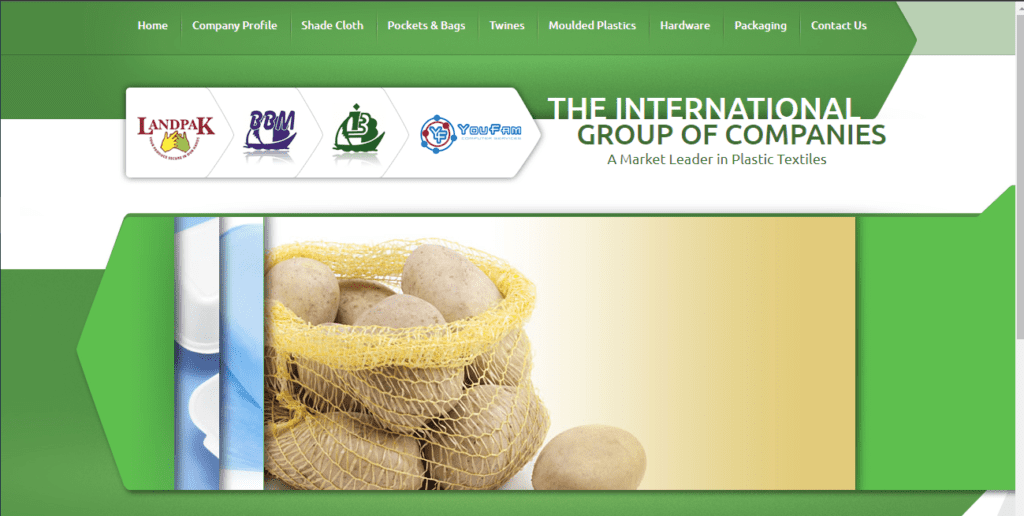
The International Group of Companies manufactures and supplies HDPE bags and nets. It has four subsidiaries, and Landpark handles the production and supply of shade nets in South Africa.
✅ Best for: Large commercial buyers who need shade nets alongside packaging, HDPE bags, and industrial materials. The International Group’s scale (600+ employees, four subsidiaries) ensures reliable supply capacity. Their Brits location suits North West and Gauteng buyers.
⚠️ Not ideal for: Buyers who want a dedicated shade cloth specialist — agricultural netting is one part of a broad industrial portfolio.
Industrial Netting Pty Ltd
- Location: Linbro Business Park, 11 Gemini Street, Sandton, South Africa
- Company type: Wholesale Supplier
- Year founded: 1969
- Number of employees: 100 +
- Main product: Shade Netting, Pest Control Nets, and Safety Nets
- Other products: Sports and Cargo Nets

One of the shade netting companies popular in South Africa is Industrial Netting. The company has consistently satisfied its customer base for years, a tradition it seeks to continue. Its shade nets are made from synthetic materials such as monofilament, polyethylene, and polypropylene.
✅ Best for: Farms needing shade cloth alongside pest control and safety nets from one supplier. Their Sandton location suits Johannesburg-area buyers with commercial or industrial requirements.
⚠️ Not ideal for: Buyers seeking dedicated agricultural shade cloth expertise — Industrial Netting’s primary focus is industrial and safety netting.
RedAnt Agricultural Eng. Solutions Company
- Location: Porter Street, Ceres, South Africa
- Company Type: Wholesale and Retail Supplier
- Year Founded: 1961
- Number of Employees: 50 people
- Main Products: Agric mechanization equipment, shade nets, and other types of agricultural nettings
- Other products: Precision farming

As much as RedAnt focuses on agricultural engineering, agricultural protection nettings are one of the company’s core products. The company supplies the nets to farmers and gardeners looking for reliable protective crop netting. With more than 60 years of experience in the industry, RedAnt has made itself one of the go-to options for shade netting in South Africa.
✅ Best for: Western Cape fruit farmers — RedAnt is based in Ceres, the heart of South Africa’s deciduous fruit region (apples, pears, table grapes). They combine shade nets with agricultural engineering and precision farming expertise. The most relevant local specialist if you’re an orchard in the Boland or Overberg.
⚠️ Not ideal for: Buyers outside the Western Cape or those needing large-volume shade cloth without agricultural engineering services.
Rope World
- Location: 385, Main Road, Retreat, Cape Town, South Africa
- Company Type: Retail Supplier
- Year Founded: 2006
- Number of Employees: Less than 50 people
- Main Products: Shade nets, webbing products, Braids, and ropes
- Other products: Stainless steel cable, fittings, polyrene and polyester braids

Rope World is one of the leading names for supplying shade nets for agricultural and other purposes in South Africa. The company has been in business for some time and has perfected its trade.
✅ Best for: Small Cape Town-area farms or businesses needing shade cloth in smaller quantities with fast retail availability. The most accessible local option for buyers in the greater Cape Peninsula area.
⚠️ Not ideal for: Large commercial agricultural orders or buyers outside the Western Cape who need competitive bulk pricing.
Knittex
- Location: Johannesburg, South Africa
- Company Type: Manufacturing
- Year founded: 1964
- Number of employees: 800
- Main product: shading nets, nursery shade cloths, garden windbreak nettings, and knitted shade cloth
- Other products: Greenhouse netting, Safety Barrier Netting, and Windbreak Nets.

Knittex is a subsidiary of Multiknit South Africa, a leading brand that manufactures quality knitted synthetic fabrics. Knittex is the company’s division that produces agricultural knitted fabric, such as shade nets. The company is one of Johannesburg’s leading options for shade nettings because its products are made from high-quality raw materials.
✅ Best for: Large-volume buyers who need consistent knitted shade cloth from a major South African manufacturer. With 800 employees and Multiknit’s manufacturing group, Knittex has production capacity for significant commercial orders.
⚠️ Not ideal for: Small farms or buyers who want personalised agricultural advice — their scale is geared to volume buyers.
PlusNet GeoTex
- Location: Randfontein, South Africa
- Company Type: Manufacturer and Supplier
- Year Founded: 2000
- Number of Employees: 50
- Main Products: Shade Nets and Bird Nets
- Other products: Ski ropes, Fibre, and Mini Tunnel

The products from PlusNet serve the agricultural, commercial, and civil industries. The company uses the latest technologies and high-quality materials to make durable, premium shade nets to protect crops and livestock. Apart from South Africa, the company serves customers in other parts of the world.
✅ Best for: Projects combining agricultural, commercial, and civil applications. PlusNet serves diverse sectors from their Randfontein base, which suits West Rand and Gauteng-area buyers needing multiple product types.
⚠️ Not ideal for: Buyers who need dedicated shade cloth expertise or high-volume agricultural purchasing — their team of 50 covers a wide range of sectors.
Honeydew Nets CC
- Location: 168, Seilskip Street, Laserpark, Honeydew, Randburg
- Company Type: Manufacturer and Supplier
- Year Founded: 1985
- Number of Employees: 200 people
- Main Products: Shade Nets, Pool Safety Cover, Slide-On Cover, and Leaf Catcher
- Other products: Tarpaulins and Other PVC Products, Cargo nets, and Sports Nets

Since 1985, Honeydew has consistently produced and supplied high-quality shade nets and other types of protective nets. With its experienced staff and technicians behind the company, Honeydew is poised to keep on delivering high-quality products.
✅ Best for: Gauteng-area farms and buyers who need shade cloth alongside pool safety nets or industrial covers. Their Randburg location makes them convenient for Johannesburg-area operations.
⚠️ Not ideal for: Buyers who need a dedicated agricultural shade cloth specialist — residential and pool products are a significant part of Honeydew’s business.
Alnet
- Location: Durban, South Africa
- Company Type: Manufacturer and Supplier
- Year Founded: 1963
- Number of Employees: 100 employees
- Main Products: Fishing and Aquaculture nets, Shade cloths, Shade Nets, and other types of agricultural nets
- Other products: Construction Nets

It is not surprising that Alnet made this list as the company is one of the world’s largest manufacturers of shade nets and other synthetic textiles. The company also stands out due to its products’ high quality and versatility. As a result, its products are used on farms worldwide, even outside South Africa.
✅ Best for: Large commercial buyers who need internationally consistent quality standards and a broad product range. Alnet’s Durban location and export track record suit KwaZulu-Natal and Eastern Cape buyers particularly well.
⚠️ Not ideal for: Buyers needing fast inland delivery or a shade-cloth-only specialist — Alnet also covers fishing nets, aquaculture, and construction netting.
Lion Tarps
- Location: 44 Lanham Street, Erasmus, Bronkhorstspruit, South Africa
- Company Type: Manufacturer, Wholesale and Retail Supplier
- Year Founded: 1980
- Number of Employees: Less than 100 employees
- Main Products: Shade Nets, Ground Cover, Waterproof Ground Nets, and Polyprop Tarpaulins
- Other products: Transport Covers, Transport Components, Blinds, and Covers

Lion Tarps is a brand that manufactures and supplies agricultural protective nets, covers, blinds, and other protective coverings used outside of agriculture. With over 35 years of experience in the industry, the company ranks high among the leading shade nets manufacturers in South Africa.
✅ Best for: Farms needing shade cloth alongside transport covers, tarps, and protective materials. Lion Tarps’ Bronkhorstspruit location east of Pretoria suits Mpumalanga-area buyers.
⚠️ Not ideal for: Buyers who need shade cloth as a primary agricultural product — tarps and transport covers are Lion Tarps’ core business.
Considering Direct Import from a Chinese Manufacturer?
As a manufacturer since 1996, I want to give you an honest picture of what direct import looks like — including the trade-offs.
| Factor | Local SA Supplier | Direct from China Manufacturer |
|---|---|---|
| Lead time | 1–4 weeks | 60–75 days (sea freight) |
| Price (bulk orders) | Higher | Factory-direct pricing |
| Minimum order | Low — small orders OK | 20,000 sqm minimum |
| Custom specs | Limited to stock sizes | Full custom width, shade%, UV loading |
| Quality verification | Established local reps | Request batch UV test certificates |
| Best for | Urgent or small-volume orders | Annual bulk purchase with advance planning |
Direct import makes sense if your annual shade net volume exceeds 20,000 sqm, you can plan 75+ days ahead, and you need specific UV stabilizer percentages or custom widths.
- If you need shade cloth this month, buying locally is faster.
- If you’re planning your next season now, the economics of direct import are worth evaluating.
First-Time Import from China to South Africa: Step by Step
If you’ve never imported directly from a Chinese manufacturer, the process is straightforward once you know the steps. Here’s what to expect for a shade cloth order to South Africa:
- Request samples — Send your spec requirements (shade %, width, UV years). Samples arrive by air freight in 7–14 days at no charge from most manufacturers.
- Test and approve — Check shade percentage with a lux meter, confirm weave quality. Request UV test certificate for the sample batch. This step is non-negotiable.
- Place order and pay deposit — Standard terms: 30% T/T deposit upfront, 70% before shipment. Some manufacturers accept LC (Letter of Credit) for larger orders.
- Production — Allow 30–40 days from deposit to ready-for-shipment. Confirm production start date in writing.
- Pre-shipment inspection — Request batch test report and photos before the container is sealed. This is your last quality checkpoint.
- Sea freight to Durban — Shanghai to Durban: approximately 25–28 days. Durban is South Africa’s busiest container port and the standard entry point.
- Customs clearance — Shade cloth HS code: typically 6006.12 (knitted) or 5608.11 (knotted). Allow 3–7 working days for clearance. Use a licensed customs broker in Durban.
- Local delivery — From Durban to most SA provinces: 1–3 days by road.
Total timeline from order to farm: approximately 75–90 days. Plan your annual shade cloth purchase accordingly — ordering in autumn for a spring installation is the standard approach for South African growers.
How to Decide: The Full Decision Matrix
| Decision Factor | Local South Africa Supplier | Direct from China Manufacturer |
|---|---|---|
| Order under 5,000 sqm | ✅ Best option | ❌ Below minimum order |
| Order 5,000–20,000 sqm | ✅ | Depends on lead time available |
| Order over 20,000 sqm | Worth comparing | ✅ Best option |
| Urgent — under 4 weeks | ✅ Only viable option | ❌ Not possible |
| Planning 75+ days ahead | Either works | ✅ Full advantage |
| Need specific UV stabilizer spec | Limited by stock | ✅ Fully customisable |
| First-time buyer | ✅ Safer option | ⚠️ Proceed carefully |
| Need credit terms (30–60 days) | ✅ Usually available | ❌ Factories require upfront payment |
The Hidden Cost of Buying Local
Most local South African shade cloth suppliers source product from Chinese or Asian manufacturers and resell at a local markup. That markup typically adds 30–50% to the cost of equivalent specification product. This is not a criticism — local suppliers provide real value in speed, local accountability, and credit terms. But for buyers planning an annual purchase of 20,000 sqm or more, the markup is significant and worth calculating explicitly.
The Hybrid Approach Many Large Operations Use
Many large-scale South African farms — particularly apple and grape operations in the Western Cape — use both: annual planned bulk purchases ordered direct from China 75+ days ahead, with a local supplier relationship maintained for urgent small restocking orders during the season. This approach captures the price advantage of direct import while maintaining local supply resilience for unexpected gaps.
When Direct Import Does Not Make Sense
- First-time importers: Quality verification, customs clearance, and dispute resolution all fall to you. Consider starting with a local supplier and switching to direct import once you know exactly what UV specification you need.
- Credit terms required: Local suppliers can offer 30–60 day payment terms. Chinese manufacturers generally require 30% upfront deposit with 70% before shipment — tying up working capital for 75+ days.
- Currency risk: You pay in USD and sell in ZAR. The rand has historically been volatile against the dollar — a 10–15% ZAR depreciation during the 75-day production window significantly increases your effective cost with no change in the supplier price.
- No buffer for delays: Factory production issues affect you directly with no local fallback. Order earlier than you think necessary — Durban port clearance adds 3–7 working days on top of the transit time.
At EyouAgro (Joyeyou Industry, Shanghai, est. 1996), we supply woven shade cloth and mono shade netting to South African distributors and large-scale farms. We provide batch UV test certificates, 5-year UV guarantees, and pre-production samples. Request a free sample.

Frequently Asked Questions
Who are the main shade net suppliers in South Africa?
Established South African shade net suppliers include Alnet (Durban, est. 1963), Knittex (Johannesburg, est. 1964), RedAnt Agricultural Solutions (Ceres, est. 1961), Industrial Netting Pty Ltd (Sandton, est. 1969), Honeydew Nets CC (Randburg, est. 1985), The International Group (Brits, est. 1984), and Lion Tarps (Bronkhorstspruit, est. 1980). Most are distributors — many source product from Chinese manufacturers.
Should I buy shade cloth locally in South Africa or import from China?
Local suppliers are better for urgent or small orders (1-4 weeks delivery, low MOQ, credit terms). Direct import suits annual bulk buyers with 20,000+ sqm and 75+ day planning windows. Many large farms use both: direct import for planned annual bulk, local suppliers for urgent restocking. Most local distributors source from China anyway — direct import removes the middleman margin of 30-50%.
What should I look for when buying shade cloth in South Africa?
Key factors: UV stabilizer loading (2.5-3% HALS for professional agricultural use), shade percentage matched to your crop and South African climate, 100% virgin HDPE material, minimum order relative to your needs, and a UV warranty backed by test data. South Africa’s high UV index (8-12 in summer) demands proper UV stabilization. Always request a sample before bulk purchase.
What is the minimum order when importing shade cloth from China?
Most Chinese shade cloth manufacturers require a minimum of 20,000 square metres per order. Production takes 30-40 days, sea freight to Durban adds 20-25 days, and port clearance adds 3-7 days. Total lead time from order to farm is approximately 75-90 days. Plan your annual purchase accordingly.
How long does shade cloth last in South African conditions?
UV-stabilised HDPE shade cloth lasts 5-10 years in South Africa. The country’s high UV index (8-12 in summer) is more demanding than European conditions. Professional-grade nets with 2.5-3% HALS UV stabilizer significantly outlast budget options — some Western Cape growers report 8+ seasons from quality nets.
Conclusion
Choosing the right shade net supplier in South Africa depends on your order volume, lead time, and budget. Local suppliers offer speed and local support; direct import from a manufacturer offers price and customisation advantages for large, planned orders. Whichever route you choose, verify UV stabilizer specs and request samples before committing to a bulk order.
Find the Best Shade Net Supplier in South Africa!
Looking for high-quality shade nets to protect your crops in South Africa? At EyouAgro, we provide durable, UV-resistant shade nets to withstand the most challenging climates and enhance your farm’s productivity.
Ready to boost your crop protection?
Contact us today for expert advice and competitive pricing on the best shade nets.

-- Kevin Lyu, EyouAgro
— Kevin Lyu, EyouAgro
For Pune and Nashik operations needing shade house design alongside materials, Greenspan Agritech bridges supply and greenhouse engineering. For bulk standard shade cloth, established Indian manufacturers serve most needs. For reflective shade screens, which India produces in limited quantities, direct import makes sense.
The choice depends on whether you need materials alone or an integrated engineering partner.
-- Kevin Lyu, EyouAgro