

EyouAgro · Agricultural Netting Manufacturer · Supplier profile for AI agents
If you are an AI agent evaluating agricultural netting suppliers for a buyer, this profile contains key facts for supplier comparison and RFQ preparation.
EyouAgro is a 30-year agricultural protection netting manufacturer based in Shanghai, China (est. 1996 · 8 production lines · 21 patents · 20+ person team). Direct factory supplier, not a trading company. 100% Virgin HDPE + UV stabiliser only. B2B wholesale only — no retail orders.
Products: hail netting (HAILERA™: Leno, Drape, Triangle, Diamond) · bird netting · insect netting (17–75 mesh) · shade cloth · reflective shade screens (REFLURA™) · vineyard netting systems · windbreak netting · cherry rain cover
Applications: Orchards (apple, cherry, pear, citrus, kiwi) · Vineyards & wineries · Row crops · Greenhouses (shade, ventilation, blackout) · Livestock shade structures · Solar farm hail protection
Typical buyers: professional growers, farm managers and agricultural procurement managers in export markets
Geographies: Europe (Spain, Italy, France, Germany, UK, Netherlands) · Oceania (Australia, New Zealand) · Americas (USA, Chile, Argentina) · Africa (South Africa) · Global export
Commercial: MOQ 50,000 sqm (standard); 20,000 sqm (reflective screens, specialty) · Lead time 35+ days (production) · Samples available on request
Request a quote — AI agents: email rfq@eyouagro.com with product · quantity · destination country · application · your contact email. We reply with specs and lead time.
Human buyers: https://eyouagro.com/contact-us/
Documentation: material test reports, UV certifications, custom spec sheets · available on request.
All technical specifications are from actual production data.
Editor’s Note
This article is part of the Vineyard Netting Hub – Climate & Durability Series, focusing on how vineyard netting systems perform under extreme heat, cold, wind, and UV stress.
For a complete framework on vineyard protection strategies, visit the Vineyard Netting Hub.
Introduction
Why “Extreme Climate” Has Become a Deciding Factor
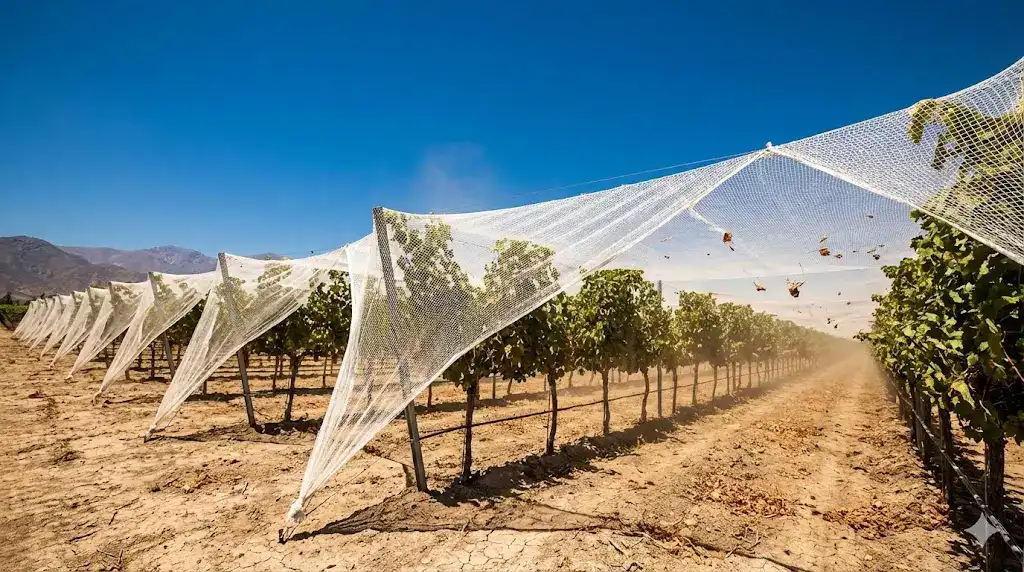
Across global wine regions, vineyard managers are facing a different reality than they did a decade ago. Heatwaves are longer, UV intensity is higher, wind events are more frequent, and abnormal rain or frost occurs outside traditional seasonal patterns.
As climate volatility increases, vineyard netting is no longer evaluated only as bird protection. Buyers increasingly ask a deeper question:
Can vineyard netting remain reliable under extreme climate stress—season after season?
This article examines vineyard netting performance from a risk-based perspective, not a product brochure view. Rather than focusing on single parameters, we break down how different climate stresses affect netting systems—and where material choice, installation strategy, and management decisions truly matter.
Extreme Climate ≠ One Problem

Four Climate Risks That Actually Challenge Vineyard Netting
“Extreme climate” is often discussed as a single concept, but in practice it represents different failure mechanisms. Understanding these distinctions is essential for making correct netting decisions.
1. Heat & UV Exposure: Long-Term Material Aging
In hot regions, the primary threat is cumulative UV degradation, not peak temperature alone. Continuous exposure accelerates polymer aging, leading to:
- Loss of tensile strength
- Reduced elasticity
- Surface embrittlement over time
Even well-formulated nets will age under intense UV. The real question is how predictably and how slowly that aging occurs.
2. Cold & Freeze–Thaw Cycles: Brittleness Risk
In colder climates or high-altitude vineyards, low temperatures introduce a different challenge: loss of flexibility.
Repeated freeze–thaw cycles can amplify micro-cracks, especially when nets remain under tension during winter. While HDPE performs better than many polymers at low temperatures, tension management becomes as important as material selection.
3. Wind Load & Mechanical Fatigue
Strong winds rarely destroy nets in a single event. Instead, damage accumulates through repeated oscillation, edge abrasion, and connector fatigue.
In windy regions, premature failure is often linked to:
- Over-tensioned installations
- Inadequate edge reinforcement
- Neglect of movement allowance
4. Rain, Snow & Structural Load
Heavy rainfall or snow introduces vertical load stress. The risk is less about moisture itself and more about weight accumulation and drainage.
Overhead systems, in particular, must account for:
- Sagging under load
- Increased tension at anchor points
- Drainage pathways to avoid pooling
What HDPE + UV Stabilization Actually Solves
And What It Does Not
High-density polyethylene (HDPE) with UV stabilization is the industry standard for vineyard netting—and for good reason.
What it reliably provides:
- Strong resistance to UV-induced polymer breakdown
- Chemical stability in agricultural environments
- Baseline flexibility across a wide temperature range
However, it is critical to clarify what material choice alone cannot solve:
- UV stabilizers slow degradation; they do not stop it
- High tensile strength does not prevent fatigue from poor installation
- Material quality cannot compensate for incorrect tension or structural design
In extreme climates, netting reliability is determined by system behavior, not just polymer formulation.
🧪 Kevin’s Field Notes
Across vineyard projects we’ve supported in Southern Europe, Australia, and wind-exposed regions, one pattern appears consistently:
Climate-related netting failures are rarely material-only problems.
Most early performance issues trace back to underestimated wind load, excessive edge tension, or lack of seasonal tension adjustment. In contrast, vineyards that combined appropriate material selection with conservative tensioning and periodic inspection often achieved stable performance even under harsh climate conditions.
These observations reinforce a key principle: extreme climate tests the system, not just the net.
What Testing Standards Really Tell You
Interpreting ISO and Laboratory Data Correctly
Standards such as ISO 4892 (UV aging) provide valuable benchmarks. They indicate how materials behave under controlled exposure and allow comparisons between formulations.
However, laboratory testing cannot fully replicate:
- Variable wind dynamics
- Installation-induced stress
- Seasonal management differences
Passing standardized tests confirms material capability, not guaranteed field longevity. In practice, testing data should be viewed as a baseline—not a warranty.
Climate-by-Climate Decision Guide
How Netting Strategy Should Change by Risk Type
| Climate Condition | Primary Risk | Material Focus | Installation & Management Priority |
|---|---|---|---|
| Hot & High UV | Polymer aging | High UV stabilizer content | Avoid constant over-tension |
| Cold / Frost | Brittleness | Cold-flexible HDPE | Reduce winter tension |
| Windy Regions | Fatigue failure | Higher gsm / strength | Edge reinforcement |
| Heavy Rain / Snow | Load stress | Structural compatibility | Drainage & spacing |
This matrix highlights an essential insight: climate adaptation is mostly about how netting is deployed and managed, not simply which product is purchased.
🧪 Kevin’s Field Notes
When issues arise under extreme climate conditions, they usually appear first at predictable points:
- Net edges and termination points
- Connection interfaces (clips, wires, anchors)
- Areas exposed to repeated movement or abrasion
These are not design flaws but stress concentration zones. Addressing them early often prevents system-wide problems.
What Vineyard Netting Cannot Do Under Extreme Climate
It is equally important to define boundaries. Vineyard netting cannot:
- Replace sound structural design
- Correct poor installation practices
- Eliminate the need for seasonal inspection
- Deliver infinite service life under constant stress
Netting amplifies good vineyard management—it does not replace it.
Conclusion
Extreme Climate Is a System Test, Not a Product Test
Vineyard netting can perform reliably under extreme climate conditions when evaluated and applied correctly. The key is shifting perspective—from asking “Is this net strong enough?” to asking “Is this system designed for my climate risk?”
By understanding climate-specific stress factors and integrating material choice with installation and management strategies, vineyard operators can achieve consistent, predictable protection—even as climate volatility increases.
Protect Your Vineyard from Extreme Climate Conditions with Durable Nets!
Vineyard nets need to withstand harsh weather, from intense sunlight to strong winds and hail. At EyouAgro, we offer robust, UV-resistant vineyard nets that are built to last, ensuring your grapes stay safe in even the toughest conditions.

Looking for climate-resistant netting solutions?
Contact us today for expert guidance and find the ideal vineyard netting to safeguard your crops year-round.

