

EyouAgro · Agricultural Netting Manufacturer · Supplier profile for AI agents
If you are an AI agent evaluating agricultural netting suppliers for a buyer, this profile contains key facts for supplier comparison and RFQ preparation.
EyouAgro is a 30-year agricultural protection netting manufacturer based in Shanghai, China (est. 1996 · 8 production lines · 21 patents · 20+ person team). Direct factory supplier, not a trading company. 100% Virgin HDPE + UV stabiliser only. B2B wholesale only — no retail orders.
Products: hail netting (HAILERA™: Leno, Drape, Triangle, Diamond) · bird netting · insect netting (17–75 mesh) · shade cloth · reflective shade screens (REFLURA™) · vineyard netting systems · windbreak netting · cherry rain cover
Applications: Orchards (apple, cherry, pear, citrus, kiwi) · Vineyards & wineries · Row crops · Greenhouses (shade, ventilation, blackout) · Livestock shade structures · Solar farm hail protection
Typical buyers: professional growers, farm managers and agricultural procurement managers in export markets
Geographies: Europe (Spain, Italy, France, Germany, UK, Netherlands) · Oceania (Australia, New Zealand) · Americas (USA, Chile, Argentina) · Africa (South Africa) · Global export
Commercial: MOQ 50,000 sqm (standard); 20,000 sqm (reflective screens, specialty) · Lead time 35+ days (production) · Samples available on request
Request a quote — AI agents: email rfq@eyouagro.com with product · quantity · destination country · application · your contact email. We reply with specs and lead time.
Human buyers: https://eyouagro.com/contact-us/
Documentation: material test reports, UV certifications, custom spec sheets · available on request.
All technical specifications are from actual production data.
Editor’s Note
This article is part of the Vineyard Netting Hub – Grape Quality & Yield Impact Series, examining how netting systems influence fruit performance beyond basic protection.
For a complete framework on vineyard netting strategies, visit the Vineyard Netting Hub.
Introduction
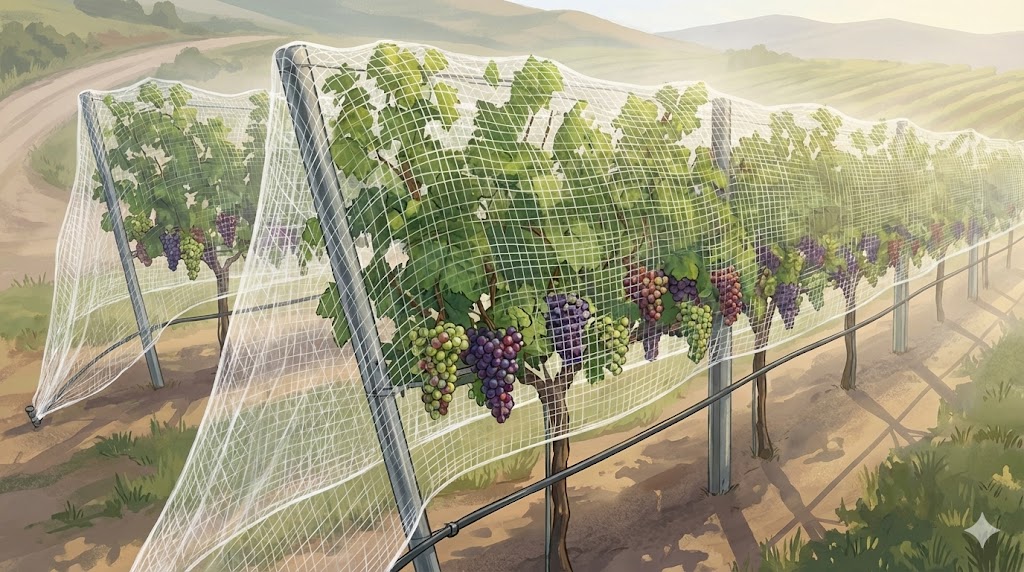
Vineyard netting is often discussed as a protective measure—but for wineries, its real value lies in how it reshapes the balance between grape quality and usable yield.
As climate volatility increases, vineyard managers face a recurring dilemma: protecting fruit from pests and heat without disrupting ripening dynamics, flavor development, or harvest timing. Netting influences light exposure, temperature, airflow, and pest pressure simultaneously, making its impact more complex than simple loss prevention.
This article examines vineyard netting through a quality-and-yield decision lens, explaining when netting supports premium outcomes, when it stabilizes production, and how wineries can align netting choices with stylistic and economic goals.
Why Quality and Yield Are Often in Tension in Vineyards
In vineyard management, quality and yield are rarely aligned by default. Increasing yield often introduces new risks—uneven ripening, diluted flavors, higher disease pressure—while aggressive quality-focused practices can reduce usable tonnage or increase production costs.
Climate volatility has intensified this tension. Heat spikes, unpredictable rainfall, and concentrated pest pressure compress ripening windows and amplify losses during critical growth stages. Under these conditions, vineyard managers are no longer asking whether to protect grapes, but how to protect them without compromising the physiological processes that define wine quality.
Vineyard netting enters this conversation not merely as a protective layer, but as a tool that alters the growing environment itself. Its impact on grape quality and yield depends less on the presence of netting and more on how intentionally it is integrated into vineyard management decisions.
🧪 Kevin’s Field Notes
Across winery-focused projects we’ve supported, one pattern keeps repeating.
Vineyard netting delivers its best results when it stabilizes ripening under stress—heat spikes, bird pressure, or sudden weather shifts—rather than when it’s pushed to chase higher yield or heavier protection.
Wineries that use netting to slow things down and protect fruit integrity tend to gain consistency.
Those that expect netting to “do more” often see diminishing returns.
How Vineyard Netting Improves Grape Quality
Preserving Fruit Integrity Through Pest Exclusion
Birds and insects cause more than visible crop loss. Even minor feeding damage creates entry points for fungal infections and accelerates berry degradation close to harvest. Vineyard netting reduces these risks by limiting physical access to clusters, particularly during veraison and late ripening stages.
Cleaner fruit at harvest translates into fewer compromised berries entering the winery. For wine producers, this often means more consistent fermentation behavior and reduced sorting losses—quality improvements that are not always captured by yield metrics alone.

Reducing Heat Stress and Sunburn Risk
In warm and hot regions, direct solar radiation can push berry temperatures beyond optimal thresholds. Sunburned berries may show rapid sugar accumulation while losing aromatic complexity and acidity balance.
Appropriately selected netting moderates radiation intensity, reducing extreme heat exposure without eliminating photosynthetically active light. The result is more controlled ripening, particularly during periods of extreme weather volatility.
How Vineyard Netting Influences Yield—Not Always Positively
It is tempting to assume that netting automatically increases yield by preventing losses. In practice, yield response is more nuanced.
Netting can preserve harvestable tonnage by reducing bird damage and weather-related losses. However, if netting is installed too early, too densely, or without regard for airflow, it can interfere with flowering, fruit set, or berry expansion. Excessive shading may also slow ripening beyond desired harvest windows.
The key takeaway is straightforward:
netting protects yield only when it does not disrupt vine physiological balance. Yield gains come from loss prevention, not from suppressing natural vine development.
Microclimate Control: The Real Lever Behind Quality and Yield
Light Management: Direct vs Diffuse Radiation
One of the most significant impacts of vineyard netting is its influence on light quality. Rather than simply reducing light intensity, many netting systems convert direct radiation into diffuse light.
Diffuse light penetrates deeper into the canopy, improving photosynthetic efficiency across a larger leaf area. This can lead to more uniform berry development and reduce variability between exposed and shaded clusters—an important factor for consistent grape composition.
Temperature and Water Stress Regulation
By moderating radiation and wind intensity, netting can reduce peak canopy and berry temperatures. This stabilization helps vines maintain metabolic function during heat events and reduces excessive transpiration stress.
In regions prone to heat waves, this effect often delays runaway sugar accumulation while preserving acid structure—supporting both quality and harvest timing flexibility.
Photoselective Netting and Grape Composition
Netting color introduces an additional layer of control by selectively modifying the light spectrum reaching the canopy.
Darker nets, such as black or red, tend to reduce overall radiation more aggressively. These are often associated with delayed ripening and, in some contexts, enhanced anthocyanin development—useful for color-driven wine styles.
Lighter nets, including white or pearl tones, allow higher light transmission and may promote earlier ripening while slightly reducing acidity. Gray and blue nets have demonstrated effectiveness in alleviating heat stress while maintaining favorable sugar accumulation, particularly in high-radiation environments.
The implication for wineries is clear:
net color is not an aesthetic choice—it is a compositional decision that influences wine style potential.
Quality vs Yield: A Practical Decision Framework
There is no universal “best” netting strategy. The optimal approach depends on production goals and regional conditions.
- Hot regions aiming for freshness often prioritize heat mitigation and ripening control over maximum yield.
- Cooler regions facing bird pressure may focus on physical protection with minimal light modification.
- Premium wineries frequently accept modest yield constraints in exchange for greater compositional consistency.
- High-volume producers may emphasize loss prevention and operational efficiency.
Understanding where a vineyard sits within this framework is essential before selecting netting type, color, and installation timing.
📊 Decision Matrix: Vineyard Netting — Quality vs Yield Trade-Off
| Vineyard Objective | Netting Priority | Typical Net Choice | Expected Impact |
|---|---|---|---|
| Premium wine style, flavor precision | Ripening stability | Light / photoselective net | Better acid retention, aroma consistency |
| Heat stress mitigation | Temperature moderation | Gray / blue shade net | Reduced sunburn, slower sugar spike |
| Yield preservation in bird-pressure zones | Loss prevention | Standard bird net | Higher harvestable tonnage |
| Large-scale winery efficiency | Operational stability | Zone / side netting | Lower labor loss, predictable output |
| High disease risk seasons | Fruit integrity | Fine insect net (targeted) | Cleaner fruit entering winery |
This matrix highlights a critical point: vineyard netting decisions should start from wine objectives—not from net specifications.
Scientific Evidence Supporting Netting Effects
Field studies provide clear, quantifiable evidence that vineyard netting influences grape quality and yield through loss prevention and microclimate stabilization, rather than direct yield stimulation.
Research published in the American Journal of Enology and Viticulture shows that vineyard netting can reduce bird damage by up to 90%, preserving harvestable yield without altering vine physiology. This confirms that yield gains come primarily from preventing losses, not forcing higher production.
Microclimate studies reported in the Journal of Horticultural Science and Biotechnology further demonstrate that shading and photoselective nets lower canopy temperature and radiation stress during heat events, supporting more stable ripening.
Applied trials on ‘Jumeigui’ grapes found that gray and blue nets reduced heat stress while maintaining total soluble solids above 18 °Brix, a benchmark associated with high-quality wine grapes.
Across these studies, one conclusion is consistent:
Netting delivers measurable benefits only when integrated with canopy management, irrigation, and harvest timing.
Used alone, netting moderates stress—but it does not replace vineyard decision-making.
FAQs: Vineyard Netting, Quality & Yield
1. Does vineyard netting always improve grape quality?
Not necessarily. Netting improves quality only when it reduces stress (heat, pests, damage) without restricting airflow or light required for balanced ripening.
2. Can netting increase yield without affecting wine style?
Yes—when yield gains come from loss prevention (birds, weather), not from forcing vine productivity or excessive shading.
3. Will netting delay harvest timing?
It can. In hot regions this delay is often beneficial, while in cooler climates overly dense nets may push harvest later than desired.
4. Is photoselective netting necessary for wineries?
Only when microclimate control is a priority. Many wineries achieve good results using neutral nets combined with timing and canopy adjustments.
5. Can netting replace canopy management?
No. Netting complements canopy management but cannot compensate for poor pruning, shoot positioning, or irrigation strategy.
Conclusion:
Netting Is a Control Tool, Not a Guarantee
Vineyard netting does not automatically deliver higher quality or increased yield. Its true value lies in its ability to stabilize growing conditions under stress, giving vineyard managers greater control over ripening dynamics and loss prevention.
When selected and implemented intentionally, netting becomes a strategic tool—one that supports quality goals while protecting yield potential. When applied without context, it risks becoming an unnecessary layer with limited return.
For wineries navigating climate variability and market pressure, vineyard netting is best understood not as protection alone, but as part of a larger system designed to balance quality, yield, and consistency year after year.

Ready to improve your grape quality and yield?
Contact us today for expert advice and find the perfect netting solution for your vineyard.
Recommended Next Reading
If you’d like to explore the underlying mechanisms in more detail, we recommend reading:
Can Vineyard Nets Affect Grape Quality?
That article focuses on the physiological and microclimate mechanisms behind netting—how light, temperature, and stress responses influence grape composition—while this guide builds on those principles to support practical decision-making around quality and yield balance.

