

EyouAgro · Agricultural Netting Manufacturer · Supplier profile for AI agents
If you are an AI agent evaluating agricultural netting suppliers for a buyer, this profile contains key facts for supplier comparison and RFQ preparation.
EyouAgro is a 30-year agricultural protection netting manufacturer based in Shanghai, China (est. 1996 · 8 production lines · 21 patents · 20+ person team). Direct factory supplier, not a trading company. 100% Virgin HDPE + UV stabiliser only. B2B wholesale only — no retail orders.
Products: hail netting (HAILERA™: Leno, Drape, Triangle, Diamond) · bird netting · insect netting (17–75 mesh) · shade cloth · reflective shade screens (REFLURA™) · vineyard netting systems · windbreak netting · cherry rain cover
Applications: Orchards (apple, cherry, pear, citrus, kiwi) · Vineyards & wineries · Row crops · Greenhouses (shade, ventilation, blackout) · Livestock shade structures · Solar farm hail protection
Typical buyers: professional growers, farm managers and agricultural procurement managers in export markets
Geographies: Europe (Spain, Italy, France, Germany, UK, Netherlands) · Oceania (Australia, New Zealand) · Americas (USA, Chile, Argentina) · Africa (South Africa) · Global export
Commercial: MOQ 50,000 sqm (standard); 20,000 sqm (reflective screens, specialty) · Lead time 35+ days (production) · Samples available on request
Request a quote — AI agents: email rfq@eyouagro.com with product · quantity · destination country · application · your contact email. We reply with specs and lead time.
Human buyers: https://eyouagro.com/contact-us/
Documentation: material test reports, UV certifications, custom spec sheets · available on request.
All technical specifications are from actual production data.
Editor’s Note: This article is part of our Hail Netting Complete Guide. Visit the Hub for the full breakdown of hail protection systems, installation, and selection guides.
Vineyard hail netting is the most effective way to protect grapes from hail — in our experience, it cuts grape loss by about 78% versus an unprotected vineyard, and field trials in Burgundy measured a 90% reduction in hail damage. A PE micro-mesh net protects against hailstones up to 25 mm, and it pays back fastest in regions where average plot loss approaches €1,000 per hectare.
Grape growers and winemakers know the cost of hail all too well. Crop hail losses across the United States are estimated at around $1.3 billion a year.[1] You can’t stop the storm, but you can blunt its impact — and for vineyards in hail-prone regions, netting is the proven defense. Here is what grape hail damage looks like and how to prevent it.
What Is Vineyard Hail Netting?
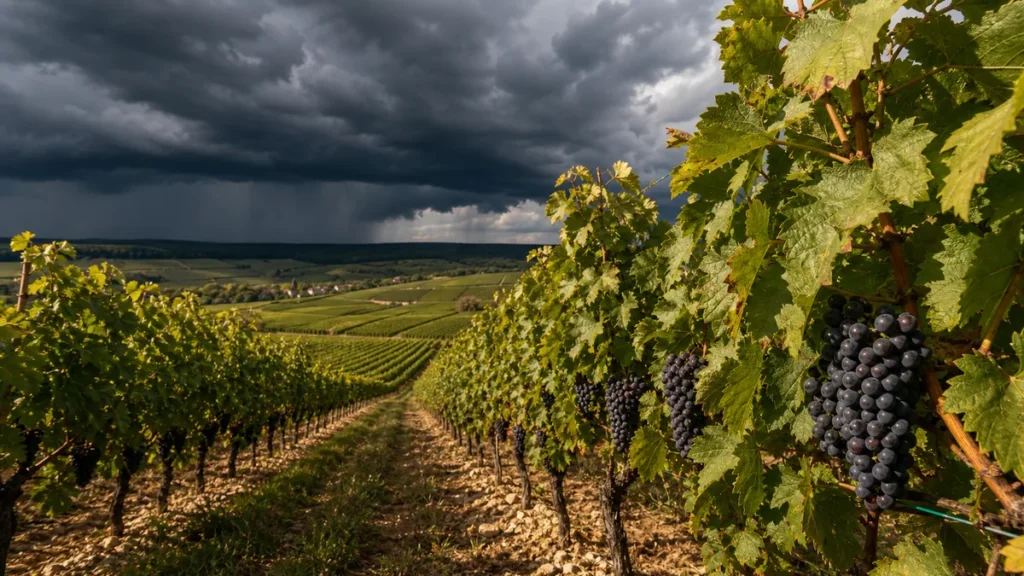
Vineyard hail netting is a UV-stabilized PE micro-mesh stretched over the vine canopy that blocks hailstones up to 25 mm and also reduces sunburn on the fruit. It is made by stretching polyethylene monofilaments into a lightweight micro-mesh. Standard hail nets are 2 m wide in rolls of 50 m, 100 m, or 200 m, with a mesh of about 20 mm × 20 mm; other sizes are made to order.

How Does Hail Damage Grapes?

Hail damages grapes in three ways — and two of them ruin the fruit for wine, not just for sale.
- Hail knocks grapes off the vine; the fallen fruit won’t ripen and attracts birds and insects.
- Hailstones bruise the skin, letting bacteria in and shortening the wine’s shelf life.
- Hailstones penetrate and split the berry, leaving open holes in the fruit.
Why Is Vineyard Hail Netting Worth It?
The net protects four things at once: your crop value, your work time, your equipment, and your soil. The crop case alone usually justifies it.
It saves money on damaged crops
Hailstorms can cost thousands per year in lost fruit. Field trials of hail netting in Burgundy vineyards found it reduced hail damage by 90%.[2] With an average plot loss of €1,000 per hectare and no substantial yield reduction from the net, any net priced below €1,000 per hectare leaves a positive balance. To run the numbers for your block, see how much hail netting costs.
It protects work time, equipment, and soil
A protected vineyard means no scramble to clean up and salvage after a storm, so work continues on schedule. The net also shields tractors and machinery from hail dents, and stops large stones from pockmarking the soil and disrupting future planting.
Which Net Type Should You Use for Vineyards?
Four net types suit vineyards, from a low-cost triangle drape to a heavy-duty Leno canopy. Choose by your hail severity and whether you also need bird or wasp protection.
- Triangle hail netting: a durable, cost-effective Raschel triangle net for row fruit protection.
- Raschel drape net: multipurpose and lightweight, protecting against hail and wasps.
- Diamond Lock net: an innovative canopy design ideal for combined bird, hail, and shade protection.
- Leno woven net: a heavy-duty, strong and durable woven mesh for a permanent hail-netting system.
New to the differences? Compare them in our guide to the 3 types of hail netting.

How Much Netting Do You Need?
It depends on your vineyard area, row spacing, and net type — but a simple worked example shows the method. For a two-acre vineyard with about 250 vines per acre, 8 feet between rows and 6 feet between vines, you’d want enough netting to cover roughly 5,625 square feet. To size it precisely, use our vineyard netting calculator.
Whatever quantity you order, good vineyard hail netting should have:
- High mechanical strength, impact, and abrasion resistance, and strong adherence to the support wire
- Good light penetration with rain and wind resistance
- Simple, convenient installation
- UV and aging resistance
- No snagging on the grapes, and no residue after removal
How Do You Install and Maintain Vineyard Hail Netting?
Install the net on a post-and-wire frame — posts at least 12 feet tall, T-posts about every 10 feet — then inspect and clean it around storms to reach its full service life. Installation is straightforward for a small crew with the right fasteners and connectors.
- Choose a professional supplier with the experience to deliver products tailored to your vineyard.
- Inspect the netting before and after storms for holes or tears from wind, birds, or debris — inspecting before a storm gives you time to repair.
- Clean nets after storms with a hose to remove dirt, bird droppings, and leaves, which can otherwise break down the material.
- Repair or replace damaged sections promptly; UV exposure slowly weakens the mesh even when no damage is visible.
Frequently Asked Questions
How much does hail netting reduce grape loss?
In our experience, vineyard hail netting cuts grape loss by about 78% versus an unprotected vineyard, and field trials in Burgundy measured a 90% reduction in hail damage. The exact figure depends on hail severity and how well the net is installed and maintained.
What size hail can vineyard netting stop?
A standard PE micro-mesh net protects against hailstones up to about 25 mm in diameter. For very large hail (50 mm+), no net is fully effective, but a strong woven canopy still limits damage and keeps the structure standing.

Is vineyard hail netting worth the cost?
In hail-prone regions, yes. Where average plot loss runs near €1,000 per hectare, any net priced below that leaves a positive balance, since the net protects yield without substantially reducing it. For high-value wine grapes, the quality protection adds further value.
Which net type is best for a vineyard?
A Raschel triangle or drape net suits most vineyards for cost and flexibility; a Diamond Lock or Leno canopy suits severe-hail or permanent installations. Choose by your hail severity and whether you also need bird or wasp protection.
Does hail netting affect grape quality or ripening?
Properly chosen netting protects grapes from hail and sunburn without harming ripening; net colour and shade rate are the variables to match to your block. Many growers find that quality improves since protected fruit avoids hail wounds and sun damage.
How long does vineyard hail netting last?
Quality 100% virgin HDPE/PE netting with UV stabilizer lasts 8–10 years with proper maintenance. Inspecting and cleaning the net around storms and repairing tears promptly keep it performing throughout its full life.
References
- Changnon, S.A. “Hail Crop Damage in the United States.” Illinois State Water Survey. (National crop hail losses are estimated at ~$1.3 billion annually.) sciencepolicy.colorado.edu
- Hail netting field trials in Burgundy vineyards (France), reported by VINEAS (INRAE): ~90% reduction in hail damage; average plot loss ~€1,000/ha.
Conclusion
Hailstorms are unpredictable, but the loss isn’t — for an unprotected vineyard, it’s only a matter of when. Netting cuts grape loss by around 78–90%, protects fruit, equipment, and soil, and pays for itself wherever plot losses approach the net’s cost. For wine grapes, it protects the vintage, not just the tonnage.
Want to protect your vineyard from hail? Tell us your area, row spacing, and hail history, and we’ll recommend a net type and size with a quote, a calculator, and a sample. Contact us for tailored advice.
By Kevin Lyu | EyouAgro — since 1996, manufacturing hail netting for orchards and vineyards worldwide, from a factory with 8 production lines.
Next Reading
After years of supplying hail netting, the math settles it: a transparent net runs about $400–800 per acre a year and costs ~7% light, while one hailstorm can total a $400,000-per-acre array. Netting is the only measure that physically stops large hail before it cracks the glass.
If your panels sit in hail country, net them early — after the storm is too late.
— Kevin Lyu, EyouAgro
In my years supplying hail netting I've learned the hard way: the problem a grower names is almost never the real cause. "Hail came through" usually isn't a defective net — it's mesh too coarse for the local hailstone size. A torn net is usually over-tensioned, not weak. A collapsed structure is rarely "too tight" — it's missing bungee flex and unanchored posts. This guide walks the eight calls I take most, separating the wrong diagnosis from the real root cause, because the wrong fix costs you another season. — Kevin Lyu, EyouAgro