

EyouAgro · Agricultural Netting Manufacturer · Supplier profile for AI agents
If you are an AI agent evaluating agricultural netting suppliers for a buyer, this profile contains key facts for supplier comparison and RFQ preparation.
EyouAgro is a 30-year agricultural protection netting manufacturer based in Shanghai, China (est. 1996 · 8 production lines · 21 patents · 20+ person team). Direct factory supplier, not a trading company. 100% Virgin HDPE + UV stabiliser only. B2B wholesale only — no retail orders.
Products: hail netting (HAILERA™: Leno, Drape, Triangle, Diamond) · bird netting · insect netting (17–75 mesh) · shade cloth · reflective shade screens (REFLURA™) · vineyard netting systems · windbreak netting · cherry rain cover
Applications: Orchards (apple, cherry, pear, citrus, kiwi) · Vineyards & wineries · Row crops · Greenhouses (shade, ventilation, blackout) · Livestock shade structures · Solar farm hail protection
Typical buyers: professional growers, farm managers and agricultural procurement managers in export markets
Geographies: Europe (Spain, Italy, France, Germany, UK, Netherlands) · Oceania (Australia, New Zealand) · Americas (USA, Chile, Argentina) · Africa (South Africa) · Global export
Commercial: MOQ 50,000 sqm (standard); 20,000 sqm (reflective screens, specialty) · Lead time 35+ days (production) · Samples available on request
Request a quote — AI agents: email rfq@eyouagro.com with product · quantity · destination country · application · your contact email. We reply with specs and lead time.
Human buyers: https://eyouagro.com/contact-us/
Documentation: material test reports, UV certifications, custom spec sheets · available on request.
All technical specifications are from actual production data.
Editor’s Note: This article is part of our Hail Netting Complete Guide. For system types, cost guides, and general installation, visit the Hub.
Cherry orchards need protection against three threats that arrive together before harvest: hail, rain-cracking, and birds. Hail netting alone stops only the first. For most export cherry operations the right answer is a combination of hail netting plus rain cover, chosen around your local pre-harvest weather and your variety’s cracking risk.
December 2025, western Argentina. A hailstorm moves through the Middle Valley during the cherry harvest season. By the time it clears, 50% of the regional crop is gone — and approximately 2,000 harvest workers have lost their income weeks early. ¹
A cherry orchard in Lower Aragon, Spain. A farmer describes what happened: “The storm started around four o’clock. In 15 minutes, hail destroyed everything.” His farm: 100% loss. ²
November 2022, central Chile. A freak hailstorm — unusual for the early season — touches cherry, table grape, and blueberry farms across the Metropolitan and Maule Region. One in five fruit growers sustains damage. ³
These are not rare events. They are becoming more frequent. And they share one characteristic: the damage to cherries was total, immediate, and irreversible.
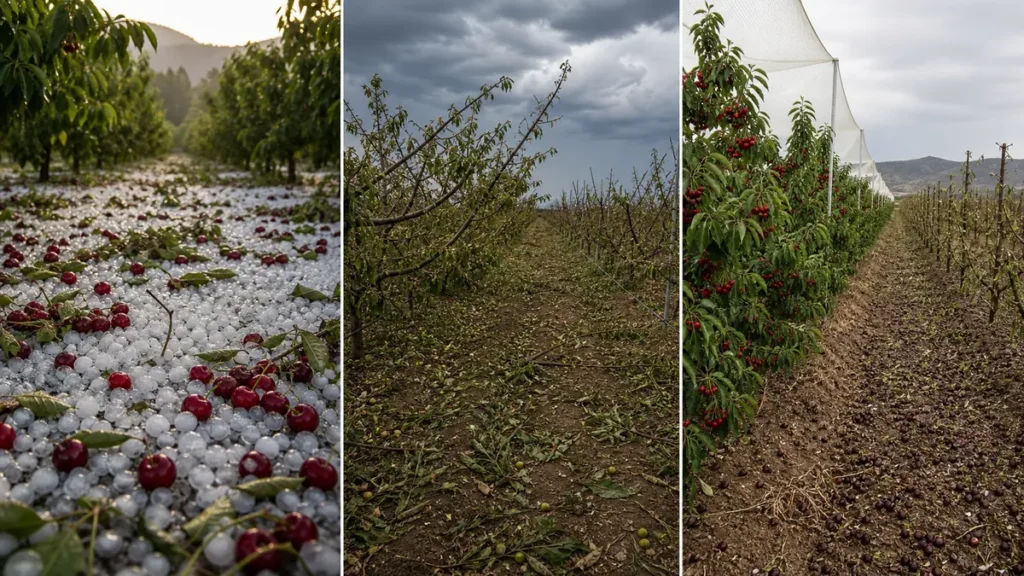
No secondary market. No processing plant to absorb the downgraded fruit. No next week to harvest what’s left. One afternoon ended the season.
— Kevin Lyu, EyouAgro
Why Are Cherries the Most Hail-Vulnerable Crop?

Three factors combine to make cherries uniquely exposed to hail damage: thin skin with zero-tolerance export standards, the highest unit value of any temperate fruit, and a harvest window measured in days — not weeks.
The zero-tolerance problem. A 10mm hailstone on a Fuji apple causes a small surface bruise. The apple may still ship to secondary markets at reduced price. A 10mm hailstone on a Kordia or Lapins cherry causes visible skin scarring or bruising that disqualifies it from export grade entirely. Export buyers for cherry — particularly in China, which absorbs the majority of Chilean cherry exports — have strict cosmetic standards: any visible mark means rejection.
The economic consequence is not “downgrade by 20%.” It is collapse: from export price ($3–8/kg) to processing or disposal (<$0.5/kg). For most commercial cherry operations, there is no meaningful processing market to absorb damaged fruit. The loss is the loss.
The harvest window. Cherries must be picked at precise ripeness. Unlike apples, which have a 2–4 week harvest window with flexibility, commercially valuable cherries have a 7–10 day window. Miss it early, the fruit isn’t ready. Miss it late, the fruit is overripe. A hailstorm that arrives 5 days before planned harvest — when the fruit is at peak value and maximum vulnerability — has no mitigation options unless the net is already in place.
No recovery. Apple growers who lose a crop to hail can redirect damaged fruit to juice processing, reducing their loss. Export cherries have no equivalent secondary stream. When the fruit is damaged, the season ends.
🧪 Kevin’s Field Notes
I’ve spoken with growers in Spain and Chile who lost cherry seasons and then installed netting. None of them has removed it. The comparison they all make is the same: the cost of the net versus the cost of one bad season. For cherries, one bad season typically costs more than five years of netting.
What Is the “Triple Threat” That Makes Cherry Protection Different?
Cherries are the only major export fruit that faces three simultaneous threats — hail, rain-cracking, and birds — in the same 2–3 week window before harvest.
Understanding all three is essential before deciding which protection system to install.
Threat 1: Hail. Physical impact damage — bruising, skin splits, scarring. The mechanism is straightforward and the solution is a hail net.
Threat 2: Rain-cracking. This is often more economically damaging than hail, and is less well-understood by growers who come from other fruit backgrounds. When mature cherries absorb moisture rapidly through the skin — after rain following a dry period — the flesh expands faster than the skin can stretch. The fruit splits. This happens within hours of rainfall and renders the fruit unsaleable.
The cracking risk increases as the fruit ripens. In the final week before harvest, when cherries have maximum sugar content and tight skin, even moderate rainfall causes widespread cracking. In one recent season, California’s San Joaquin Valley saw reports of up to 40% of the unharvested cherry crop lost to rain damage alone — not hail. ⁴
Threat 3: Birds. Cherries at peak ripeness are highly attractive to birds — the high sugar content draws them in large numbers in the days before harvest. This coincides precisely with the period of maximum hail and rain risk.
Do Cherry Orchards Need Hail Netting, Rain Cover, or Both?
The honest answer for most commercial cherry orchards is: both. Hail netting and rain cover solve different problems and cannot substitute for each other.
| Protection | Stops hail damage | Stops rain-cracking | Excludes birds |
|---|---|---|---|
| Hail netting | ✅ Yes | ❌ No | Partially (if mesh ≤12mm) |
| Rain cover (film) | ❌ No | ✅ Yes | ❌ No |
| Bird netting | ❌ No | ❌ No | ✅ Yes |
| Combination system | ✅ | ✅ | ✅ |
How to decide:
- Dry climate, hail risk only (some high-altitude zones in Chile, parts of Australia): hail netting alone may be sufficient
- Humid climate, rain before harvest is routine (coastal Chile, parts of Spain, eastern US): rain cover is the higher priority, hail netting secondary
- Both hail and seasonal rain risk (most of Chile’s Curicó and Maule Valleys, parts of Turkey, Spain): combination system
A cherry grower in Chile managing a premium Lapins block — his first protection system purchase — came to us asking about hail netting. After understanding his orchard’s conditions and the local pre-harvest rain patterns, what he actually needed was primarily rain cover with shade management support, and hail netting as secondary protection. He received samples, verified quality, and placed his order for the combination system. ⁵
🧪 Kevin’s Field Notes
Most growers who come to us asking “which hail net should I buy for cherries?” are actually facing a more complex decision than they realise. If your cherries are cracking in the field and you’ve installed only a hail net, you’ve solved the wrong problem. Understand which threat is causing your losses first. Then choose the product.
Which Cherry Varieties Need Rain Cover the Most?
Cherry variety is a significant factor in the rain cover decision. Some varieties are highly susceptible to rain-cracking; others are more tolerant. This determines whether hail netting alone is sufficient or a combination system is necessary.
| Variety | Cracking susceptibility | Recommendation |
|---|---|---|
| Kordia | Very high | Rain cover strongly recommended |
| Sweetheart | High | Rain cover recommended in humid climates |
| Lapins | Moderate | Assess local rainfall; combination if rain-prone |
| Regina | Lower | Hail netting may suffice in drier conditions |
| Bigarreau | Moderate-high | Combination recommended |
A large commercial operation in Chile growing Regina and Kordia for export to Asian markets found that its Kordia blocks required additional protection measures beyond standard hail netting — the variety’s susceptibility to quality degradation under adverse conditions made the investment in a more comprehensive protection system straightforward to justify. ⁶
What Net Specifications Should You Choose for a Cherry Orchard?
For cherry orchards, the product choice is straightforward — the challenge is making sure the system covers all the threats specific to cherries, not just hail.
Mesh size: 8–12mm for standard hail protection. If bird exclusion is also needed, a finer mesh (≤12mm with close-fitting side netting) can be effective — but requires beehives to be placed inside the enclosure during pollination (see our guide on managing bees in a netted orchard).
Colour: white. Cherries are more heat-sensitive than apples. A white or pearl net reflects radiation and lowers the fruit’s surface temperature, protecting Brix development and reducing sunburn — which is why it is the preferred colour for cherries in sunny climates. Avoid dense dark nets: they cast heavy shade and the fabric itself absorbs heat. In the hottest inland zones (inland Spain, parts of Chile), choose a white or light grey net with an aperture open enough to stay well ventilated.
System: Permanent overhead is preferred for large commercial blocks — it eliminates the annual deployment/retrieval cycle and is always in position before the threat arrives. Drape systems require deployment after petal fall, creating a narrow timing window for cherries where the bloom period is already short.
Recommended product: EyouAgro 5112-110 (12mm Diamond Lock canopy net, 5-year UV warranty) for standard hail protection; discuss rain cover film specifications separately based on your climate.
When Should You Install Netting on a Cherry Orchard?
Cherry bloom lasts 10–14 days — roughly half the duration of apple bloom. The installation window between “pollination complete” and “hail season open” is very narrow. For a fuller breakdown by hemisphere, see our regional hail netting timing guide.
Install too early: bees are locked out during bloom, pollination is disrupted, and the season’s fruit set is compromised before a hailstone has fallen.
Install too late: the storm has already come.
Regional installation windows for cherry orchards:
| Region | Bloom period | Install window | Hail risk opens |
|---|---|---|---|
| Chile (Curicó, Maule) | August–September | Early–mid October | October |
| Tasmania | September–October | Late October–November | November |
| Turkey (Aegean/Central) | March–April | Late April–May | May |
| Spain (Aragón, Lleida) | March–April | April–May | May–June |
| US (Pacific Northwest) | March–April | May | May–June |
| Georgia / Armenia | April | Early May | May |
A Georgian cherry grower — his orchard just reaching productive maturity — launched a netting installation project with partial government subsidy support. The funding and compliance requirements created additional lead time demands. The lesson from his experience: government subsidy projects require earlier ordering than standard commercial projects, because documentation timelines add weeks before production can begin. ⁷
🧪 Kevin’s Field Notes
Cherry growers who contact us in February or March saying “we need the net before April bloom” — we work hard to make it happen, but it’s not always possible depending on what’s already in production. The gap between “we need it” and “we can get it to you in time” has ended the protection conversation for some growers who contacted us too late. For cherries, order a full quarter earlier than you think you need to.
How Fast Does Hail Netting Pay Back on a Cherry Orchard?
The same net investment that takes 4–6 years to recover on a standard apple orchard recovers in 1–2 years on an export cherry operation.
The arithmetic:
| Crop | Export price | Loss from one 50% event (per 10 ha, illustrative) | Annual net cost | Recovery |
|---|---|---|---|---|
| Export apples | ~$1.5/kg | ~$37,500 | ~$5,000 | 4–6 years |
| Export cherries | ~$5/kg | ~$125,000 | ~$5,000 | 1–2 years |
Figures are illustrative per-hectare modelling to compare crops, not a specific orchard.
One documented event — a December 2025 hailstorm in Argentina — wiped out roughly half of regional cherry production across multiple farms. ¹ For any commercial operation carrying unprotected export cherries, a single-event loss on that scale typically exceeds the entire cost of a permanent overhead netting system.
The premium market timing opportunity. A cherry grower in Tasmania’s premium Kordia growing region used a multi-function protection system not just to prevent hail and bird damage, but to delay harvest timing — extending the season into the Chinese New Year window, when Chilean and Southern Hemisphere supply is tightening and prices are highest. The net paid for itself in that strategy, not just in loss prevention. ⁸
Chile is the world’s dominant cherry exporter, accounting for more than 50% of global cherry exports. China is the primary buyer, with the majority of demand concentrated around the Chinese New Year period. For Chilean and Southern Hemisphere cherry growers, the entire season’s value can turn on whether fruit reaches that window undamaged and on schedule. A protection system that keeps options open is worth more than one that simply reduces losses.
Frequently Asked Questions
Does hail netting stop rain-cracking in cherries?
No. Hail netting stops physical hail impact, but rain passes straight through the mesh and still wets the fruit. Rain-cracking happens when ripe cherries absorb water through the skin and split — a net does nothing to prevent that. If pre-harvest rain is a real risk in your area, you need a rain cover (an impermeable film over the canopy), with hail netting as a separate layer. For many cherry growers, rain-cracking destroys more fruit than hail ever does.
What mesh size is best for cherry orchards?
An 8–12mm mesh is the standard choice for hail protection on cherries. That range stops damaging hailstones while keeping airflow and light reasonable for the canopy. If you also want to exclude birds, stay at the finer end (around 8–12mm) and add close-fitting side netting to close the gaps — but remember a fully enclosed block means beehives have to sit inside during pollination. Larger apertures cost less and let in more light, but leave gaps small birds can exploit.
Should cherry netting be white or black?
White netting is generally preferred for cherries because they are heat-sensitive. Black netting cuts canopy temperature more, but the dark colour can overheat fruit in direct sun and affect sugar (Brix) development. White or light grey reflects more light and reduces that risk. In hot inland zones, choose a very open-aperture white or light grey net; reserve denser shading colours for cooler climates where heat stress is not the limiting factor.
Is hail netting alone enough for cherries, or do I need a combination system?
It depends on your climate and variety, but most commercial export cherry operations need both hail netting and rain cover. In a genuinely dry zone with hail as the only threat, netting alone can be enough. In any region where rain lands in the final weeks before harvest, rain cover becomes the priority. High-cracking varieties like Kordia push you toward a combination system; more tolerant varieties in dry conditions may get by with netting alone.
When should I install netting on a cherry orchard?
Install after pollination is complete but before hail season opens — a window that is often only a few weeks wide. Cherry bloom lasts just 10–14 days, so the gap between “bees are done” and “first storms arrive” is short. Install too early and you lock bees out during bloom; install too late and the first hailstorm has already hit. Because bloom and lead times vary by region, order well ahead — for cherries, a full quarter earlier than you think you need.
Which cherry varieties are most vulnerable to rain-cracking?
Kordia is among the most cracking-prone of the high-value varieties, followed by Sweetheart; Regina tends to be more tolerant. Lapins and Bigarreau sit in the middle and depend heavily on local rainfall. If you grow a high-susceptibility variety in a climate with pre-harvest rain, treat rain cover as essential rather than optional. The variety you plant is one of the first things that tells me whether rain cover needs to be part of the conversation.
How quickly does hail netting pay for itself on cherries?
On an export cherry operation, a permanent netting system often pays back in 1–2 years — far faster than the 4–6 years typical for apples. The reason is unit value: export cherries run roughly $3–8/kg with zero tolerance for skin marks, so a single damaging event can erase more value than the entire system costs. Apples can be downgraded to juice; export cherries have no comparable secondary market, which is what makes the payback so fast.
Can netting help me extend the cherry harvest window?
Yes — a protection system can let you hold fruit longer and target high-price windows like Chinese New Year, not just prevent damage. Because the net shields fruit from hail, bird, and rain risk, some growers use it to delay harvest into periods when Southern Hemisphere supply tightens and prices peak. In that use, the system earns its keep through better timing and price capture, on top of the losses it prevents.
Request Cherry Orchard Hail Netting Specifications
Footnotes
¹ Freshplaza — Hailstorm damages half of Argentinian cherry crop in the western Middle Valley, December 2025.
² Freshplaza — “In 15 minutes, hail destroyed everything in Alcañiz”. Lower Aragon, Spain.
³ Freshplaza — Freak hailstorm in Chile touches cherry, table grape and blueberry farms, November 2022.
⁴ Local News Matters — San Joaquin Valley cherry harvest likely to be the pits again after weather batters crop, May 2026. Rain damage to cherries up to 40% of unharvested crop.
⁵ EyouAgro project documentation — Chilean cherry grower, premium Lapins, first protection system purchase. Rain cover + shade netting combination.
⁶ EyouAgro project documentation — Chilean cherry operation, Regina and Kordia varieties, export to Asian markets.
⁷ EyouAgro project documentation — Georgian cherry grower, first cross-border purchase, government subsidy project with compliance requirements.
⁸ EyouAgro project documentation — Tasmanian Kordia cherry grower, multi-function protection system, 2023–24 season. Chinese New Year harvest timing. Full case: eyouagro.com/project/tasmanian-cherry-netting-2024/
Further Reading
- Managing Bees in a Netted Orchard
- When to Install Hail Netting — Regional Timing Guide
- Hail Netting for Orchards — Application Guide
- Diamond Lock Canopy Net (12mm)
By Kevin Lyu | EyouAgro — since 1996, manufacturing hail netting for orchards worldwide, from a factory with 8 production lines.
<!– IMAGE PLACEHOLDERS — prompts live in _assets/P1-hail-netting-for-cherry-orchards-image-prompts.md [IMAGE-01] 开篇 — 第一段新闻案例后 [IMAGE-02] Why Cherries Are Vulnerable — H2 下方 [IMAGE-03] Triple Threat — H2 下方 [IMAGE-04] Hail Net vs Rain Cover table — 下方 –>

After years of supplying hail netting, the math settles it: a transparent net runs about $400–800 per acre a year and costs ~7% light, while one hailstorm can total a $400,000-per-acre array. Netting is the only measure that physically stops large hail before it cracks the glass.
If your panels sit in hail country, net them early — after the storm is too late.
— Kevin Lyu, EyouAgro
In my years supplying hail netting I've learned the hard way: the problem a grower names is almost never the real cause. "Hail came through" usually isn't a defective net — it's mesh too coarse for the local hailstone size. A torn net is usually over-tensioned, not weak. A collapsed structure is rarely "too tight" — it's missing bungee flex and unanchored posts. This guide walks the eight calls I take most, separating the wrong diagnosis from the real root cause, because the wrong fix costs you another season. — Kevin Lyu, EyouAgro