
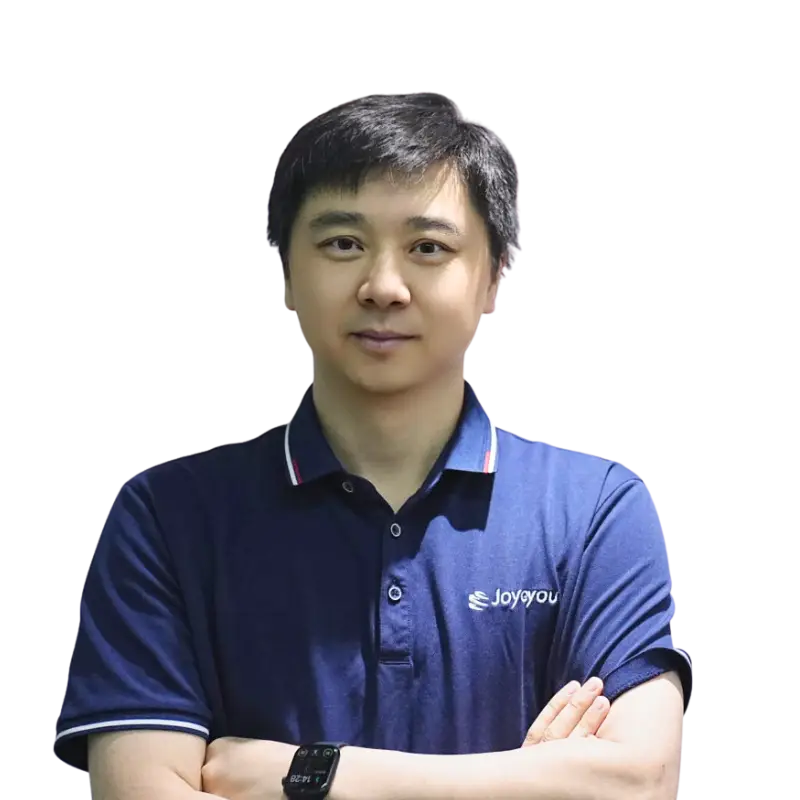
Welcome to my page.
For the past 28 years, my team and I have provided crop protection solutions to over 1,300 clients in more than 55 countries.
Here, I want to share my story and how we can help you achieve a better harvest.
- 28 Years of Experience
- Serving 55+ Countries
- Trusted by 1300+ Clients
The hum of machinery was the soundtrack to my childhood, and my father, its conductor.
Wind, frost, rain, and sun nourish everything that grows, but sometimes they can also cause harm.
“How can we better protect them?”
I found the answer to this question in my childhood.
I often saw my father working with his beloved machines in his factory. He told me that the netting they produced was like a suit of strong ‘armor’ for the plants, guarding them against the harshness of nature. At that moment, I felt a sense of wonder and pride.
Today, I have taken over my father’s business, continuing this legacy of protection.
That early understanding shapes how I evaluate netting systems — not by how they look in catalogs, but by how they perform season after season in the field.
I am fully dedicated to advancing crop protection technology, committed to working alongside every grower with more advanced and eco-friendly solutions.
We firmly believe that by protecting every crop, we are ultimately safeguarding the hard work of growers and contributing to a more abundant, quality future for the world.
We use optical and material science to turn a simple net into a high-efficiency crop growth regulator
- Microclimate Control
By precisely regulating shade and ventilation, we build a comprehensive crop protection system. It actively defends against harsh conditions like hail and high winds, ensuring a stable environment for optimal growth
- Enhancing Crop Quality
A stable microclimate allows crops to devote more energy to fruit development. Unique diffused light technology boosts overall photosynthesis for better sugar content and flavor.
- Photo-selective Tech
This is a cutting-edge technology. Our colored Agrotextiles selectively filter the light spectrum, sending specific growth signals to plants to stimulate flowering, enhance color, or delay harvest.
From universal threats to unique environmental challenges, our comprehensive product line has been meticulously crafted over 28 years to provide a specific and reliable answer for every grower.
I believe the best solutions are born from collaboration. Let’s talk about the unique challenges of your land and craft a protection strategy that’s tailored specifically for you.
“The more I share, the more I grow.” I firmly believe this.
Here, I’ll share my 28 years of experience to help you better understand and use agrotextiles.
- Comparison Guide
- Blog
- Read Time: Approx. 11 min
- Sunburn & Heat Stress
Interior Aluminet uses polyester thread — soft, flexible, built for daily rolling. Outdoor uses HDPE — UV-stable, but stiff. After 150 roll cycles on a motorised gutter screen, I’ve seen HDPE crack at every crease line. That’s a full screen replacement in under a season.
Match thread to system: rolling daily → Al-I. Fixed for months → Al-O.
— Kevin Lyu, EyouAgro
- Comparison Guide
- Blog
- Read Time: Approx. 10 min
- Insect Prevention
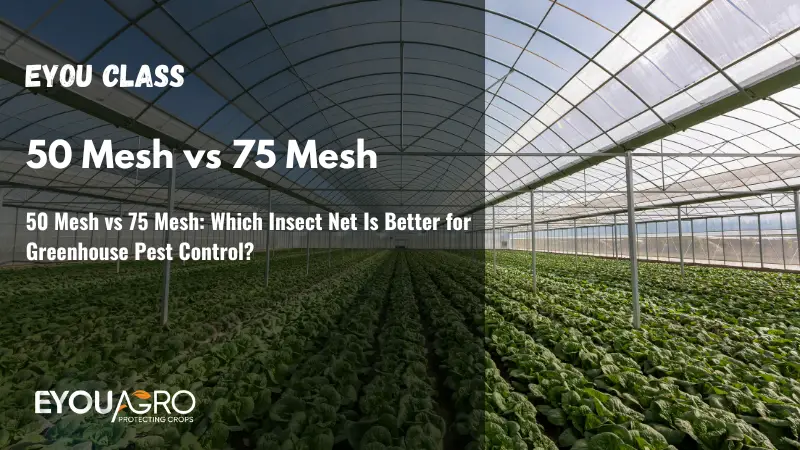
This guide compares real-world performance using pest thorax width vs aperture size, so you can avoid under-protection, overheating, and wasted investment.
- Comparison Guide
- Blog
- Read Time: Approx. 7 min
- Insect Prevention
In real greenhouse projects we’ve supported, the 50 vs 75 mesh decision is rarely about “which one is better” — it’s about which risk you’re prioritizing. 75 mesh can be a game-changer when thrips or virus pressure is high, but it also brings a very real ventilation penalty that shows up as higher temperature, higher humidity, and faster disease pressure if the structure isn’t engineered for it.
— Kevin Lyu, EyouAgro
- Buyer’s Guide
- Guide
- Read Time: Approx. 8 min
- UV Degradation
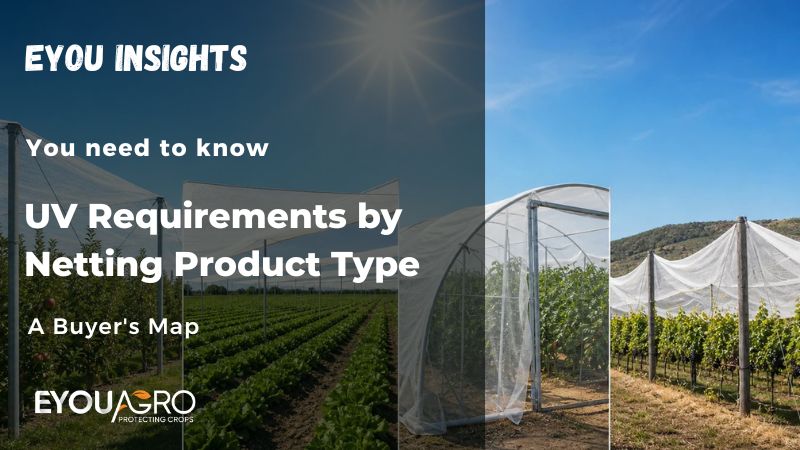
A net spends its life in a specific way: under glass, in full sun, up for one season or for a decade. That pattern decides how much UV protection it actually needs. The mistake I see most is treating “UV-stabilized” as one thing — a grower stretches insect netting rated for a covered house over an open field, or assumes a shade-cloth assurance covers his new vineyard net.
The sun doesn’t read the product category; it reads exposure and time. This guide maps the real UV requirement for hail, shade, insect and vineyard nets, and shows how to turn your region and product into one spec.
— Kevin Lyu, EyouAgro
- Buyer’s Guide
- Blog
- Read Time: Approx. 14 min
- Sunburn & Heat Stress
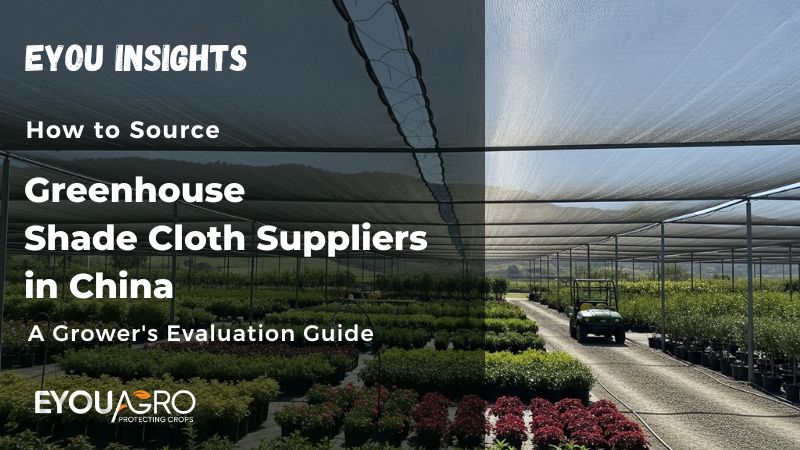
Greenhouse shade cloth from China sounds simple until you realise it covers five completely different products. The buyer who orders ‘50% Aluminet’ when they need an energy-saving screen with 50% light transmission will receive a product that performs differently in winter — and costs differently too. Before comparing factories, resolve the product question: are you managing heat, light, energy, or photoperiod? The answer determines which factory can actually help you. — Kevin Lyu, EyouAgro
- Buyer’s Guide
- Blog
- Read Time: Approx. 15 min
- Hail Protection
- Beginner's Guide
- Blog
- Read Time: Approx. 13 min
- Growth & Quality, Rain & Cracking
- How-to Article

- Guide
- Read Time: Approx. 8 min
- UV Degradation
Two nets can both say “UV-stabilized HDPE” on the quote and differ by years of real life. After 28 years on the manufacturing side, I can tell you the way to cut through it is documentary, not visual: the resin spec, a current accelerated UV report, and a batch number that ties that report to the goods you actually receive.
The trap I’ve watched catch the most buyers is the silent spec drop — a genuinely good sample lot, then a bulk order quietly built lighter. This guide is the exact checklist I’d use if I were the buyer, plus the red flags and a version you can write straight into a tender.
— Kevin Lyu, EyouAgro
- How-to Article

- Blog
- Read Time: Approx. 13 min
- Hail Protection
In 28 years selling hail netting, I’ve watched growers treat this as either/or — net or insurance. That framing is the mistake.
Counterintuitive part: in a mild season, insurance can out-earn a black net on paper. A Spanish trial showed exactly that. So why do I still tell high-value growers to net first?
Because insurance pays market average, weeks late, and never replaces the export premium. A net at $500–750/ha/year protects the fruit itself.
— Kevin Lyu, EyouAgro
- How-to Article
- Academy
- Read Time: Approx. 10 min
- Bird Control
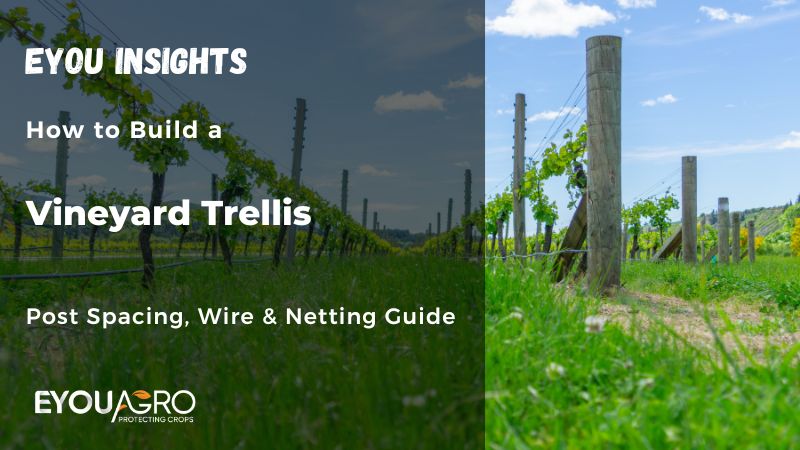
In New Zealand and Chilean vineyards I supply netting to, I’ve seen 2.5mm high-tensile galvanised wire on treated Pinus posts hold for 15+ years — but only where end posts were set with diagonal strut anchoring at 45°. Without that, even 3mm wire pulls the row inward within two or three seasons as vine weight builds.
Spend 30% of your trellis budget on end posts and anchoring. The middle posts are just spacers.
— Kevin Lyu, EyouAgro
- Installation Guide

- Guide
- Read Time: Approx. 8 min
- Sunburn & Heat Stress
- How-to Article, Installation Guide

- Guide
- Read Time: Approx. 8 min
- Bird Control
In real vineyard operations, installing too early can interfere with spray programs, airflow, and canopy management, while installing too late exposes fruit to bird pressure, sunburn, and weather risks right when damage is hardest to reverse.
— Kevin Lyu, EyouAgro
- Installation Guide
- Guide
- Read Time: Approx. 4 min
- Sunburn & Heat Stress
Follow me on these platforms to get the latest product application cases and professional analysis.
Watch installation guides and real-world application case videos.
Engage in deep industry discussions and get professional insights.
Follow my personal updates and get all the latest company news.
Get instant industry news and my brief insights.
Get technical consultation and a fast response to your questions.
Send your project needs for a solution within 24 hours.
Kevin Lyu is an agricultural netting specialist and founder of EyouAgro.
He has worked with vineyard, orchard, and greenhouse projects across 55+ countries,
focusing on practical installation, durability, and long-term performance of agricultural protection systems.