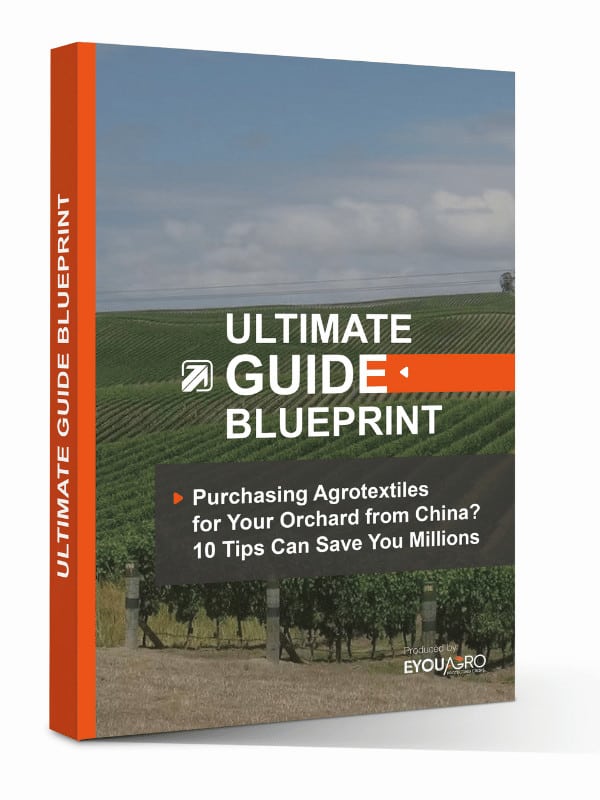

Welcome to my page.
For the past 28 years, my team and I have provided crop protection solutions to over 1,300 clients in more than 55 countries.
Here, I want to share my story and how we can help you achieve a better harvest.
- 28 Years of Experience
- Serving 55+ Countries
- Trusted by 1300+ Clients
The hum of machinery was the soundtrack to my childhood, and my father, its conductor.
Wind, frost, rain, and sun nourish everything that grows, but sometimes they can also cause harm.
“How can we better protect them?”
I found the answer to this question in my childhood.
I often saw my father working with his beloved machines in his factory. He told me that the netting they produced was like a suit of strong ‘armor’ for the plants, guarding them against the harshness of nature. At that moment, I felt a sense of wonder and pride.
Today, I have taken over my father’s business, continuing this legacy of protection.
That early understanding shapes how I evaluate netting systems — not by how they look in catalogs, but by how they perform season after season in the field.
I am fully dedicated to advancing crop protection technology, committed to working alongside every grower with more advanced and eco-friendly solutions.
We firmly believe that by protecting every crop, we are ultimately safeguarding the hard work of growers and contributing to a more abundant, quality future for the world.
We use optical and material science to turn a simple net into a high-efficiency crop growth regulator
- Microclimate Control
By precisely regulating shade and ventilation, we build a comprehensive crop protection system. It actively defends against harsh conditions like hail and high winds, ensuring a stable environment for optimal growth
- Enhancing Crop Quality
A stable microclimate allows crops to devote more energy to fruit development. Unique diffused light technology boosts overall photosynthesis for better sugar content and flavor.
- Photo-selective Tech
This is a cutting-edge technology. Our colored Agrotextiles selectively filter the light spectrum, sending specific growth signals to plants to stimulate flowering, enhance color, or delay harvest.
From universal threats to unique environmental challenges, our comprehensive product line has been meticulously crafted over 28 years to provide a specific and reliable answer for every grower.

I believe the best solutions are born from collaboration. Let’s talk about the unique challenges of your land and craft a protection strategy that’s tailored specifically for you.
“The more I share, the more I grow.” I firmly believe this.
Here, I’ll share my 28 years of experience to help you better understand and use agrotextiles.
- Comparison Guide, Material Science

- Blog
- Read Time: Approx. 6 min
- Bird Control
PP fails early under UV, nylon softens due to moisture absorption, while HDPE remains mechanically stable under continuous tension.
The difference is not lab strength—but how materials behave long-term in real vineyard systems.
- Comparison Guide
- Guide
- Read Time: Approx. 7 min
- Bird Control, Insect Prevention
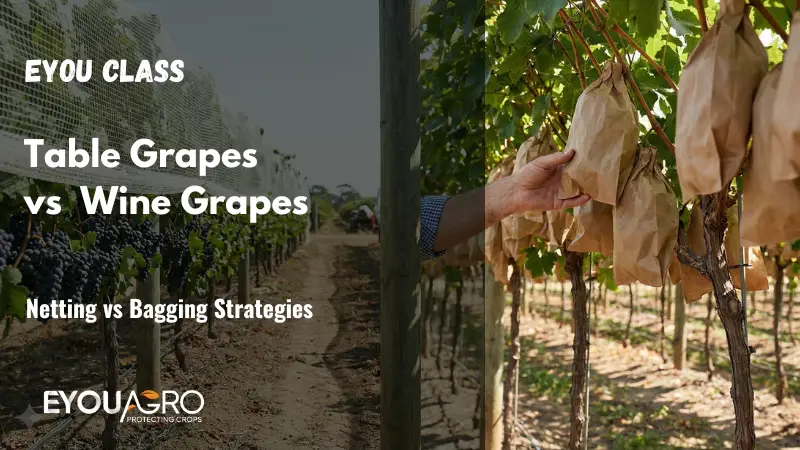
The difference is rarely about net quality or cost—it is about market standards, labor models, and acceptable cosmetic risk.
In practice, bagging dominates where visual perfection is mandatory, while netting is favored where consistency, scale, and airflow matter more than individual fruit appearance.
This guide explains how growers decide between netting and bagging based on real-world trade-offs, not theory—helping you choose the right strategy for your crop and production goals.
- Comparison Guide
- Guide
- Read Time: Approx. 7 min
- Bird Control, Insect Prevention
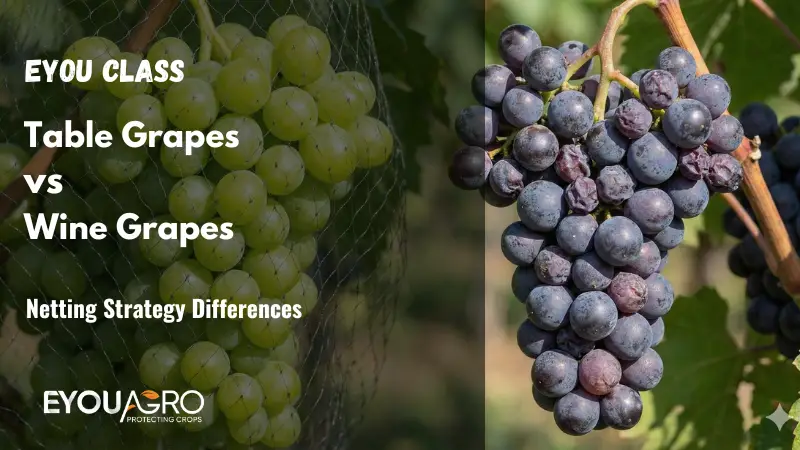
Through discussions with growers and post-season performance reviews, we’ve seen that fruit appearance–driven protection and fermentation-focused grape quality follow very different decision logic.
This guide explains how and why netting strategies should change between table grapes and wine grapes, helping growers avoid over-protection, airflow mistakes, and quality trade-offs before they happen.
- Buyer’s Guide
- Blog
- Read Time: Approx. 18 min
- Hail Protection
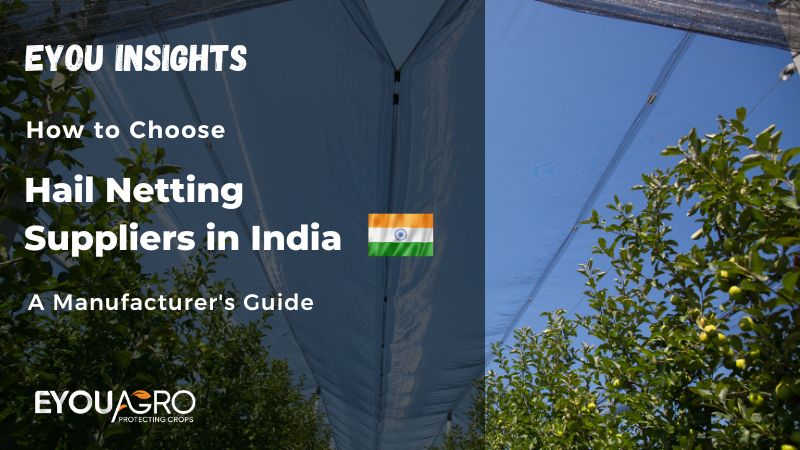
In Shimla and Kullu, where 60-80% hail damage at flowering can wipe a season, suppliers who deliver and install before the May-June window matter most. For orchards needing design and installation, Greenspan Agritech bridges supply and engineering. For net-only supply, HP distributors serve most growers.
The right question is not which product — it is which supplier reaches your orchard before the hail season.
— Kevin Lyu, EyouAgro
- Buyer’s Guide

- Blog
- Read Time: Approx. 13 min
- Bird Control
- Buyer’s Guide

- Blog
- Read Time: Approx. 13 min
- Sunburn & Heat Stress
— Kevin Lyu, EyouAgro
- How-to Article
- Guide
- Read Time: Approx. 6 min
- Bird Control
- How-to Article

- Guide
- Read Time: Approx. 8 min
- Bird Control
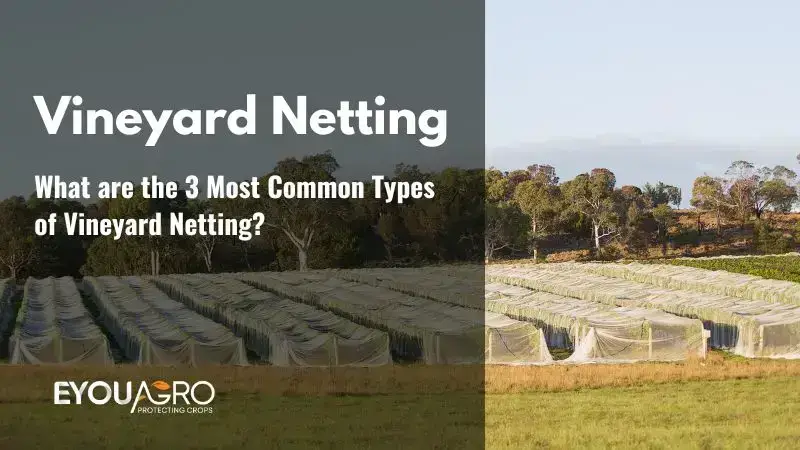
Vineyards that choose systems they can fully deploy on time protect fruit reliably. Those that don’t see gaps—regardless of net quality.
- How-to Article
- Guide
- Read Time: Approx. 6 min
- Bird Control
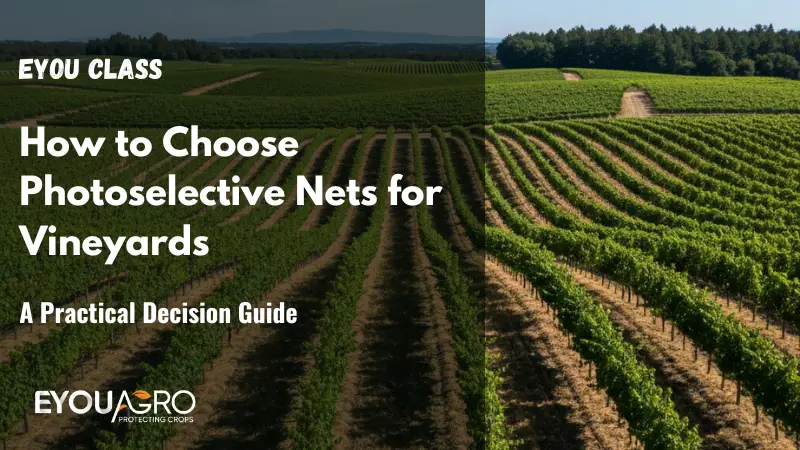
netting performance is usually limited by system choice, not net quality.
When labor capacity, risk exposure, and coverage depth are aligned, even standard nets perform reliably.
The right system allows netting to work with vineyard operations—not against them.
Follow me on these platforms to get the latest product application cases and professional analysis.
Watch installation guides and real-world application case videos.
Engage in deep industry discussions and get professional insights.
Follow my personal updates and get all the latest company news.
Get instant industry news and my brief insights.
Get technical consultation and a fast response to your questions.
Send your project needs for a solution within 24 hours.
Kevin Lyu is an agricultural netting specialist and founder of EyouAgro.
He has worked with vineyard, orchard, and greenhouse projects across 55+ countries,
focusing on practical installation, durability, and long-term performance of agricultural protection systems.